
Gigabyte 7VT600 1394 (KT600): More Fun with KT600
- Posted in
- Motherboards
Gigabyte 7VT600 1394: Basic Features
| Motherboard Specifications | |
| CPU Interface | Socket-462 |
| Chipset | VIA KT600 North Bridge VIA VT8237 South Bridge |
| Bus Speeds | up to 254MHz (in 1MHz increments) |
| Core Voltages Supported | up to 1.850V (in 0.0250V increments) |
| I/O Voltages Supported | N/A |
| DRAM Voltages Supported | up to 2.80V (in 0.1V increments) |
| Memory Slots | 3 184-pin DDR DIMM Slots |
| Expansion Slots | 1 AGP 8X Slot 5 PCI Slots |
| Onboard IDE RAID | N/A |
| Onboard USB 2.0/IEEE-1394 | Eight USB 2.0 ports supported by VT8237 VIA VT6306 IEEE-1394 FireWire (up to 3 ports available) |
| Onboard LAN | Realtek RTL8101L |
| Onboard Audio | Realtek ALC655 AC’97 codec |
| Onboard Serial ATA | Two SATA connectors via VT8237 (RAID 0, 1 & 0 + 1) |
| BIOS Revision | MG0 BIOS (6/20/2003) |
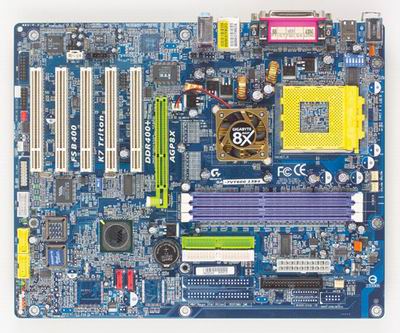
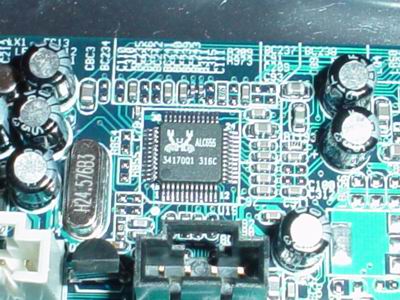
Unfortunately, Gigabyte makes the same mistake with their KT600-based 7VT600 1394 motherboard that Epox had made with their KT600-based 8KRA2+. Gigabyte utilizes the Realtek ALC655 codec for onboard sound, instead of what VIA would have preferred – the VT1616 codec. The VT1616’s advantage stems from the fact that it can offer high fidelity sound while using the analog out port. The same cannot be said about nForce2 motherboards, which use the ALC650/655 codec. In other words, you won’t hear sound as good as what the VT1616 codec provides from an MCP-T powered nForce2 motherboard unless you make use of a SPDIF-out port and have speakers with a receiver. Like Epox, Gigabyte could have one upped other nForce2 motherboards in the sound department if they had simply opted for the VT1616 codec instead of the ALC655 codec. At least Gigabyte used the ALC655 codec instead of the ALC650, as the ALC650 does not dynamically switch the Mic in, Line in, and Line out ports.
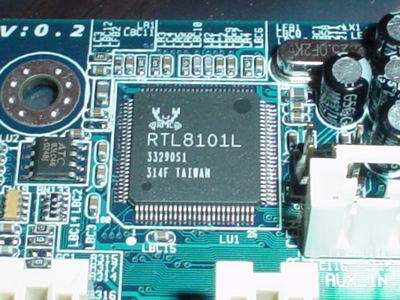
The 7VT600 1394 utilizes a very basic 10/100 controller from Realtek, dubbed the RTL8101L. There’s nothing special to report about this particular 10/100 solution. In general, it should fit broadband users’ need quite well. Serious Gigabit Ethernet users will need to purchase an add-in (PCI) 10/100/1000 network card, if they plan on purchasing the 7VT600 1394.
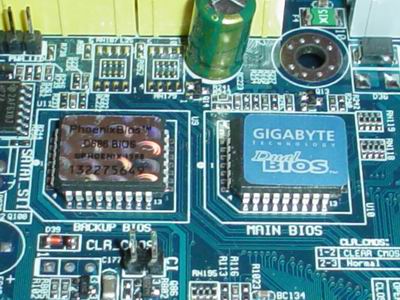
Like so many of Gigabyte’s motherboards, the 7VT600 1394 includes support for dual BIOS technology. A backup BIOS is nice to have if you corrupt your first BIOS chip (e.g. you lose power to your system as you're updating your primary BIOS). You can switch over to the second BIOS chip in this situation, and not have to go through the trouble of correcting the issue through other, time-consuming means, such as a board RMA or the swap-trick.
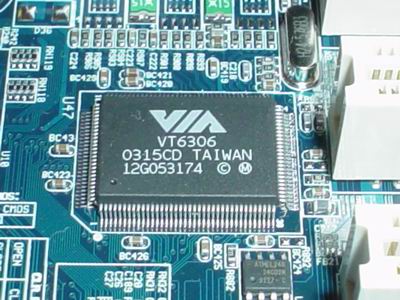
The 7VT600 1394’s I/O ports configuration is fairly standard for a value motherboard. Included in this setup are two PS/2 ports, two serial ports, one parallel port, four USB 2.0 ports, one LAN port, and Mic In, Line In, and Line Out ports, which drive the onboard sound. The 7VT600 1394 also supports IEEE 1394 FireWire, courtesy of a VT6306 PCI-bound controller, capable of supporting up to three ports via two onboard headers. Fortunately, Gigabyte does include the 3-port IEEE 1394 FireWire bracket so that users aren’t forced to purchase one. This is especially important considering that the 7VT600 1394 does not have any rear FireWire, which has been the excuse in the past for motherboard makers not to include FireWire brackets.
As with all KT600 motherboards that we’ve come into contact with over the last couple weeks, the 7VT600 1394 has native Serial ATA support, courtesy of VIA’s brand new VT8237 South Bridge. The VT8237 supports RAID 0, 1 and 0 + 1, which is a nice addition for users looking for the best combination of RAID support in a desktop motherboard. The advantage of RAID 0 + 1 is fast data access (like RAID 0), but with the ability to lose one drive, yet still have a duplicate surviving drive or set of drives (like RAID 1). In case you didn’t already know, RAID 0 + 1 is stripping (RAID 0) and mirroring (RAID 1) combined without parity having to be calculated and written. In addition to all of this, VIA has also upped V-link's throughput from 533MB/s to 1066MB/s. All in all, VIA’s new South Bridge is impressive, and certainly gives KT600 boards some added value compared to nForce2 motherboards. The new increased chipset I/O bandwidth is a very welcome addition, as it should help for those “intangible” computing experiences, such as multi-tasking.
Originally published at https://www.anandtech.com/show/1121 (Wayback Machine).