
865PE/875P Motherboard Roundup June 2003 - Part 1: 20-way Shootout
- Posted in
- Motherboards
Gigabyte 8KNXP Ultra
|
Motherboard Specifications |
|
|
CPU
Interface
|
Socket-478
|
|
Chipset
|
Intel
82875P MCH (North Bridge)
Intel 82801ER ICH5R (South Bridge) |
|
Bus
Speeds
|
up
to 355MHz (in 1MHz increments)
|
|
Core
Voltages Supported
|
up
to 1.760V (in 0.0125V increments)
|
|
I/O
Voltages Supported
|
N/A
|
|
DRAM
Voltages Supported
|
up
to 2.8V (in 0.1V increments)
|
|
Memory Slots
|
6 184-pin
DDR DIMM Slots
|
|
Expansion Slots
|
1 AGP
8X Slot
5 PCI Slots |
|
Onboard IDE RAID/SCSI
|
ITE
GigaRAID 8212F controller (RAID 0, RAID 1 & RAID 0 + 1)
Adaptec SCSI Ultra 320 7902W Controller |
|
Onboard USB 2.0/IEEE-1394
|
Eight
USB 2.0 ports supported through South Bridge
No IEEE-1394 FireWire |
|
Onboard LAN
|
Intel
PRO/1000CT Gigabit LAN (CSA bus)
|
|
Onboard Audio
|
Realtek
ALC655 codec
|
|
Onboard Serial ATA
|
Two
SATA connectors via ICH5R (RAID 0 & RAID 1 only)
|
|
BIOS
Revision
|
Revision
F2c (03/26/2003)
|
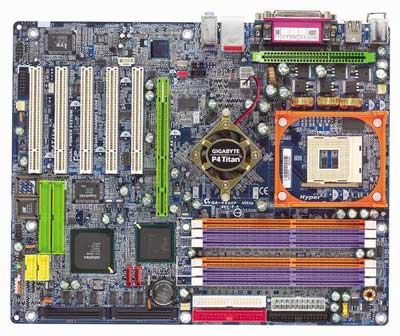
An interesting feature that Gigabyte has included on such motherboards as the 8INXP (E7205 chipset) and SINXP1394 (SiS 655 chipset) is Dual Power System 2 (DPS 2). This is a separate, add-in card that gives the 8KNXP 6-phase power circuitry instead of 3-phase. Gigabyte claims that, in Parallel mode (versus Backup mode), DPS 2 is able to deliver better system stability (especially while overclocked) in addition to longer onboard components life.
It should come as no surprise that Gigabyte continues to incorporate dual BIOS chips even though the 8KNXP Ultra is a workstation/server class motherboard. As we mentioned in the AOpen AX4C Max section, having two BIOS chips can be helpful if you've permanently corrupted your first BIOS chip (through overclocking, overvolting, etc.) and so instead of being forced to RMA your board or replace the chip yourself, your board will simply revert to the second backup BIOS chip during your next bootup.
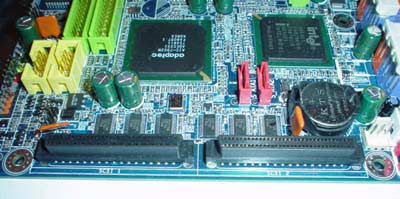
Quite obviously the defining feature of the 8KNXP Ultra is its SCSI support. The 8KNXP Ultra has an onboard Adaptec SCSI Ultra 320 7902W controller that sits on an independent 32bit 66MHz PCI bus (via 2nd PCI bridge), meaning bandwidth is limited to 266MB/s. Theoretically the full 320MB will not be realized, but since the 320MB transfer is only reached in burst rates (not sustained) and will depend on loading (number of hard drives) it won't make a performance difference, as there are very few system apps that will saturate this bandwidth. Still, it is obviously better than sharing the standard 32bit 33MHz PCI I/O that is limited to 133MB/s. Interestingly enough Gigabyte is going to continue improving the 8KNXP Ultra when they release a revision 2.x 8KNXP Ultra in mid-June, which is to incorporate PCI64 66MHz maxing out at 533MB/s. Gigabyte says there will be availability this week or at least sometime this month, but we'll have to wait and see if that turns out to be true.
UPDATE 6/19/2003 We should also mention that you must hold the CTRL key and press F1 to bring up the Advanced Chipset Features section, where you will be able to adjust your memory module's timings.
Originally published at https://www.anandtech.com/show/1114 (Wayback Machine).