
865PE/875P Motherboard Roundup June 2003 - Part 1: 20-way Shootout
- Posted in
- Motherboards
Gigabyte 8KNXP
|
Motherboard Specifications |
|
|
CPU
Interface
|
Socket-478
|
|
Chipset
|
Intel
82875P MCH (North Bridge)
Intel 82801ER ICH5R (South Bridge) |
|
Bus
Speeds
|
up
to 355MHz (in 1MHz increments)
|
|
Core
Voltages Supported
|
up
to 1.600V (in 0.0250V increments)
|
|
I/O
Voltages Supported
|
N/A
|
|
DRAM
Voltages Supported
|
up
to 2.8V (in 0.050V increments)
|
|
Memory Slots
|
6 184-pin
DDR DIMM Slots
|
|
Expansion Slots
|
1 AGP
8X Slot
5 PCI Slots |
|
Onboard IDE RAID
|
ITE
GigaRAID 8212F controller (RAID 0, RAID 1 & RAID 0 + 1)
|
|
Onboard USB 2.0/IEEE-1394
|
Eight
USB 2.0 ports supported through South Bridge
TI TSB43AB23 IEEE-1394 FireWire Controller (up to 3 ports total) |
|
Onboard LAN
|
Intel
PRO/1000CT Gigabit LAN (CSA bus)
|
|
Onboard Audio
|
Realtek
ALC655 codec
|
|
Onboard Serial ATA
|
Two
SATA connectors via ICH5R (RAID 0 & RAID 1 only)
|
|
BIOS
Revision
|
Rev.
M4 (6/03/2003)
|
There are usually quite a few unique features to talk about when reviewing a Gigabyte motherboard, and in the 8KNXP's case there are boatloads of features unique to this motherboard.
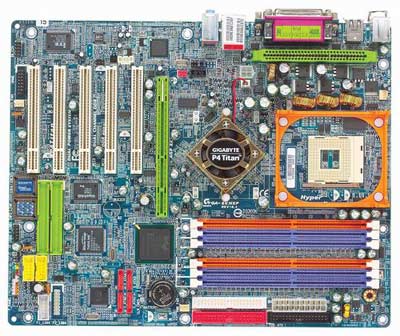
An interesting feature that Gigabyte has included on such motherboards as the 8INXP (E7205 chipset) and SINXP1394 (SiS 655 chipset) is Dual Power System 2 (DPS 2). This is a separate, add-in card that gives the 8KNXP 6-phase power circuitry instead of 3-phase. Gigabyte claims that, in Parallel mode (versus Backup mode), DPS 2 is able to deliver better system stability (especially while overclocked) in addition to longer onboard components life.
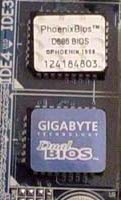 Another
feature unique to Gigabyte motherboards (for the most part) is their dual BIOS
feature. As we mentioned in the AOpen AX4C Max section, having two BIOS chips
can be helpful if you've permanently corrupted your first BIOS chip (through
a flash programming error for example) and instead being forced to RMA your
board or replace the chip yourself your board will simply revert to the second
backup BIOS chip.
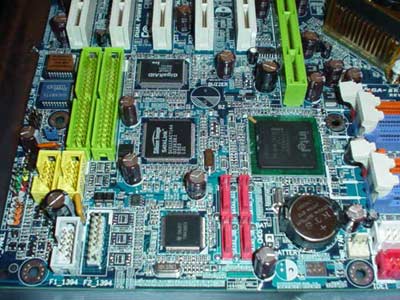
The defining feature of the 8KNXP is its leading Serial ATA and IDE support. As usual the Primary and Secondary IDE connectors support two channels each, or up to four IDE devices total. There are also two additional IDE connectors powered by the GigaRAID IT8212F controller. This ATA133 GigaRAID controller was developed by ITE, and is capable of RAID 0 (striping), RAID 1 (mirroring) and RAID 0+1 arrays (read more about this IDE RAID controller here) while also being able to support a total of four drives. What's especially nice about the ITE GigaRAID controller is that it doesn't just support four hard drives but also ATAPI (optical) drives as well. This is a huge advantage over other motherboards with Promise or Silicon Image controllers that are capable of supporting only hard drives. In total you will be able to connect a combination of twelve different Serial ATA or IDE drives to the 8KNXP. This is one of the highest amount of drive support we've ever seen a desktop motherboard.
The most negative aspect of the Gigabyte 8KNXP is its price. Currently this motherboard is selling for between $215 and $225 in the U.S., with barely a handful of vendors offering the 8KNXP for under $220. This is quite a lot for a desktop motherboard, no doubt about that. However when it comes right down to it power users aren't exactly concerned with price when they're building their dream system. So for those types of users the 8KNXP couldn't be a better match.
UPDATE 6/19/2003 We should also mention that you must hold the CTRL key and press F1 to bring up the Advanced Chipset Features section, where you will be able to adjust your memory module's timings.
Originally published at https://www.anandtech.com/show/1114 (Wayback Machine).