
The Toshiba OCZ VX500 (256GB, 512GB, 1024GB) SSD Review
Sequential Read Performance
The sequential read test requests 128kB blocks and tests queue depths ranging from 1 to 32. The queue depth is doubled every three minutes, for a total test duration of 18 minutes. The test spans the entire drive, and the drive is filled before the test begins. The primary score we report is an average of performances at queue depths 1, 2 and 4, as client usage typically consists mostly of low queue depth operations.
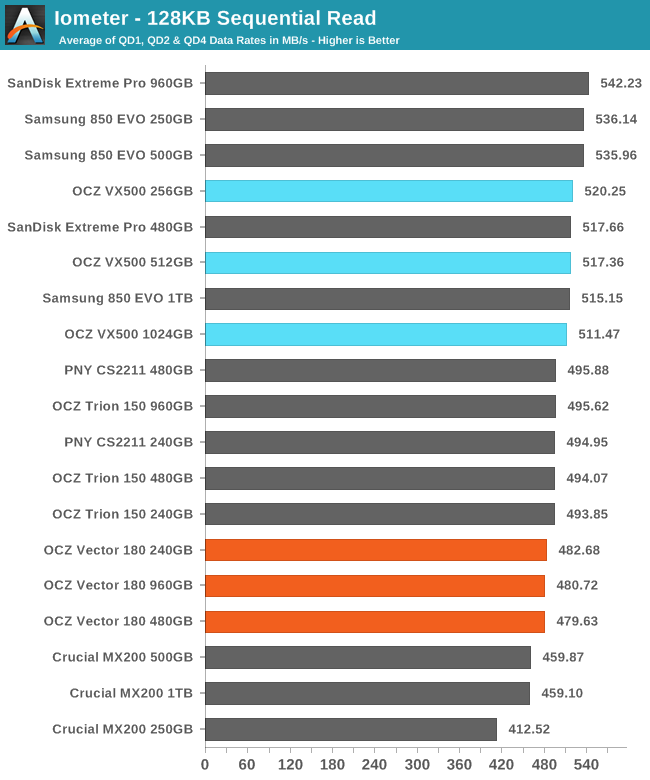
The VX500 delivers very good sequential read performance, in the same league as the Samsung 850 EVO and SanDisk Extreme Pro. Because the spread of scores on this test is so small, this only represents a slight improvement over the Vector 180.
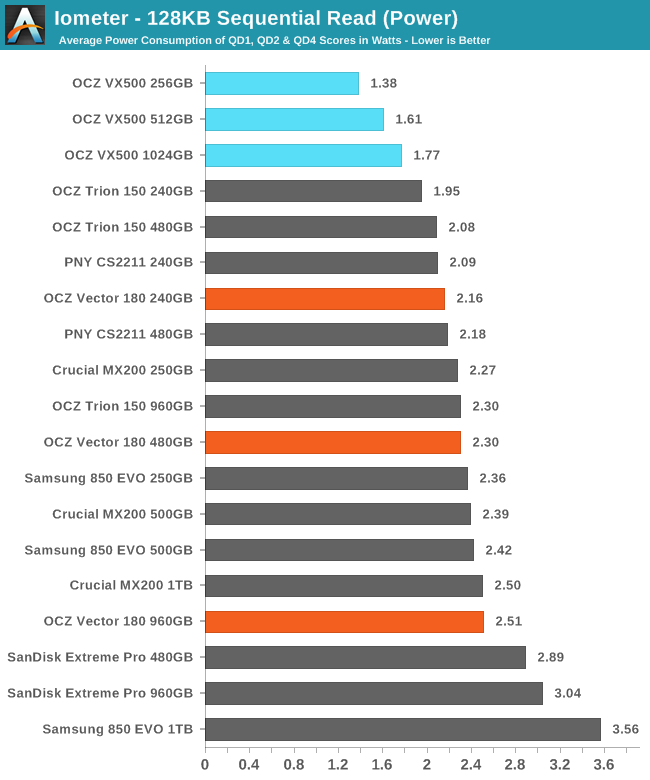
Power consumption is quite a bit lower than the competition and efficiency is again near record levels.
 |
|||||||||
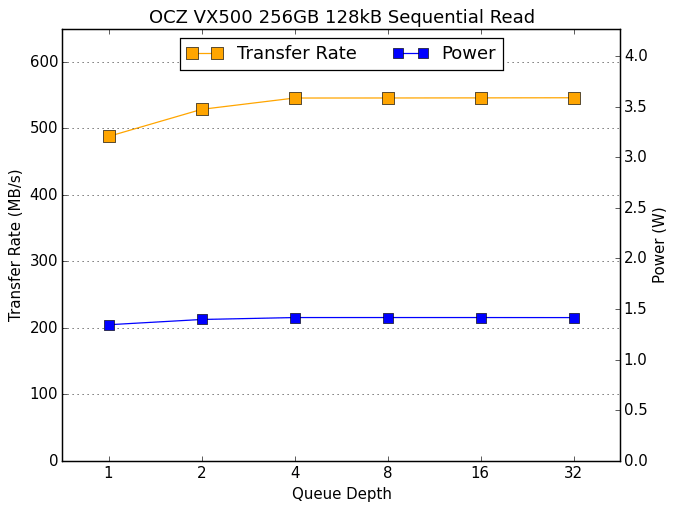
The VX500 starts out with very good QD1 performance and very little room for improvement. It reaches the limit of the SATA interface by QD4, and power consumption is nearly constant across the whole test.
Sequential Write Performance
The sequential write test writes 128kB blocks and tests queue depths ranging from 1 to 32. The queue depth is doubled every three minutes, for a total test duration of 18 minutes. The test spans the entire drive, and the drive is filled before the test begins. The primary score we report is an average of performances at queue depths 1, 2 and 4, as client usage typically consists mostly of low queue depth operations.
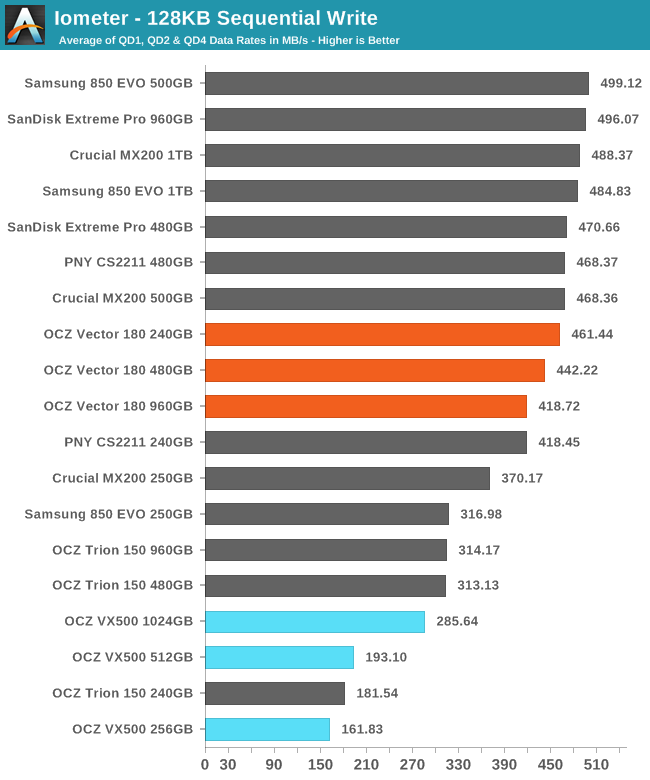
The OCZ VX500 fares very poorly on this test. The drive is filled before the test is run, and apparently the VX500 did not finish flushing the SLC cache before the performance measurement began. These numbers thus represent the worst-case write performance for the VX500, while some TLC SSDs will continue to degrade under a longer write load.
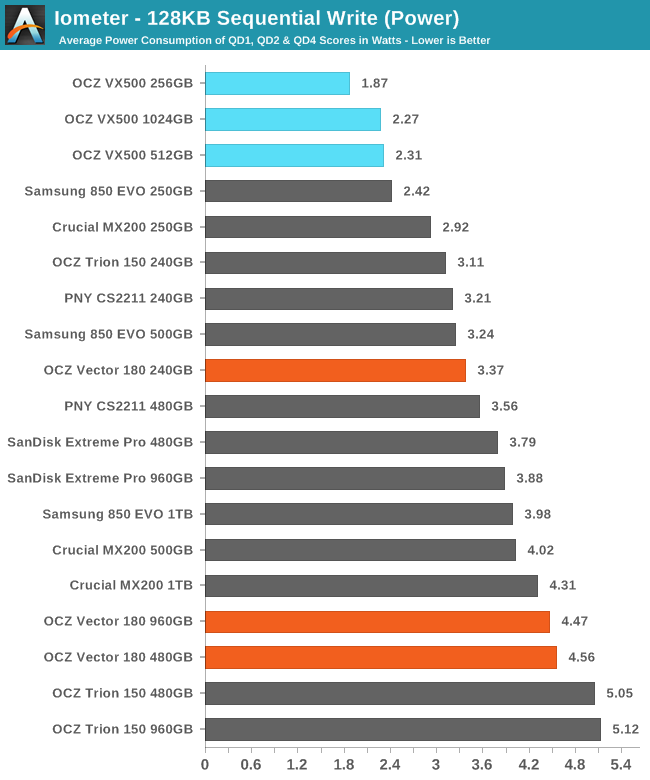
In spite of the extra background work during this test as the VX500 copes with an already full SLC cache, it maintains very low power consumption. Efficiency is still a regression relative to the Vector 180 for the smaller two sizes, but the 1TB model manages a slight improvement.
 |
|||||||||
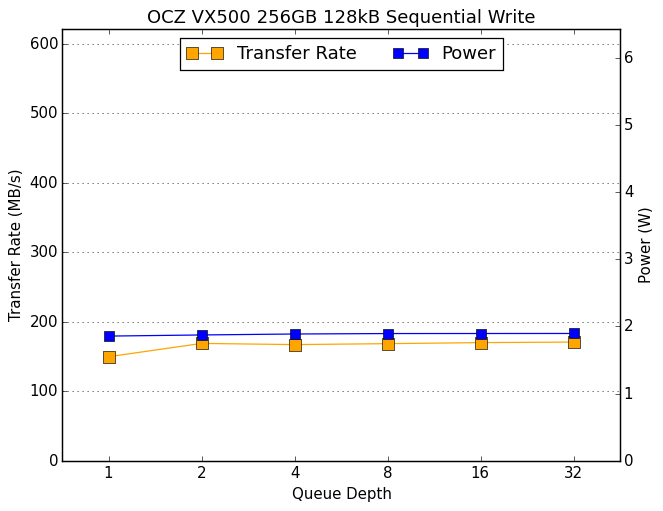
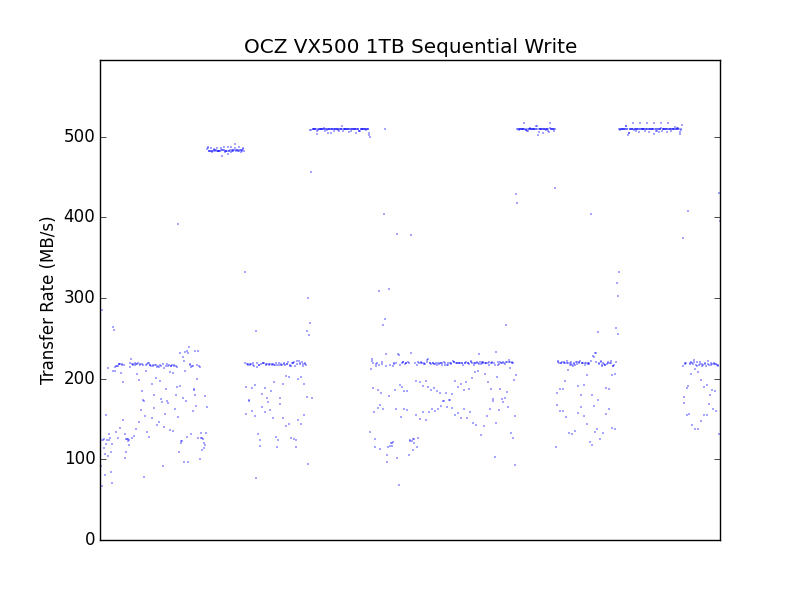
Most drives exhibit little or no scaling with queue depth, and the smaller two VX500s follow this pattern. The above plot of the 1TB model's behavior looks very odd, but an inspection of the second-by-second performance data (below) reveals that it it periodically escaping from the low-performance state and delivering write speeds near the limit of the SATA interface. On a shorter test with less data written beforehand, the smaller models would likely also have shown their good side for some or all of the test.
Originally published at https://www.anandtech.com/show/10674/the-toshiba-ocz-vx500-ssd-review (Wayback Machine).