
The Skylake Core i3 (51W) CPU Review: i3-6320, i3-6300 and i3-6100 Tested
Middle-Earth: Shadow of Mordor
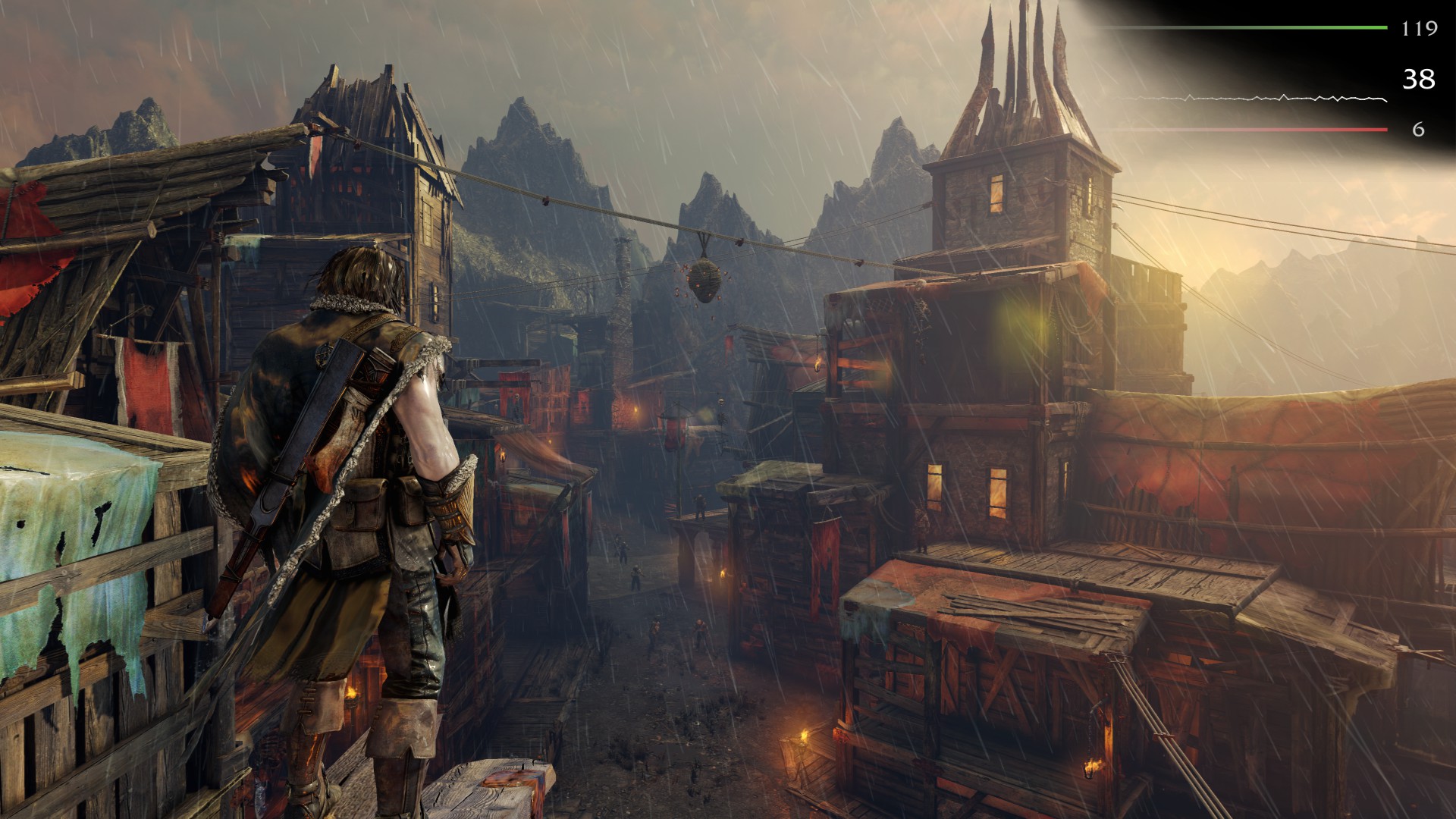
The final title in our testing is another battle of system performance with the open world action-adventure title, Shadow of Mordor. Produced by Monolith using the LithTech Jupiter EX engine and numerous detail add-ons, SoM goes for detail and complexity to a large extent, despite having to be cut down from the original plans. The main story itself was written by the same writer as Red Dead Redemption, and it received Zero Punctuation’s Game of The Year in 2014.
For testing purposes, SoM gives a dynamic screen resolution setting, allowing us to render at high resolutions that are then scaled down to the monitor. As a result, we get several tests using the in-game benchmark, taking results as the average and minimum frame rates. Minimum frame rate results can be found in Bench.
For this test we used the following settings with our graphics cards:
| Shadow of Mordor Settings | |||
| Resolution | Quality | ||
| Low GPU | Integrated Graphics | 1280x720 | Low |
| ASUS R7 240 1GB DDR3 | |||
| Medium GPU | MSI GTX 770 Lightning 2GB | 1920x1080 | Ultra |
| MSI R9 285 Gaming 2G | |||
| High GPU | ASUS GTX 980 Strix 4GB | 1920x1080 3840x2160 |
Ultra Ultra |
| MSI R9 290X Gaming 4G | |||
Integrated Graphics
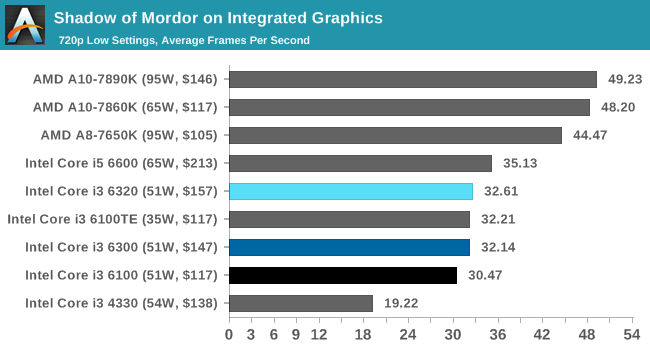
As with the other IGP tests, the APU solution gets significantly better results.
Discrete Graphics
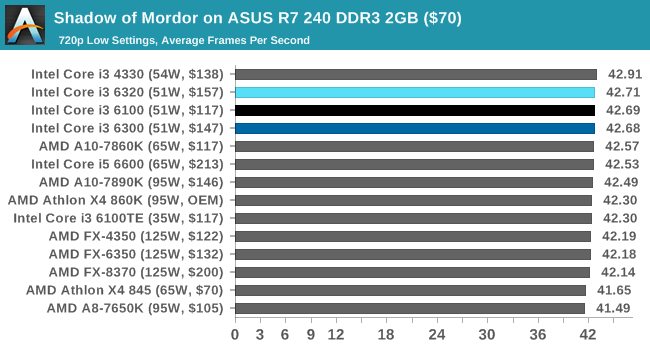
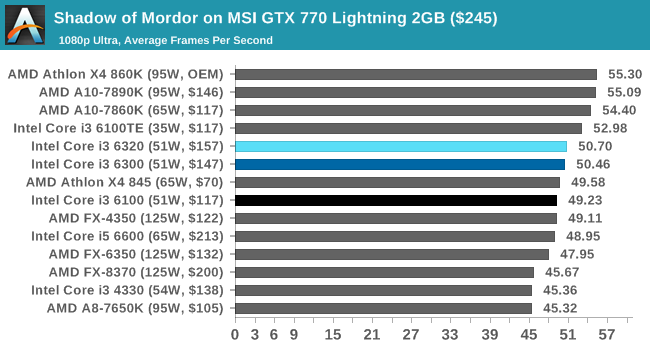
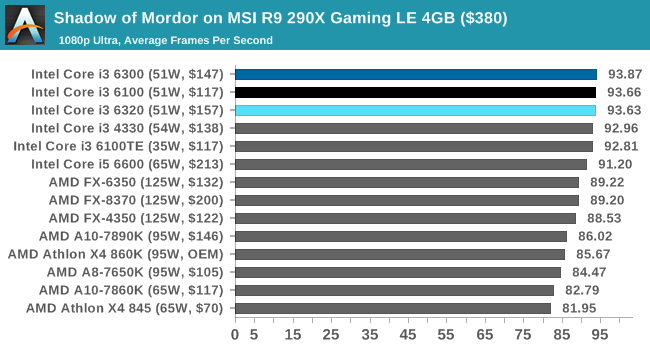
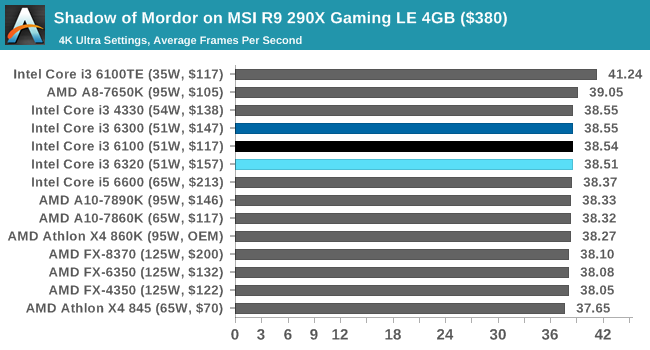
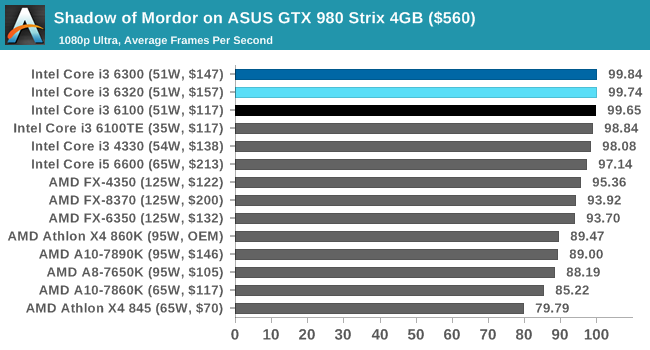
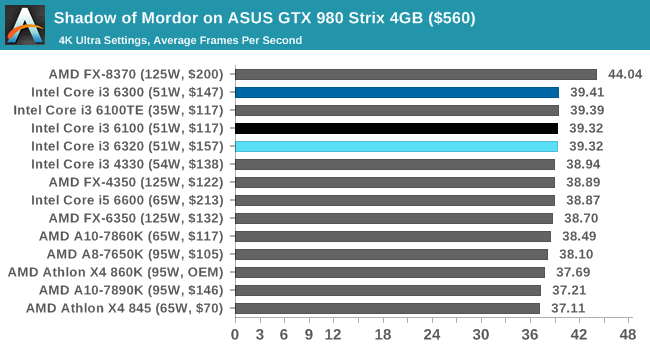
SoM is our most CPU agnostic benchmark of the set, such that as you increase the GPU power and the resolution, the CPU matters less to the performance. This is why at 4K Ultra, with both the AMD and NVIDIA discrete GPUs, the $70 CPU from AMD is within 2-3% for average frame rates.
However, it should be noted that the CPU power matters more when (a) an AMD discrete GPU is being used, or (b) lower resolutions. In both cases, the AMD FX CPUs are more likely to match up with Intel's Core i3, which sit at the top of the pack.
Originally published at https://www.anandtech.com/show/10543/the-skylake-core-i3-51w-cpu-review-i3-6320-6300-6100-tested (Wayback Machine).