
The Skylake Core i3 (51W) CPU Review: i3-6320, i3-6300 and i3-6100 Tested
GRID: Autosport
No graphics tests are complete without some input from Codemasters and the EGO engine, which means for this round of testing we point towards GRID: Autosport, the next iteration in the GRID and racing genre. As with our previous racing testing, each update to the engine aims to add in effects, reflections, detail and realism, with Codemasters making ‘authenticity’ a main focal point for this version.
GRID’s benchmark mode is very flexible, and as a result we created a test race using a shortened version of the Red Bull Ring with twelve cars doing two laps. The car is focus starts last and is quite fast, but usually finishes second or third. Both the average and minimum frame rates are recorded.
For this test we used the following settings with our graphics cards:
| GRID: Autosport Settings | |||
| Resolution | Quality | ||
| Low GPU | Integrated Graphics | 1920x1080 | Medium |
| ASUS R7 240 1GB DDR3 | |||
| Medium GPU | MSI GTX 770 Lightning 2GB | 1920x1080 | Maximum |
| MSI R9 285 Gaming 2G | |||
| High GPU | ASUS GTX 980 Strix 4GB | 1920x1080 | Maximum |
| MSI R9 290X Gaming 4G | |||

Integrated Graphics
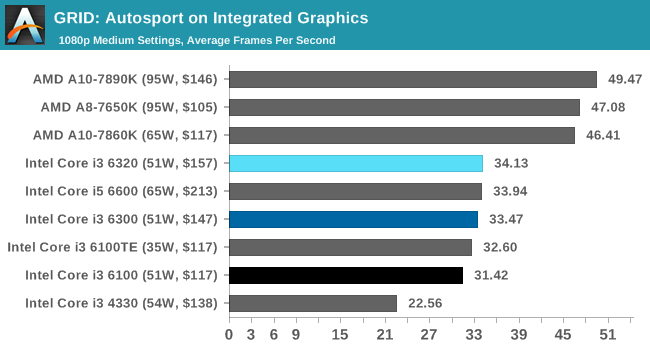
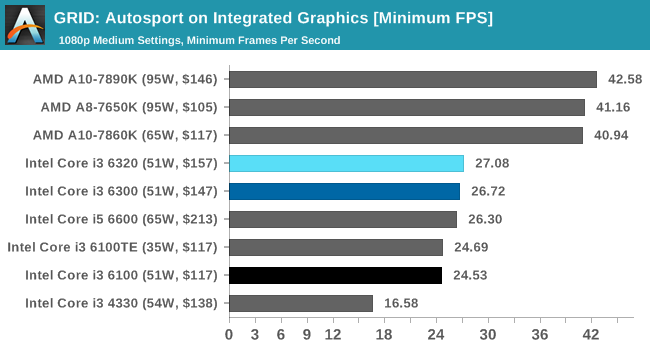
The difference between the APUs and Intel CPUs again shows up to a 33-50% difference in frame rates, to the point where at 1080p medium the integrated graphics do not break the minimum 30 FPS barrier. The GPU frequency and L3 cache again shows up the i3-6100 compared to the i3-6300.
Discrete Graphics
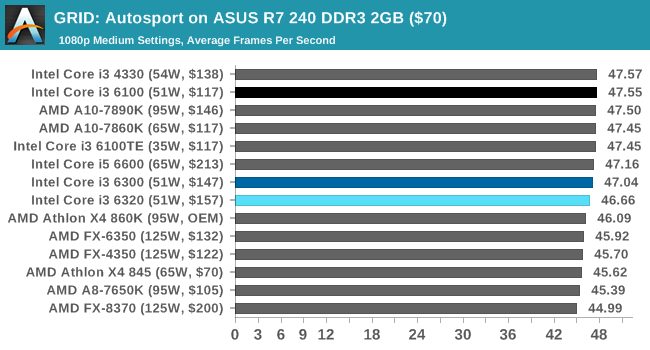
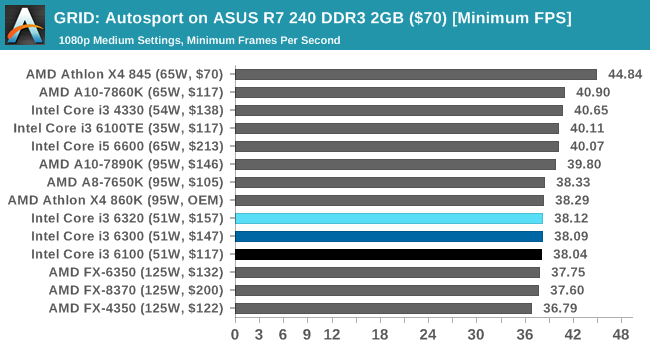
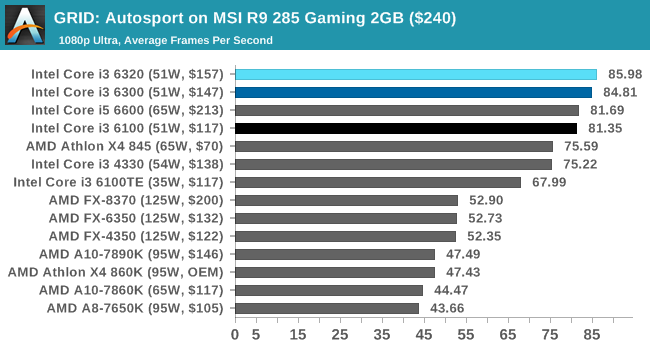
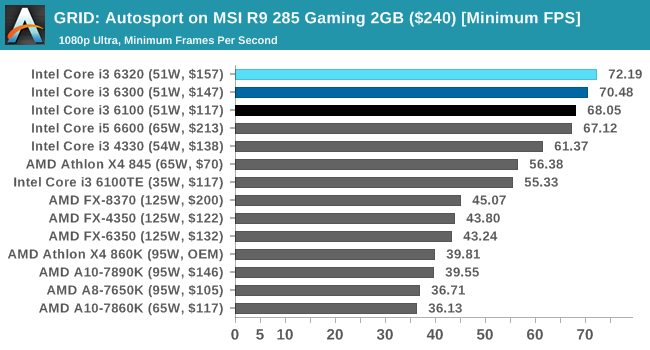
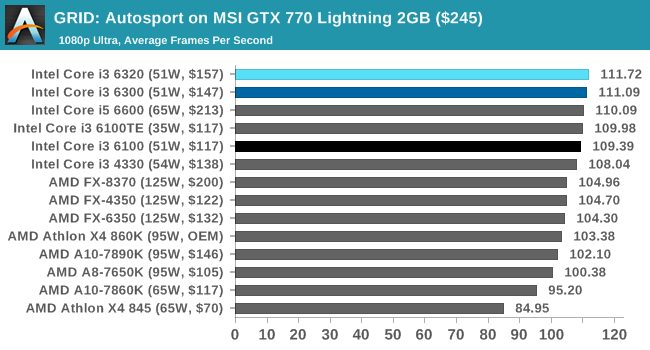
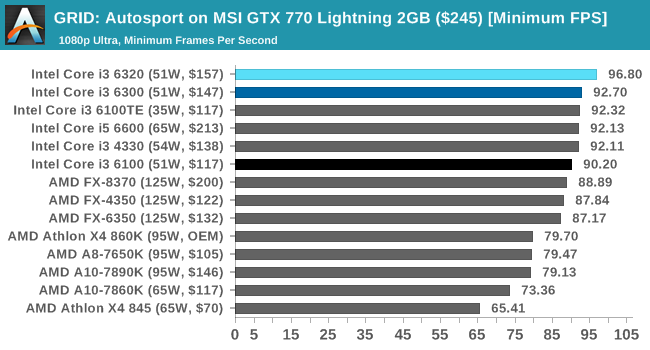
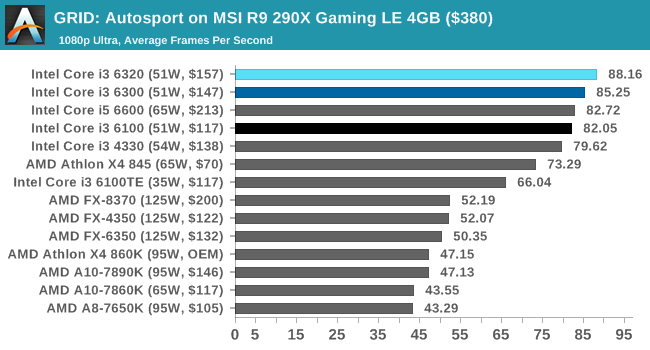
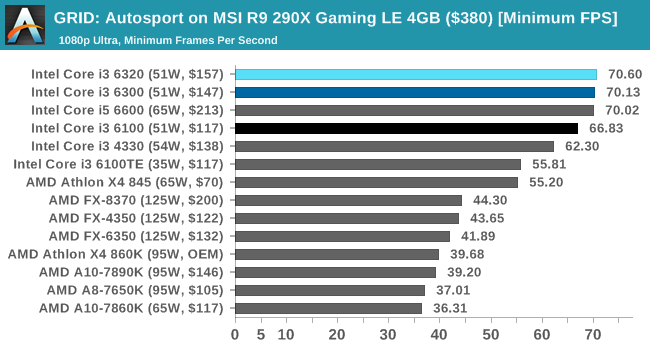
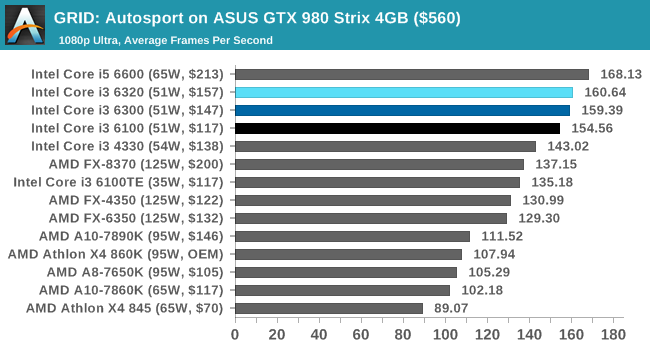
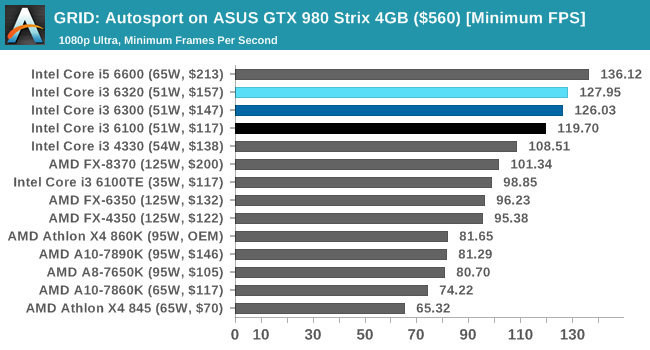
With the discrete GPUs, there are multiple avenues to take with this analysis.
On the low-end cards, the choice of CPU makes little difference in our tests.
On the mid-range and high-end cards, the power of the CPU makes more of an effect with AMD discrete cards than NVIDIA discrete cards, except with the AMD Athlon X4 845 in play. When using an AMD discrete card with a mid-range GPU, the X4 845 plays well enough with the i3 parts for its price, but falls away a bit more on the high-end AMD discrete GPU. With NVIDIA GPUs, the Athlon X4 845 sits at the bottom and the main challengers are the FX parts.
So for EGO engine rules, it would seem to be:
AMD Carrizo CPU + AMD discrete GPU is OK, the lower powered the GPU the better.
AMD FX CPU + NVIDIA discrete GPU is OK
Intel CPU + any discrete GPU works well.
One could attest the differences between the discrete GPU choices to driver implementation, IPC, or how each GPU company focuses in optimizing for each game at hand (frequency vs threads vs caches).
Originally published at https://www.anandtech.com/show/10543/the-skylake-core-i3-51w-cpu-review-i3-6320-6300-6100-tested (Wayback Machine).