
Intel's E7205: Granite Bay Hits the Streets
- Posted in
- Motherboards
Gigabyte 8INXP Rev.1: Basic Features
|
Motherboard Specifications |
|
|
CPU
Interface
|
Socket-478
|
|
Chipset
|
Intel
E7205 MCH
Intel 82801DB ICH4 |
|
Bus
Speeds
|
100
- 200MHz (in 1MHz increments)
|
|
Core
Voltages Supported
|
up
to 1.725V (in 0.025V increments)
|
|
I/O
Voltages Supported
|
N/A
|
|
DRAM
Voltages Supported
|
up
to 2.8V in 0.1V increments
|
|
Memory Slots
|
4 184-pin
DDR DIMM Slots
|
|
Expansion Slots
|
1 AGP
8X Slot
5 PCI Slots |
|
Onboard RAID
|
Promise
PDC20276
|
|
Onboard USB 2.0/IEEE-1394
|
USB
2.0 supported through South Bridge
No FireWire |
|
Onboard LAN
|
Intel
RC82540EM Gigabit LAN
|
|
Onboard Audio
|
Realtek
ALC650
|
|
Onboard Serial ATA
|
Silicon
Image 3112A controller
|
|
BIOS
Revision
|
D10b
|
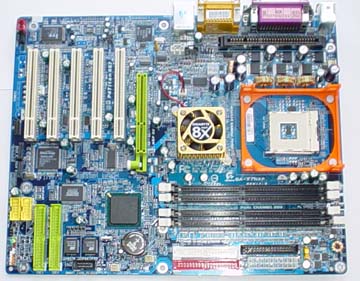
With the introduction of Intel's E7205 chipset, Gigabyte has initiated a new marketing campaign centered around the word "dual". Gigabyte is marketing the 8INXP as "The 6-Dual Miracle". The six features that make the 8INXP the "6-dual miracle" are:
- Dual Power System (DPS): this is a separate, add-in card that gives the 8INXP 6-phase power circuitry instead of 3-phase. Gigabyte claims that, in Parallel mode (versus Backup mode), DPS is able to deliver better system stability (especially while overclocked) in addition to longer onboard components life. Skip to the BIOS and Overclocking section for our test results with DPS installed.
- Dual Logical Processors: this is nothing more than Gigabyte's way of saying their board supports Intel's Hyper Threading technology.
- Dual Channel DDR: this is pretty self-explanatory. As you should know by now, Gigabyte's 8INXP motherboard uses Intel's E7205 (Granite Bay) chipset, which supports Dual DDR266 operation, for a peak memory bandwidth of 4.27GB/s.
- Dual RAID: this is Gigabyte's way of saying their board supports both Serial ATA RAID and IDE RAID. Read on to find out more about these two features.
- Dual BIOS: this feature is also fairly self-explanatory. The 8INXP supports two BIOS chips. This feature is nice to have if you corrupt your first BIOS chip (e.g. you lose power to your system as you're updating your primary BIOS). You can switch over to the second BIOS chip in this situation, and hot have to go through the trouble of correcting the issue through other, time-consuming means.
- Dual Cooling: this is the least interesting of the six "dual miracles". The North Bridge HSF and DPS HSF form the "Dual Cooling" feature. Yes, this is very cheesy.
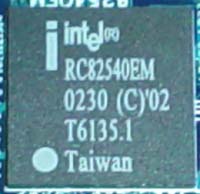
For LAN, Gigabyte goes with Gigabit technology. Gigabyte chooses Intel's RC82540EM Gigabit chip for onboard LAN; this chip supports up to 1000Mbit/s bandwidth and is found in only one other recent P4 motherboard that we know of (MSI's 845PE Max2-FIR). Setting up Gigabit via the onboard Intel controller was a cinch, and not any more difficult than setting up the P4G8X's Broadcom Gigabit LAN in addition to any other 10/100 solution.
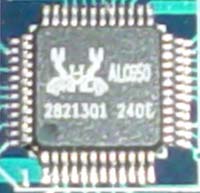
Moving on, we see that Gigabyte decided to choose Realtek's ALC650 chip for onboard sound. This 6-channel solution isn't anything special really, and is found on the vast majority of motherboards these days. It's interesting to note that we haven't encountered a motherboard without onboard sound in the last few months. This says a lot about the fierce competition in the motherboard market.
The 8INXP's I/O configuration is pretty normal for the most part. Some of the I/O ports include features like two PS/2 ports, two serial ports, one parallel port, a Game port, two rear USB 2.0 ports, a Gigabit LAN port, and Mic In, Line In, and Line Out, which drive the onboard sound.
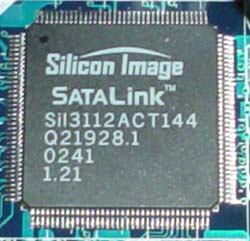
Gigabyte decides to slap on the latest and "greatest" feature for an onboard device by including Silicon Image's 3112A Serial ATA controller. We just discussed this SATA chip in the ASUS P4G8X section, but there are a few other motherboards that use this SATA controller as well, including the Intel D845PEBT2, Epox 4PEA+, and ECS L4S8A. The 3112A is capable of supporting up to two independent Serial ATA devices, as well as RAID 0 (striping) and RAID 1 (mirroring). As we've said before, we'd rather wait for chipset makers to integrate SATA into their South Bridges before we get excited about how Serial ATA drives and devices will perform.
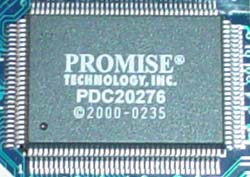
The 8INXP's IDE support is much better than the P4G8X's. As is standard now, the Primary and Secondary IDE connectors support two channels each, or up to four IDE devices total. In addition, there are two other IDE connectors, powered by the onboard Promise PDC20276 RAID controller. Each of the two IDE RAID connectors supports 2 channels each, and therefore up to four IDE devices. In total, you can hookup a grand total of 8 IDE devices, in addition to two SATA devices via the two onboard SATA connectors. Most users should be happy with this amount of device support. Before we forget, we should mention that the PDC20276 RAID controller itself supports RAID 0 (striping) and RAID 1 (mirroring) arrays. For more information on Promise's PDC20276 controller, head on over to their product information page here.
USB 2.0 support is powered by Intel's South Bridge, aka ICH4. This means the Gigabyte 8INXP is capable of supporting up to six USB 2.0 ports. In addition to the two rear USB 2.0 ports, there are also two USB headers at the bottom of the board. Gigabyte throws in a four-port USB bracket that connects to both USB headers. This is very nice to have as you don't have to take the trouble to go out and purchase a USB bracket
Unfortunately, this board did not come with FireWire. This feature would have really made the 8INXP a complete solution, but it's a minor setback nonetheless.
Originally published at https://www.anandtech.com/show/1033 (Wayback Machine).