
Intel's E7205: Granite Bay Hits the Streets
- Posted in
- Motherboards
ASUS P4G8X Deluxe: Basic Features
|
Motherboard Specifications |
|
|
CPU
Interface
|
Socket-478
|
|
Chipset
|
Intel
E7205 MCH
Intel 82801DB ICH4 |
|
Bus
Speeds
|
100
- 400MHz (in 1MHz increments)
|
|
Core
Voltages Supported
|
up
to 1.975V (in 0.025V increments)
|
|
I/O
Voltages Supported
|
N/A
|
|
DRAM
Voltages Supported
|
up to 2.7V
in 0.1V increments
|
|
Memory Slots
|
4 184-pin
DDR DIMM Slots
|
|
Expansion Slots
|
1 AGP
8X Slot
5 PCI Slots |
|
Onboard RAID
|
N/A
|
|
Onboard USB 2.0/IEEE-1394
|
USB
2.0 supported through South Bridge
TI TSB43AB22 FireWire Controller |
|
Onboard LAN
|
Broadcom
5702 Gigabit LAN
|
|
Onboard Audio
|
Realtek
ALC650
|
|
Onboard Serial ATA
|
Silicon
Image 3112A controller
|
|
BIOS
Revision
|
1001
|
Taking a quick peak at all the features the P4G8X offers, we can clearly see that ASUS is staying with their series of cutting-edge features motherboards, now called the Deluxe series of ASUS motherboards. As an all-in-one solution (minus VGA), ASUS's Deluxe series looks to be a real winner now and into the foreseeable future. Only ABIT's MAX series is as competitive.
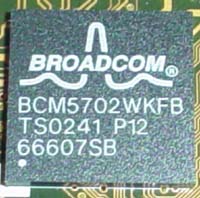
One of the first features we happened to notice was the LAN chip ASUS decided to use with their P4G8X. This isn't your usual LAN chip; in actuality, it's a Gigabit LAN chip, which supports up to 1000Mbit/s bandwidth. The Gigabyte LAN is powered by Broadcom's 5702 chip, one we're quite familiar with at this point. Setting up this particular Gigabit LAN was no more difficult than any of the other thousands of 10/100 solutions we've configured. Unfortunately, there aren't a lot of mainstream users (that includes your Joe Average as well as your power user) that will be able to take advantage of Gigabit support. This technology is usually regulated to small businesses or any institution for that matter that requires a large network.
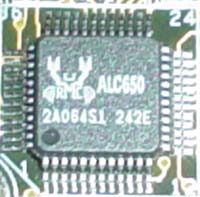
ASUS doesn't choose a very intriguing sound chip despite the high-end nature of this motherboard. A simple and very mainstream Realtek ALC650 codec is chosen to power the onboard sound of the P4S8X. This sound solution offers nothing special or interesting compared to other solutions we've used before.
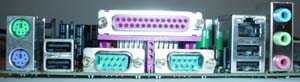
The P4G8X's I/O configuration isn't all that unusual either. We see some pretty common features like two PS/2 ports, two serial ports, one parallel port, four rear USB 2.0 ports, a Gigabit LAN port, and Mic In, Line In, and Line Out, which drive the onboard sound. No dual LAN here, but Gigabit should be adequate for most.
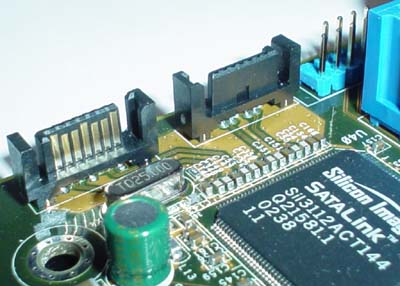
ASUS uses a Serial ATA chip we've seen on several motherboards before, including Intel's D845PEBT2, Epox's 4PEA+, and ECS's L4S8A. This SATA chip turns up on ASUS's P4G8X Deluxe board, dubbed the Silicon Image 3112A. This chip is capable of supporting up to two independent Serial ATA devices as well as RAID 0 (striping) and RAID 1 (mirroring). While certainly a nice feature, all current onboard Serial ATA implementations use the PCI bus, which translates into limited bandwidth. We would rather see native Serial ATA support in a chipset, because this way a Serial ATA device won't have to fight for bandwidth with other PCI devices, whereas the current implementation on modern-day motherboards are forced to travel through the PCI bus.
As far as IDE support goes, the ASUS P4G8X doesn't come with an abundance of options. The Primary and Secondary IDE connectors support two channels each, or four IDE devices in total. This is good only if you're the type that doesn't need more than a DVD drive, CD-RW drive, two hard drives, or some other combination thereof. Therefore, if you need to connect more than four drives or desire onboard IDE RAID, the P4G8X isn't for you.
The E7205 chipset provides support for USB 2.0 like its 845PE predecessor. The Intel ICH4 South Bridge makes this support possible; up to six USB 2.0 ports total. The P4G8X doesn't include any additional USB 2.0 support (for example, through a separate onboard USB 2.0 chip), but the P4G8X already has four rear USB 2.0 ports in addition to a two-port USB bracket that you can plug into the onboard USB header and which is bundled with the Deluxe Edition, so not too many people should be disappointed.
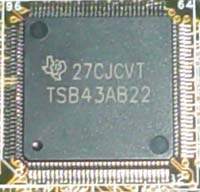
Another technology we like to see included is FireWire support. While there aren't any rear FireWire ports, there are two (red) FireWire headers at the bottom of the P4G8X. The headers are powered by TI's TSB43AB22 FireWire controller, which supports no more than two FireWire ports. If you're interested in how this FireWire controller works, head on over to TI's features page on the TSB43AB22, they list all the features about this controller that you could want to know.
Originally published at https://www.anandtech.com/show/1033 (Wayback Machine).