
USB Flash Drives - Power Consumption Measurement using Plugable's USBC-TKEY
- Posted in
- Gadgets
- Flash Drive
- DAS
- USB-C
- Plugable
USBC-TKEY in Action
The power consumed by various USB flash drives was measured under multiple scenarios. These scenarios were triggered using CrystalDiskMark 5.1.2 x64 with a 8GB test file and each test separated by a 10s interval. Flash drives typically come under two broad categories - one with a native USB controller, and the other with a SATA drive talking to the host through a SATA - USB bridge. As an example of the former category, we put the Mushkin Atom 128GB version under the scanner. For the second category, we evaluated the Samsung Portable SSD T3 along with a host of other samples.
The initial part of the graphs below show the idle power consumption of the drive. This is followed by the power consumed when CrystalDiskMark prepares the 8GB test file on the drive. The eight distinct segments that follow show the power consumption profile for the workloads (single-threaded sequential and random accesses with a queue depth of 32, followed by sequential and random accesses with a queue depth of 1). The first four segments correspond to read accesses and the last four to write accesses.

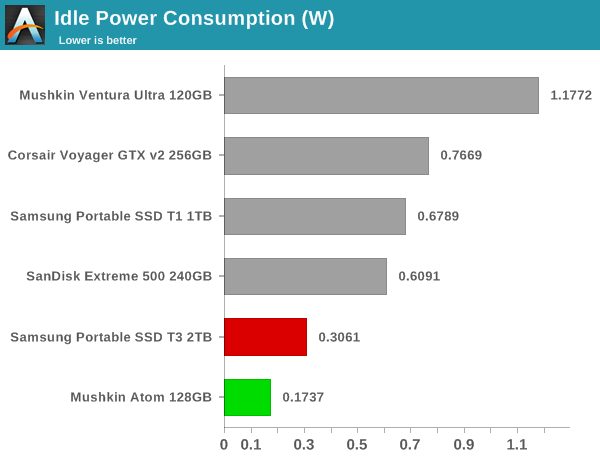
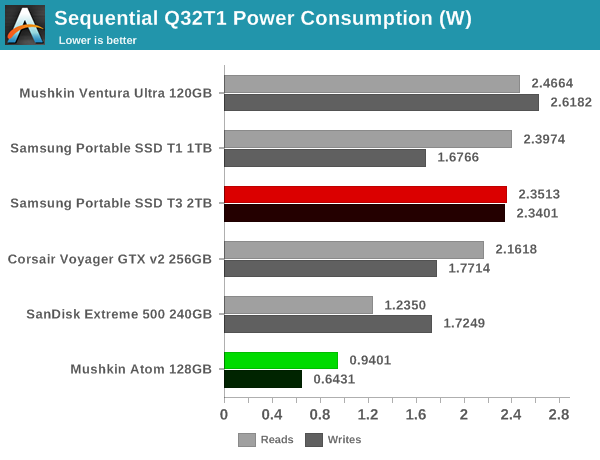
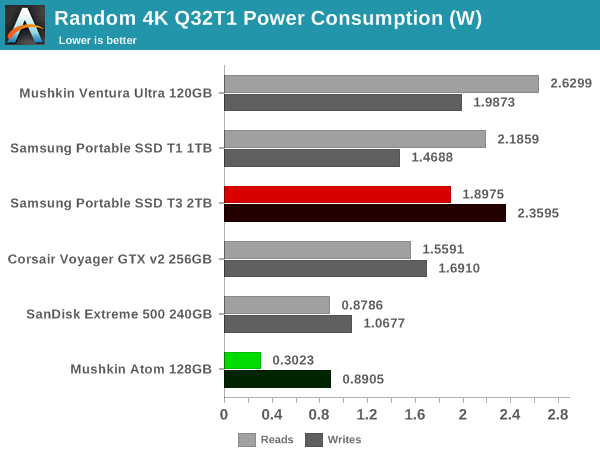
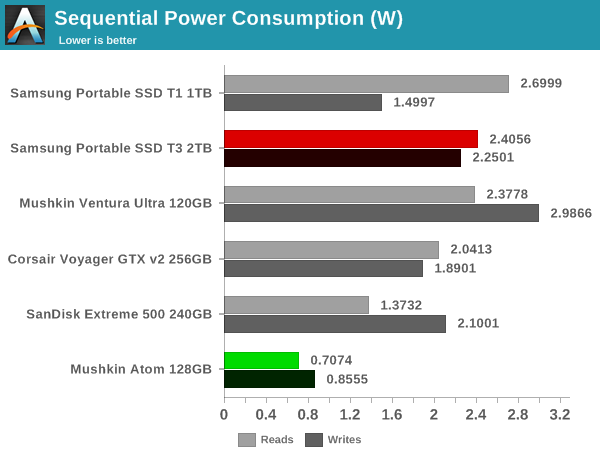
Native USB flash controllers are very power efficient, but, that obviously comes at the cost of performance (numbers that can be seen in the review of the drive). We see that the Mushkin Atom 128GB version idles at around 170 mW and has a peak power consumption of only 1.22 W. On the other hand, using a mSATA SSD and adding a SATA-USB bridge is quite punishing. For the Samsung Portable SSD T3, the idle number moves up to around 290 mW, while the peak is around 3.34 W.

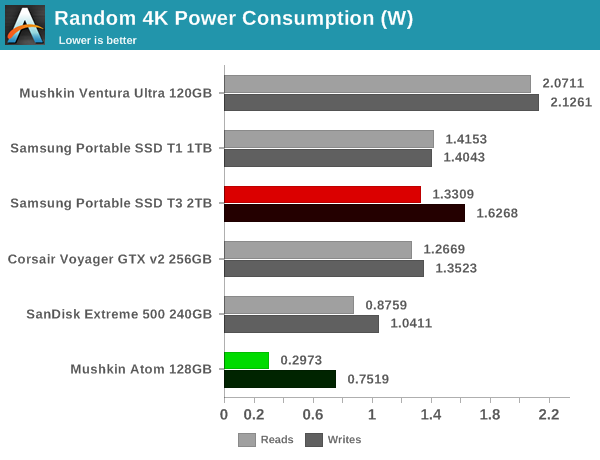
The graphs below compare the power consumption of various drives we tested under different scenarios. The Mushkin Ventura Ultra 120GB (based on a SandForce SF2281 SSD connected through a USB 3.0 - SATA bridge) is the worst when it comes to power consumption (flash drives based on SF2281 are notorious for overheating and throttling). As expected, getting rid of the bridge and going native helps the Mushkin Atom 128GB to be the most power efficient in the tested lot.
Concluding Remarks
The Chromium Twinkie / Plugable USBC-TKEY is an invaluable tool for device developers looking to debug their USB Type-C hardware. As we showed in this article, it also enables us to gain key insight into the power consumption profile of USB peripherals. We tested out various USB flash drives, and that yielded interesting, albeit, expected results.
All our tests used either USB 3.0 Type-A (with a Type-A to Type-C USB 3.1 adapter cable) or USB 3.1 Gen 1 Type-C devices. Since the USBC-TKEY is designed to be transparent to the host and device, and is fully compatible with USB 3.1 specifications, we don't expect any issues with measuring power consumed by USB 3.1 Gen 2 or Thunderbolt 3 peripherals (since Thunderbolt 3 also utilizes USB power delivery). The Plugable USBC-TKEY will enable us to add yet another evaluation point to our comprehensive direct-attached storage testing process.
Originally published at https://www.anandtech.com/show/10163/usb-flash-drives-power-consumption-measurement-using-plugables-usbctkey (Wayback Machine).