
The ADATA Premier SP550 SSD Review: A Second Look At Silicon Motion's SM2256 Controller
Random Read Performance
The random read test requests 4kB blocks and tests queue depths ranging from 1 to 32. The queue depth is doubled every three minutes, for a total test duration of 18 minutes. The test spans the entire drive, which is filled before the test starts. The primary score we report is an average of performances at queue depths 1, 2 and 4, as client usage typically consists mostly of low queue depth operations.
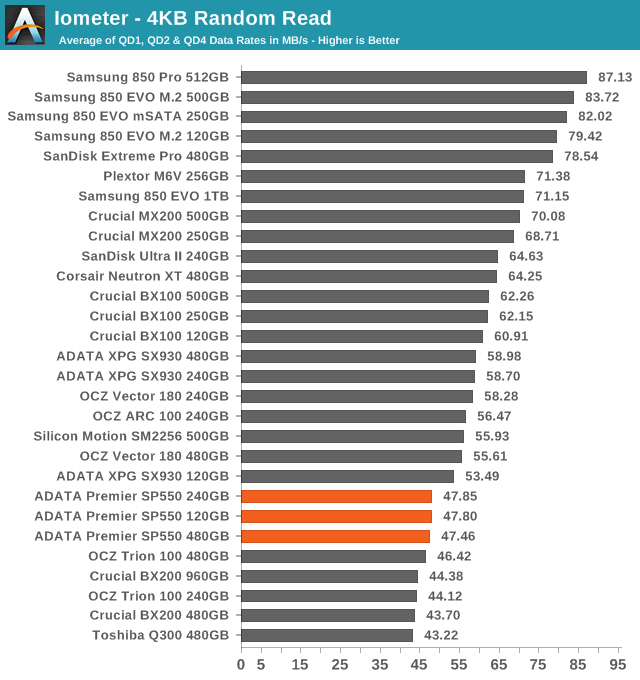
The SP550's random read performance is slightly higher than most of the TLC-based competition, but significantly slower than the SM2256 prototype with Samsung 19nm TLC managed. There's still a clear gap between the MLC drives and most of the TLC drives. The Samsung 850 EVO and SanDisk Ultra II are still the only TLC drives that can compete against MLC.
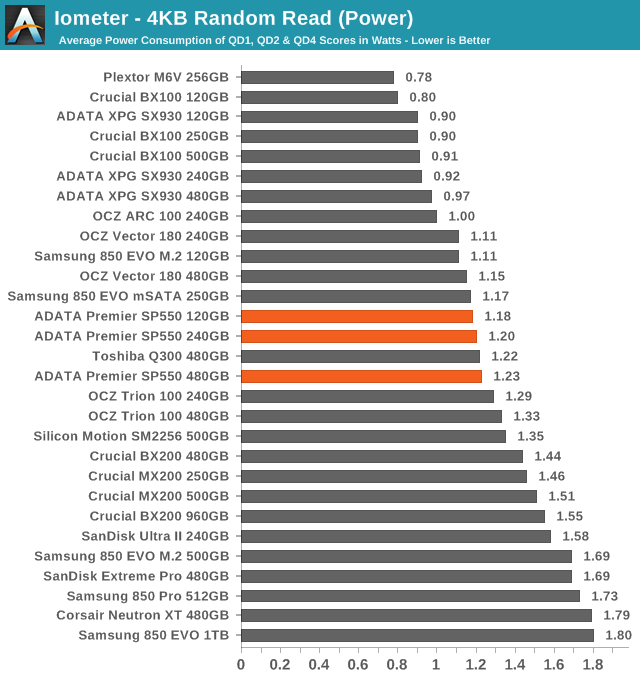
The SP550's power consumption is about average. TLC flash usually only has a slight disadvantage for read power and Silicon Motion's very efficient controller offsets that for the SP550.
 |
|||||||||
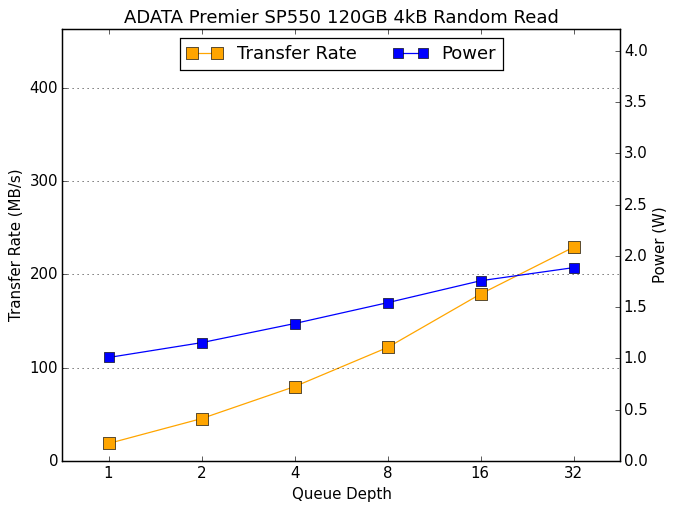
Looking at performance over various queue depths, all three capacities of the SP550 perform very similarly at low depths, with performance that starts quite low and doesn't increase very steeply. At higher queue depths the 120GB SP550 isn't able to scale up performance as much as the larger capacities, and even the 480GB model can't crack 300MB/s while high-end SATA drives top out around 400MB/s.
Random Write Performance
The random write test writes 4kB blocks and tests queue depths ranging from 1 to 32. The queue depth is doubled every three minutes, for a total test duration of 18 minutes. The test is limited to a 16GB portion of the drive, and the drive is empty save for the 16GB test file. The primary score we report is an average of performances at queue depths 1, 2 and 4, as client usage typically consists mostly of low queue depth operations.
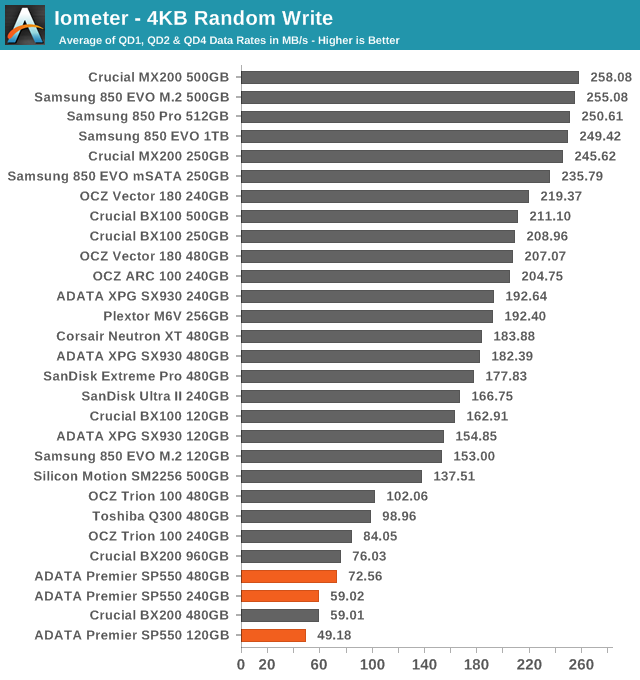
Random write performance is the SP550's biggest weakness. It beats the Crucial BX200 at equivalent capacities, but falls well behind everything else. While the steady-state random write performance was relatively good, this performance on this shorter test does not impress.
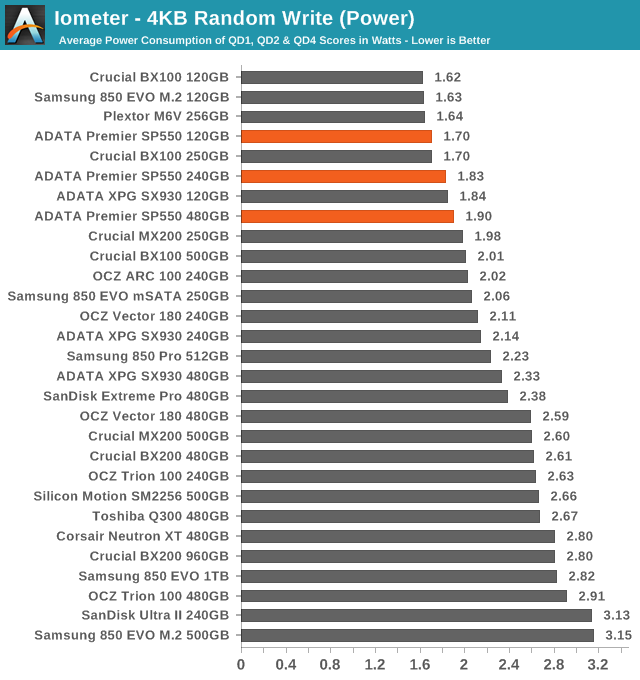
The power consumption of the SP550 on the random write test is very good, but given the bad performance there's no efficiency advantage.
 |
|||||||||
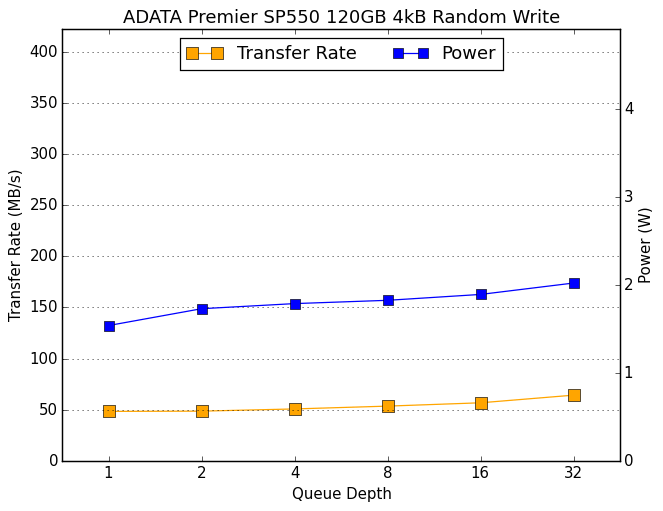
The SP550's random write speed doesn't scale much with queue depth. Fortunately, neither does the power consumption—a welcome change from the Crucial BX200. The OCZ Trion 100 and Toshiba Q300 also don't scale, but everything else does to at least some extent, including the SM2256 prototype.
Originally published at https://www.anandtech.com/show/10131/the-adata-premier-sp550-ssd-review (Wayback Machine).