
The Toshiba Q300 SSD Review: Toshiba Becomes a Retail Brand
Mixed Random Read/Write Performance
The mixed random I/O benchmark starts with a pure read test and gradually increases the proprotion of writes, finishing with pure writes. The queue depth is 3 for the entire test and each subtest lasts for 3 minutes, for a total test duration of 18 minutes. As with the pure random write test, this test is restricted to a 16GB span of the drive, which is empty save for the 16GB test file.
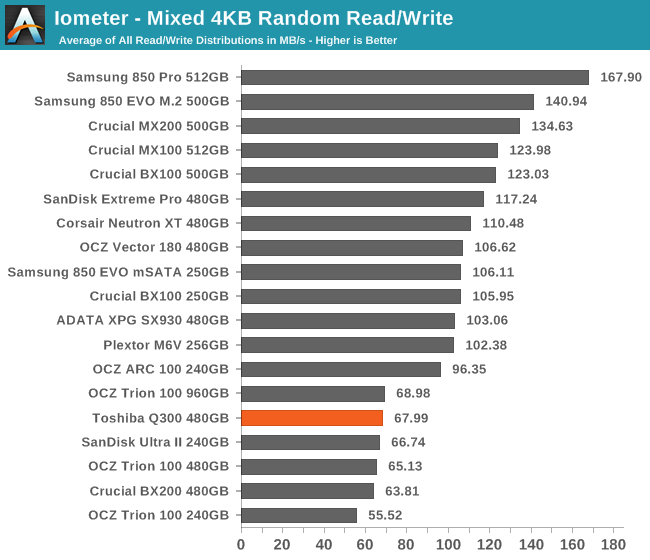
The planar TLC drives are clearly the bottom tier of mixed random performance, but the Q300's score is slightly above par by those standards. Despite using three different controller architectures, these drives all perform very similarly while the MLC drives have a fairly wide spread.
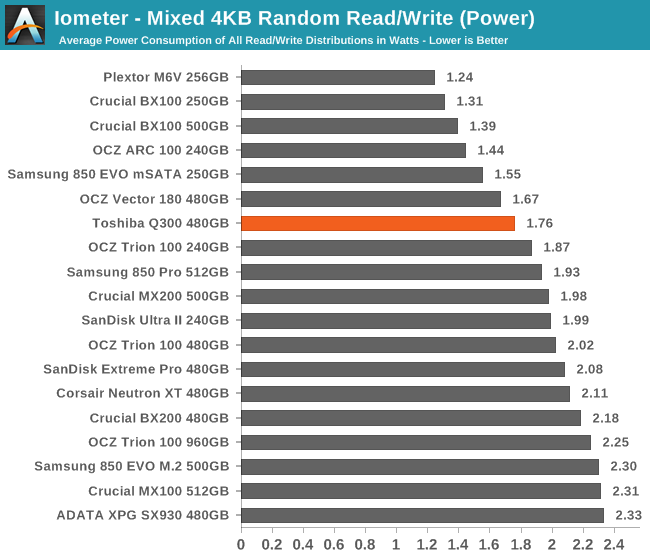
The Q300's power efficiency is significantly better than its planar TLC-based competitors and the power consumption in absolute terms is decent, but the MLC drives are mostly much more efficient due to much higher performance.
 |
|||||||||
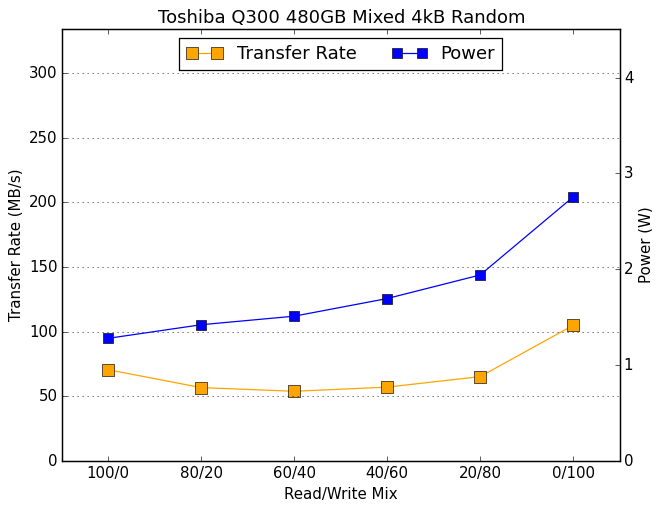
The slight drop in performance when writes are first added to the mix is not uncommon. What keeps the Q300's score low is that it does not exhibit large performance increases during the second half of the test, especially during the 100% write phase.
Mixed Sequential Read/Write Performance
The mixed sequential access test covers the entire span of the drive and uses a queue depth of one. It starts with a pure read test and gradually increases the proprotion of writes, finishing with pure writes. Each subtest lasts for 3 minutes, for a total test duration of 18 minutes. The drive is filled before the test starts.
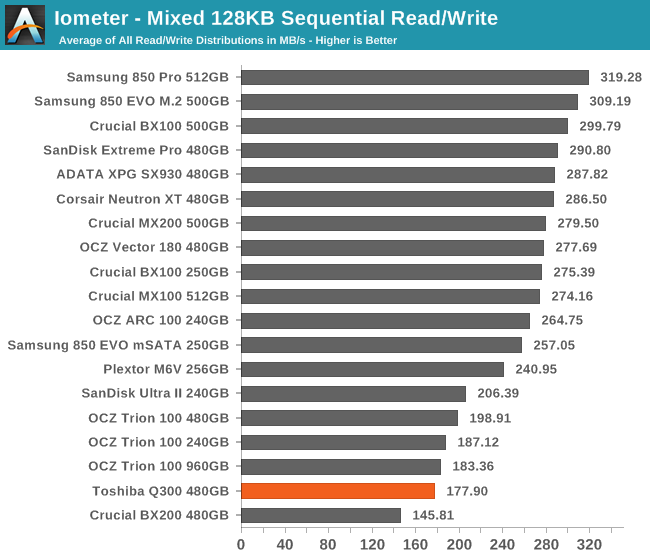
Unlike the random test, the Q300's performance on the mixed sequential test is clearly lower than the Trion 100, putting it in next to last place.
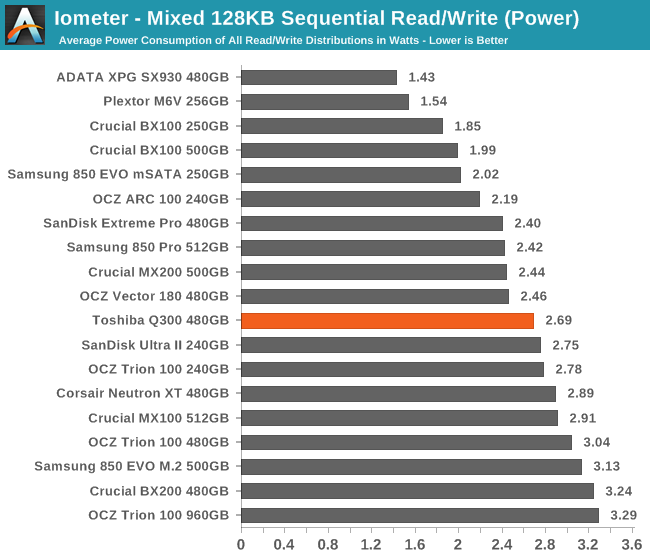
With middle of the road power consumption, the Q300's efficiency falls near the bottom, but the larger capacities of the Trion 100 and the Crucial BX200 are worse yet.
 |
|||||||||
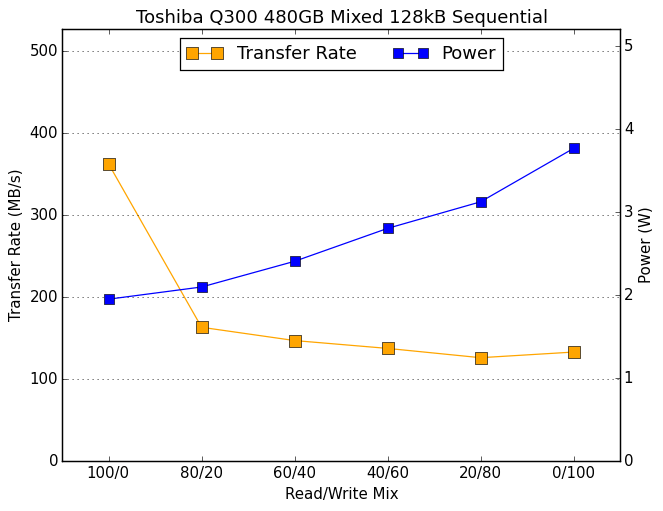
The Q300 isn't the only drive that doesn't recover performance at the end of the sequential test when the mix shifts toward pure writes. Its performance on the pure read phase at the beginning of the test is below almost every other drive except for the Crucial MX100 and MX200, which are redeemed by not dropping below 200MB/s in the later phases of the test. When writes are added to the mix, the Q300 drops to 163MB/s and keeps getting worse.
Originally published at https://www.anandtech.com/show/10084/the-toshiba-q300-ssd-review (Wayback Machine).