
The Toshiba Q300 SSD Review: Toshiba Becomes a Retail Brand
Sequential Read Performance
The sequential read test requests 128kB blocks and tests queue depths ranging from 1 to 32. The queue depth is doubled every three minutes, for a total test duration of 18 minutes. The test spans the entire drive, and the drive is filled before the test begins. The primary score we report is an average of performances at queue depths 1, 2 and 4, as client usage typically consists mostly of low queue depth operations.
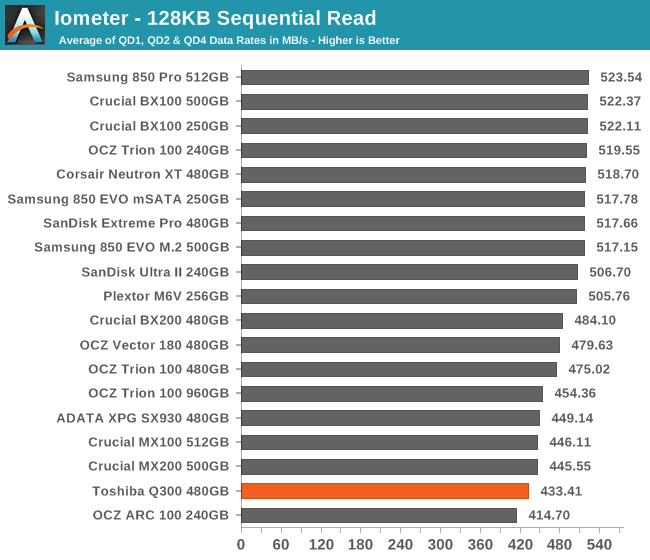
The Q300 shows a 9% performance drop relative to the 480GB Trion 100 on the sequential read test. It manages to stay out of last place, but it still disappoints and is clearly not bumping against the limits of the SATA interface at low queue depths.
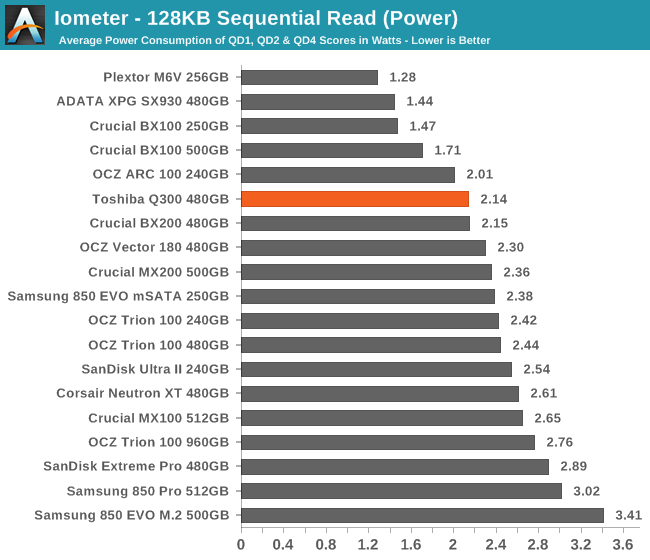
There's considerably more spread in power draw than performance on the sequential read test. The Q300's power consumption is good but not great, and most of the top performers sacrifice efficiency relative to the Q300.
 |
|||||||||
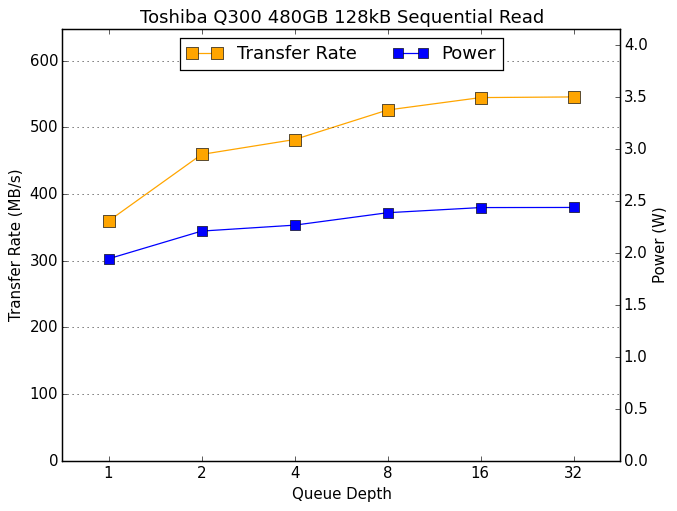
Like the larger capacities of the Trion 100, the Q300 doesn't reach full performance until QD16, and even then it's still about 10MB/s slower than the Trion 100 and closer to 20MB/s slower than the fastest SATA drives.
Sequential Write Performance
The sequential write test writes 128kB blocks and tests queue depths ranging from 1 to 32. The queue depth is doubled every three minutes, for a total test duration of 18 minutes. The test spans the entire drive, and the drive is filled before the test begins. The primary score we report is an average of performances at queue depths 1, 2 and 4, as client usage typically consists mostly of low queue depth operations.
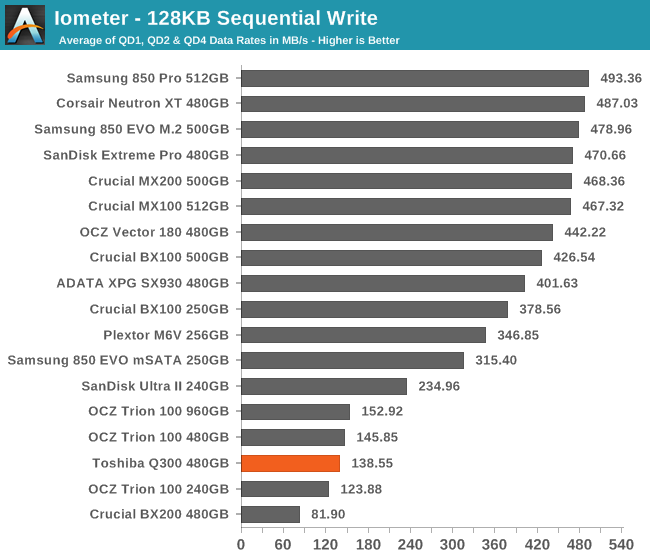
Like the Trion 100, the Q300 does not perform well for sequential writes. The SanDisk Ultra II uses very similar flash, but its Marvell controller and different implementation of pseudo-SLC write caching manages much higher throughput.
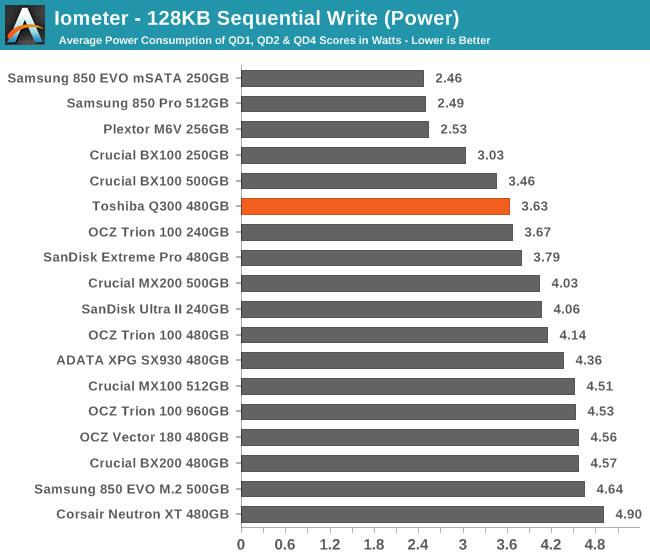
The Q300 is slightly more efficient than the Trion 100, but the planar TLC drives simply cannot hide the power cost of their longer flash program procedure.
 |
|||||||||
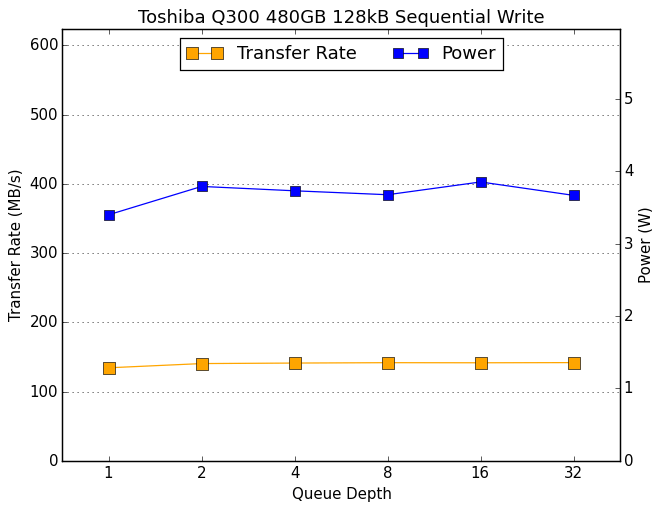
The Q300's sequential write performance is almost entirely unaffected by queue depth, and its power consumption varies only slightly. The top performers typically hit their limit once queue depth increases to two. When used with MLC flash in the Corsair Neutron XT, the Phison controller architecture was able to offer top-notch write speed that scaled with queue depth, but that was lost in adapting the firmware for use with TLC flash.
Originally published at https://www.anandtech.com/show/10084/the-toshiba-q300-ssd-review (Wayback Machine).