
The Angelbird Wings PX1 M.2 Adapter Review: Do M.2 SSDs Need Heatsinks?
Mixed Random Access
Instead of testing a range of queue depths, our mixed workload tests vary the proportion of reads and writes while using a constant queue depth. The test begins with pure reads, then incrementally shifts toward pure writes with three minutes for each subtest. As more writes come in to the mix, the odds increase that a read request will be held up by one of the flash chips being busy with a longer-duration write. Likewise, having lots of reads in the mix can limit the drive's ability to combine writes into larger batches. Thus, the worst performance on these tests usually occurs somewhere around the middle. To approximate client workloads, the mixed random access test uses a queue depth of three and like the random write test it is restricted to a 16GB portion of the drive.
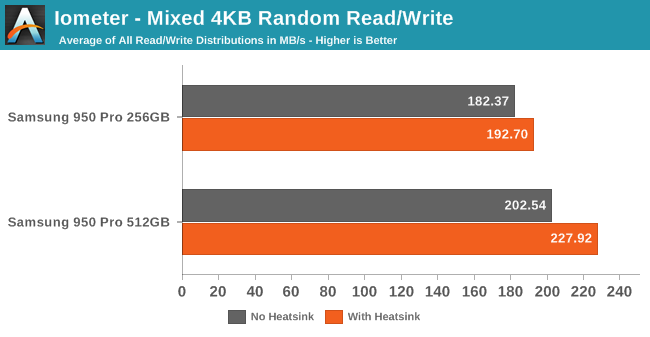
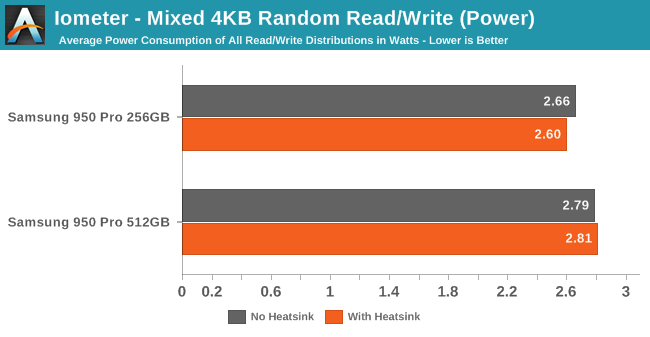
The mixed workloads were the only tests where the two capacities showed significant performance differences even without the heatsink, indicating that thermal throttling was much less of an issue for the 950 Pro here. The heatsink still helps, but only slightly. Given how random reads were essentially unaffected by the heatsink, it's a bit of a surprise that the writes improved by enough to bring the average up by 12.5% for the 512GB drive.
 |
|||||||||
| 256GB no heatsink | 512GB no heatsink | ||||||||
| 256GB with heatsink | 512GB with heatsink | ||||||||
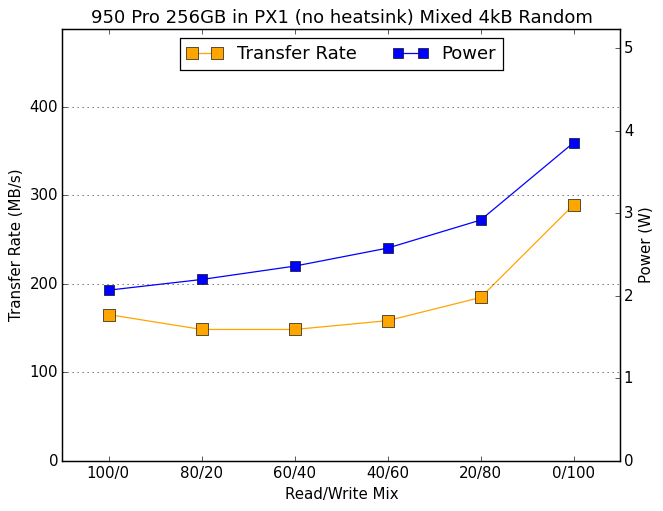
Almost all of the performance improvement with the heatsink comes at the very end of the test as it shifts to pure writes. Performance earlier in the test is virtually unaffected by the heatsink, but power efficiency does see the slight improvement from lower operating temperature.
Mixed Sequential Access
As compared with the mixed random test described above, the mixed sequential test differs by using a queue depth of one and by requesting larger chunks of data. This test operates across the whole drive, which is pre-filled with data.
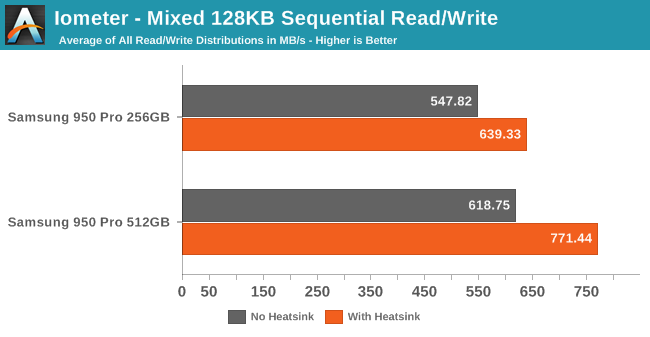
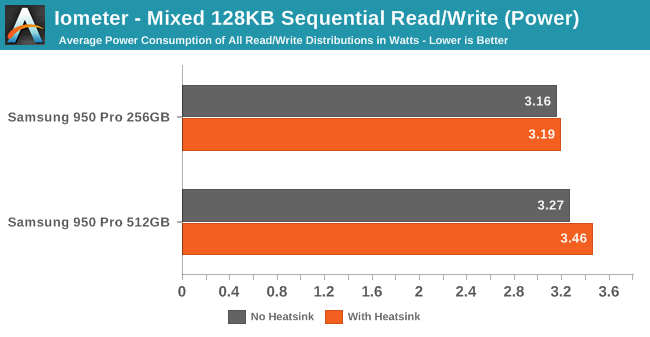
Both of the previous sequential performance tests showed huge improvements even at low queue depths, so it's no surprise to see a significant improvement in a mix of the two.
 |
|||||||||
| 256GB no heatsink | 512GB no heatsink | ||||||||
| 256GB with heatsink | 512GB with heatsink | ||||||||
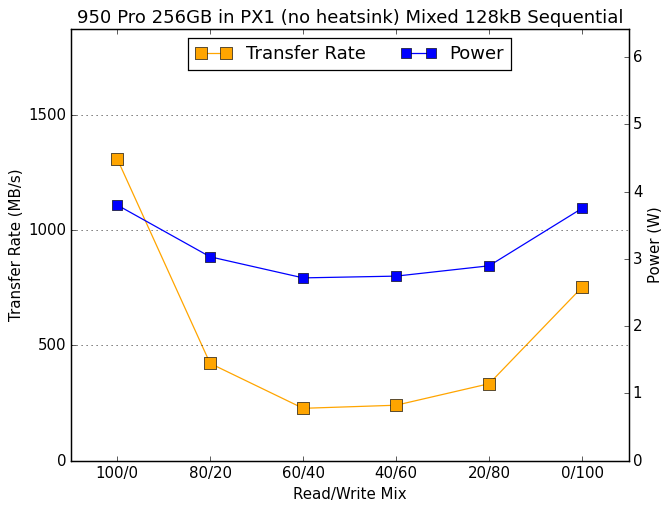
A closer look reveals that the overall performance improvements are once again attributable to the non-mixed segments of the test. Unlike the mixed random test, read speeds are part of the improvement here. But on the sub-tests with a balanced mix of reads and writes, the 950 Pro wasn't throttling even without the heatsink.
Originally published at https://www.anandtech.com/show/9856/angelbird-wings-px1-m2-adapter-review-do-ssds-need-heatsinks (Wayback Machine).