
Western Digital My Cloud Mirror Gen 2 Review
- Posted in
- NAS
- Storage
- Western Digital
- My Cloud
Miscellaneous Aspects and Final Words
In order to keep testing consistent across all 2-bay units, we performed all our expansion / rebuild testing as well as power consumption evaluation with the unit configured in RAID-1. The disks used for benchmarking (Western Digital WD4000FYYZ) were also used in this section. The table below presents the average power consumption of the unit as well as time taken for various RAID-related activities.
| WD My Cloud Mirror Gen 2 RAID Expansion and Rebuild / Power Consumption | ||
| Activity | Duration (HH:MM:SS) | Avg. Power (W) |
| Single Disk Init | 00:08:53 | 15.16 W |
| JBOD to RAID-1 Migration | 08:44:21 | 25.81 W |
| RAID-1 Rebuild | 08:33:05 | 25.99 W |
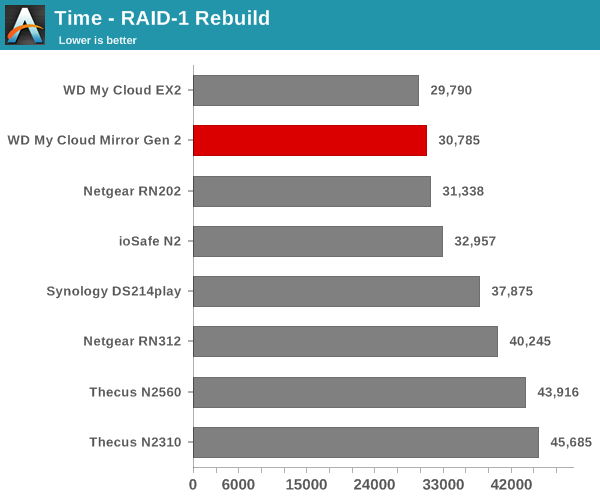
The graphs below show the power consumption and rebuild duration when repairing a RAID-1 volume for the various 2-bay NAS units that have been evaluated before.
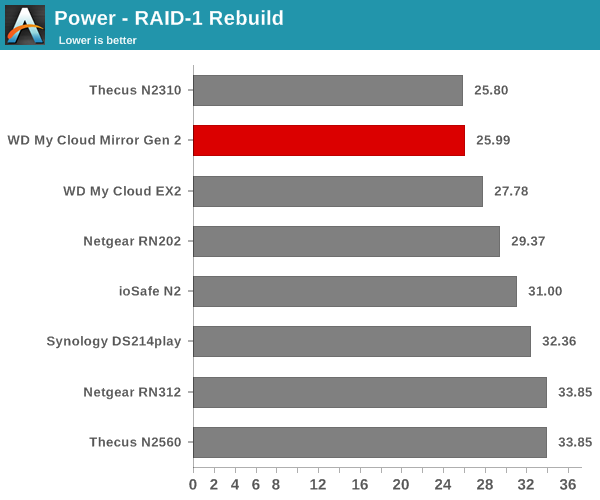
The My Cloud Mirror Gen 2 is not the best when it comes to either power or time taken for this activity. However, energy consusmption for the RAID-1 rebuild process is the lowest across all the 2-bay NAS units that we have evaluated.
Concluding Remarks
The Marvell ARMADA 385 is a very powerful solution for 2-bay NAS units. It is likely that Western Digital is using the same board for the latest models in the EX2 series. Therefore, it comes as no surprise that the performance of the WD My Cloud Mirror Gen 2 is more than enough for its target market. My Cloud OS 3 is also one of the very few commercial off-the-shelf (COTS) NAS operating systems that provides support for SMB 3.0 as a sharing service. This means that Windows 8.1 and later PCs can actually get much better performance from the unit compared to what we have gathered in the preceding pages.
The user interface, mobile and desktop apps make perfect sense for the average non-tech-savvy consumer. Vendors such as QNAP and Synology have much more stable and mature operating systems as well as mobile apps. However, they are also quite complex and tend to leave the consumer dazed. Western Digital manages to keep things short and simple. As an example, while QNAP and Synology have a whole suite of mobile apps, WD uses just one - the 'My Cloud' - to take care of almost all the expectations of the average user. The third-party app ecosystem should also improve now, given that My Cloud OS 3 comes with support for Docker.
The above advantages aside, there are certain areas where Western Digital could improve. The web UI for My Cloud OS 3 could do with some user experience upgrades. The WD Sync program has a few teething troubles. We have talked about them in detail in a previous section. Users contemplating the purchase of the My Cloud Mirror Gen 2 should be aware of all the disabled firmware features and make sure that their absence is not an issue for their use-case.
Coming to the business end of the review, we find the My Cloud Mirror Gen 2 4TB version priced at $310. The two WD Red drives, if bought separately, cost $90 each. This translates to a price of $130 for the diskless unit. The closest competitor to the My Cloud Mirror Gen 2 is the Synology BeyondCloud Mirror (BC214se). A 4TB version of the BC214se comes in at $315 with shipping included. Based on this, I don't see any specific pricing advantages for the My Cloud Mirror Gen 2. However, the channel support, ready-to-use nature right out of the box and the focused feature set make it a great choice for the average home consumer.
Originally published at https://www.anandtech.com/show/9705/western-digital-my-cloud-mirror-gen-2-review (Wayback Machine).