
The Samsung 950 Pro PCIe SSD Review (256GB and 512GB)
Random Write Performance
The random write test is confined to a 16GB portion of the drive, which is otherwise empty. This allows the drive to demonstrate much higher performance than on our performance consistency test that fills the drive. Tasks like installing software updates can modify a lot of files, but aren't hitting the entire disk. Random writes to the entire disk are usually found only in enterprise workloads such as large databases.
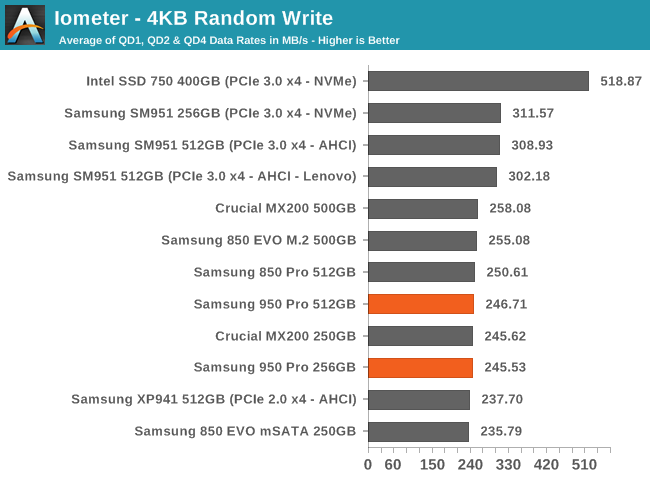
The 950 Pro's random write speeds aren't benefiting at all from the PCIe interface or the NVMe protocol, and are about 20% slower than the SM951. Since it's happening to both drives it probably isn't a thermal issue, so this may be the result of a firmware change. Still, the Intel SSD 750 is the only retail drive that significantly outperforms the tightly clustered competition.
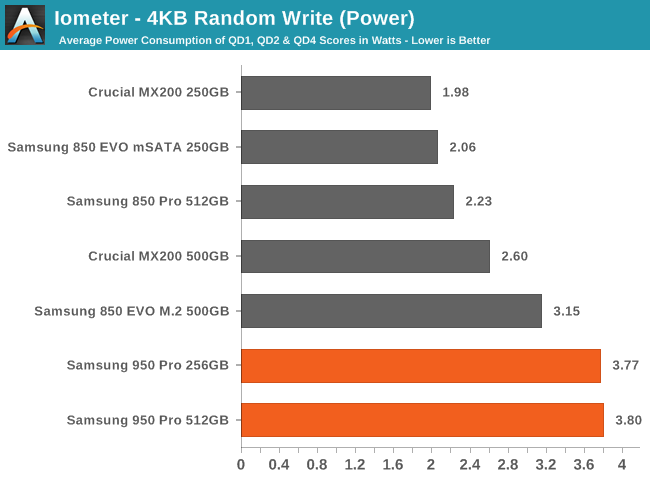
The higher power consumption during the random write test is a problem, since it's not buying any extra performance.
 |
|||||||||
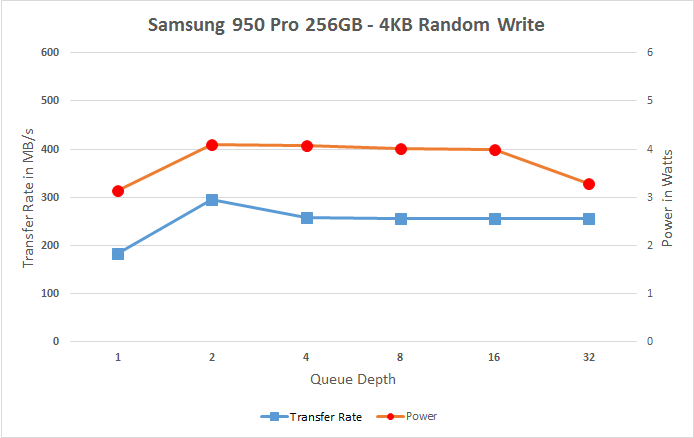
After increasing significantly from QD1 to QD2, performance and power drop slightly and stay flat for most of the rest of the test. At the very end, a slight drop in power for the 512GB and a more significant drop for the 256GB may indicate a change in what background processing is going on; the drive may be postponing some garbage collection during the onslaught of writes at the maximum queue depth, or it may be a coincidental case of the background processing catching up and throttling back near the end of the test.
Random Read Performance
Our random read performance test is conducted on a full drive and tests queue depths from 1 to 32. We focus primarily on the lower queue depths that are typical of interactive use, but also look at how the performance and power scales to more intensive loads. For desktop use, searching and virus scanning are typically the biggest sources of random reads, and they can exercise some of the larger queue depths.
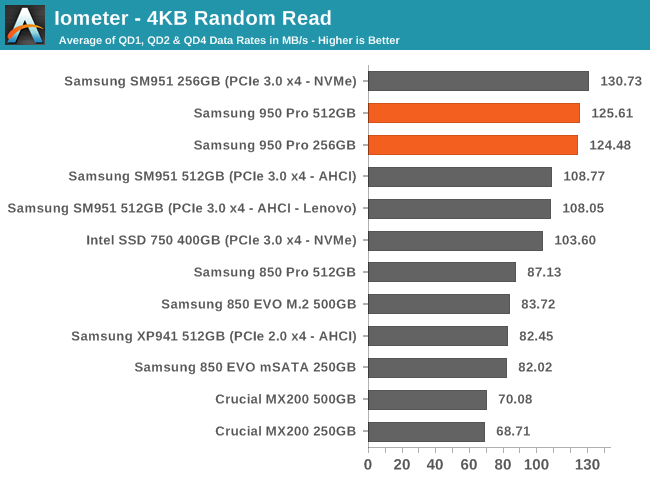
The strong random read performance of the 950 Pro provides great justification for its status as the a flagship drive for the consumer market.
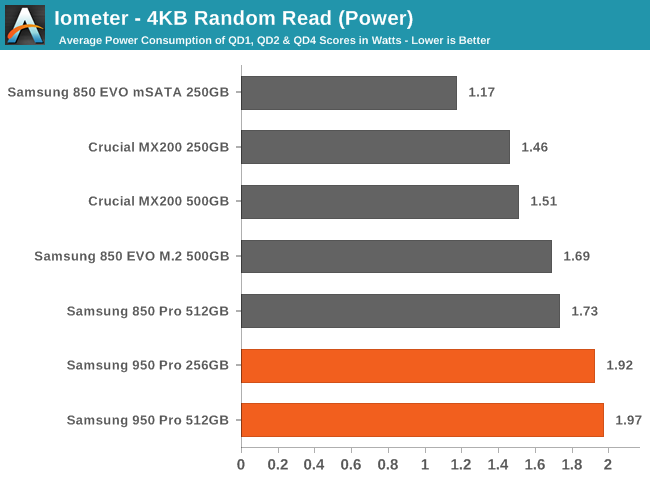
The 950 Pro's power consumption is moderately higher but nowhere close to being proprotional to the performance advantage; the 950 Pro doesn't have to run hot to offer great performance.
 |
|||||||||
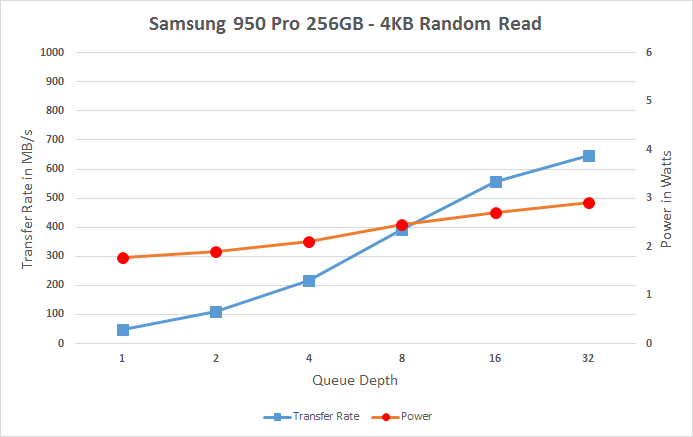
Power and performance scaling look very typical here, except I had to expand the performance axis for the 950 Pro. Both drives pass SATA's limits at or before QD16.
Originally published at https://www.anandtech.com/show/9702/samsung-950-pro-ssd-review-256gb-512gb (Wayback Machine).