
Netgear ReadyNAS RN202 2-bay NAS Review
- Posted in
- NAS
- Storage
- NetGear
- Annapurna Labs
Miscellaneous Aspects and Final Words
In order to keep testing consistent across all 2-bay units, we performed all our expansion / rebuild testing as well as power consumption evaluation with the unit configured in RAID-1. The disks used for benchmarking (Western Digital WD4000FYYZ) were also used in this section. The table below presents the average power consumption of the unit as well as time taken for various RAID-related activities.
| Netgear RN202 RAID Expansion and Rebuild / Power Consumption | ||
| Activity | Duration (HH:MM:SS) | Avg. Power (W) |
| Single Disk Init | - | 18.55 W |
| JBOD to RAID-1 Migration | 08:45:42 | 29.33 W |
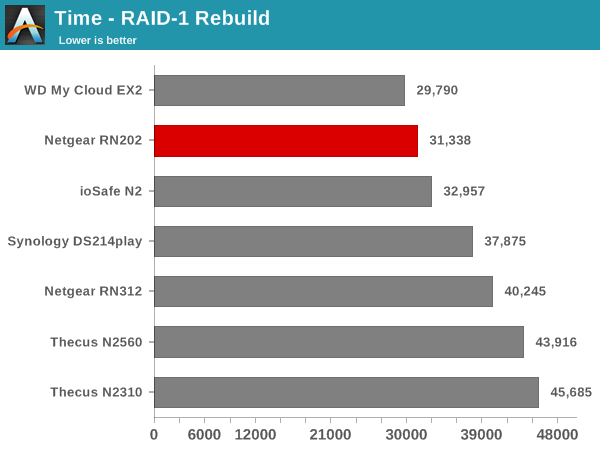
| RAID-1 Rebuild | 08:42:18 | 29.37 W |
The graphs below show the power consumption and rebuild duration when repairing a RAID-1 volume for the various 2-bay NAS units that have been evaluated before.
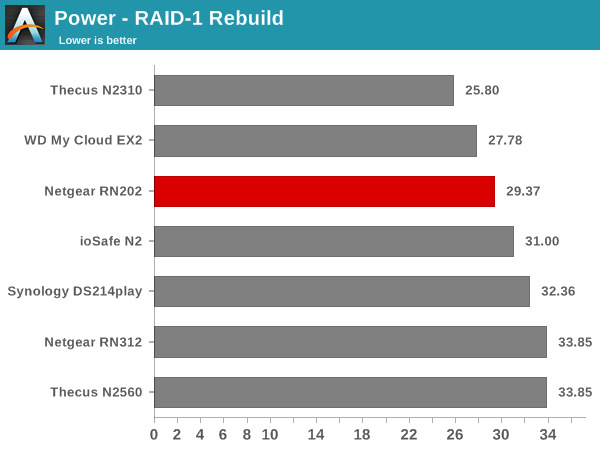
The Netgear RN202 is not the fastest or most power efficient system when it comes to RAID rebuilt, but it is in the top half of the set of 2-bay units that we have evaluated so far.
Concluding Remarks
The Annapurna Labs ARM Cortex A15 platform provides more CPU power and has the appropriate hardware acceleration blocks for the NAS market. With only two bays, the unit is more suited for home consumers. Even though link aggregatin is supported, the platform can't saturate the bonded link (topping out around 170 MBps in the real life workloads that we tested). However, in the space where ARM-based units tend to not support 802.3ad link aggregation, the RN202 is definitely better placed.
In our opinion, the Netgear ReadyNAS RN202 and ReadyNAS OS stand out in the crowded NAS market because of the btrfs support and the set of business features that enable interesting use-cases in the consumer market. Netgear's extensive networking background also allows for seamless VPN and cloud integration in ReadyNAS OS 6.

One of the interesting business features that Netgear has enabled in the RN202 is 'ReadyNAS Replicate'. This allows two ReadyNAS units connected to the Internet (and associated with the same ReadyCLOUD account) to be able to back up to each other via a secure peer-to-peer connection. This feature enables easy configuration of off-site backups. With certain tweaks (such as ability to do backups to a ReadyNAS associated with a different account), this feature could do well in the consumer market.
On the whole, ReadyNAS OS has slightly more than the bare minimum feature set required of a modern commercial off-the-shelf NAS operating system. The ReadyNAS RN202's hardware feature set makes is a good candidate for home consumers and SOHO installations. Taken in the context of units such as the QNAP TS-231 (with two network links and a sub-$200 price tag), the $282 diskless pricing of the RN202 is a bit too high for our liking.
Originally published at https://www.anandtech.com/show/9640/netgear-readynas-rn202-2bay-nas-review (Wayback Machine).