
The AMD Radeon R9 Nano Review: The Power of Size
The Talos Principle
Croteam’s first person puzzle and exploration game The Talos Principle may not involve much action, but the game’s lush environments still put even fast video cards to good use. Coupled with the use of 4x MSAA at Ultra quality, and even a tranquil puzzle game like Talos can make a good case for more powerful video cards.
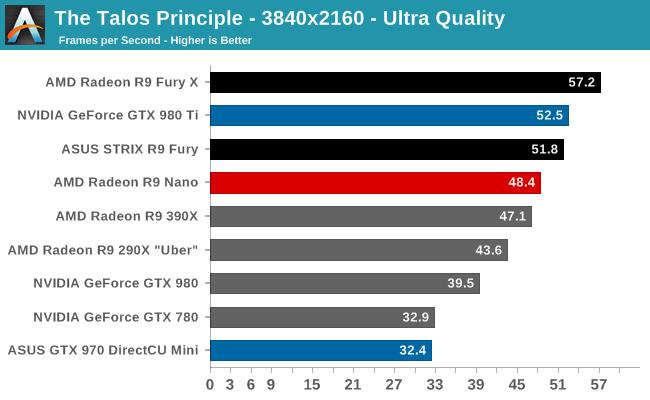
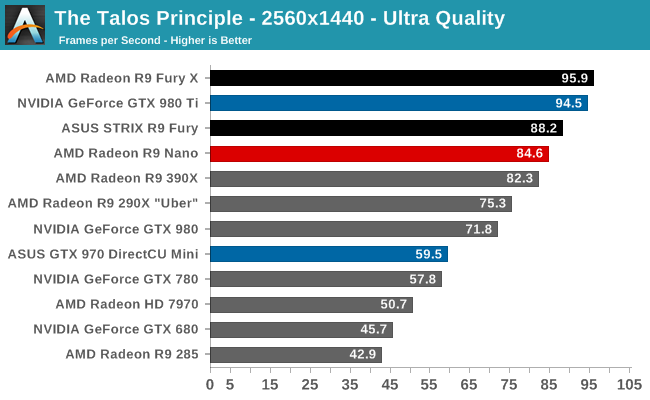
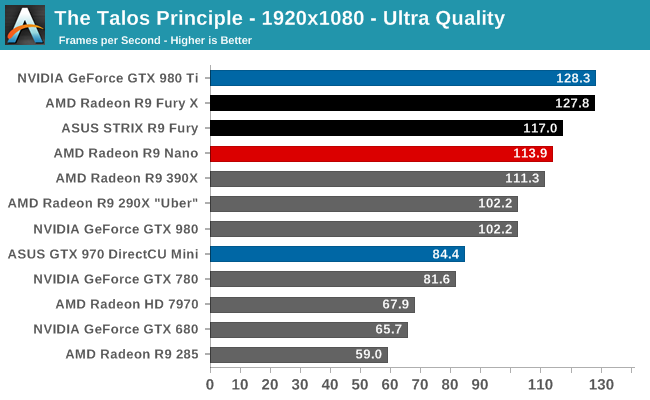
With the Talos Principle the R9 Nano is once again looking good. Performance relative to the R9 Fury X slips a bit more than in the past, now trailing the fastest Fiji by about 15%, while the card trails the slower R9 Fury by 4% at 2560x1440 and 7% at 3840x2160. At least within the AMD lineup, the only other thing of note here is the R9 390X, which is never too far away from the R9 Nano (just at substantially more power).
Otherwise to make our usual size and power comparisons, everything is in AMD’s favor. The R9 Nano is well ahead of the GTX 970 Mini, beating it by 35% even at the worse for AMD resolution of 1920x1080. Similarly, the R9 Nano enjoys a 10%+ lead over the power-similar GTX 980, with the lead growing with the resolution.
Finally, we haven’t made too many R9 285 (Tonga) comparisons, so let’s throw one of those in. Like GTX 980, R9 285 is fairly close to R9 Nano in power consumption. However for performance it’s no contest; the R9 Nano nearly doubles the performance of the R9 285 under this game.
Originally published at https://www.anandtech.com/show/9621/the-amd-radeon-r9-nano-review (Wayback Machine).