
The AMD Radeon R9 Nano Review: The Power of Size
Middle Earth: Shadow of Mordor
Our next benchmark is Monolith’s popular open-world action game, Middle Earth: Shadow of Mordor. One of our current-gen console multiplatform titles, Shadow of Mordor is plenty punishing on its own, and at Ultra settings it absolutely devours VRAM, showcasing the knock-on effect that current-gen consoles have on VRAM requirements.
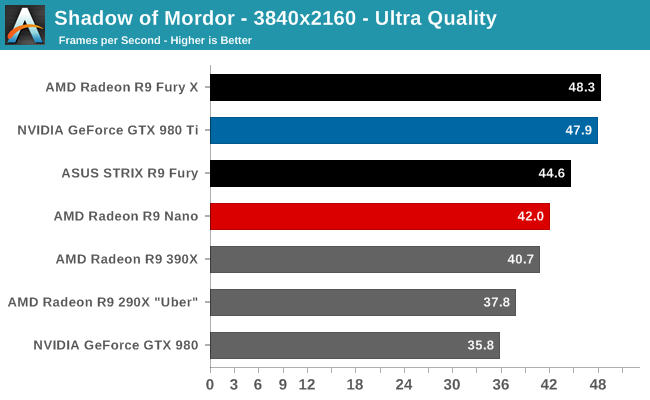
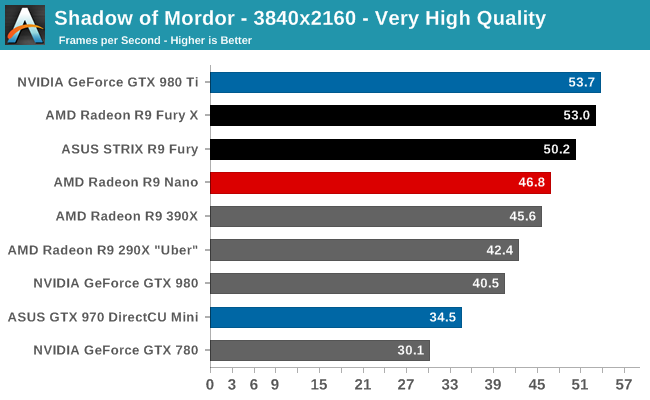
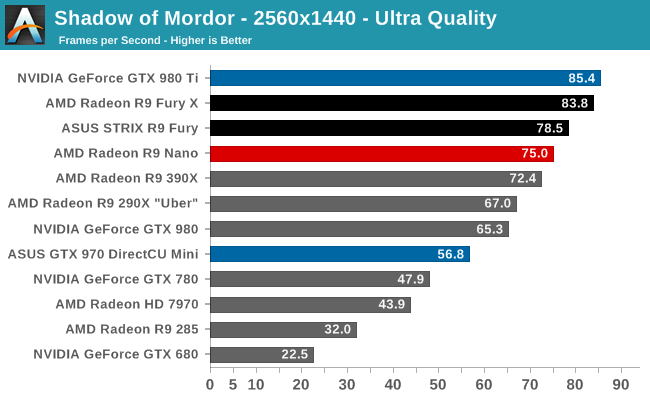
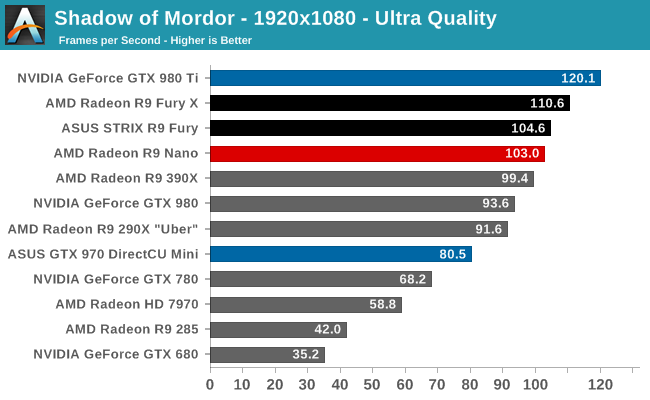
Both of AMD’s Fury cards have handled Shadow of Mordor well in the past, and R9 Nano is no exception. The R9 Nano ends up trailing the R9 Fury X and R9 Fury by around 13% and 7% respectively, not too far off from their respective overall averages. Otherwise compared to NVIDIA’s offerings the R9 Nano clearly trails the similarly priced GTX 980 Ti, but enjoys a very comfortable margin over the likes of the GTX 980 and GTX 970 Mini.
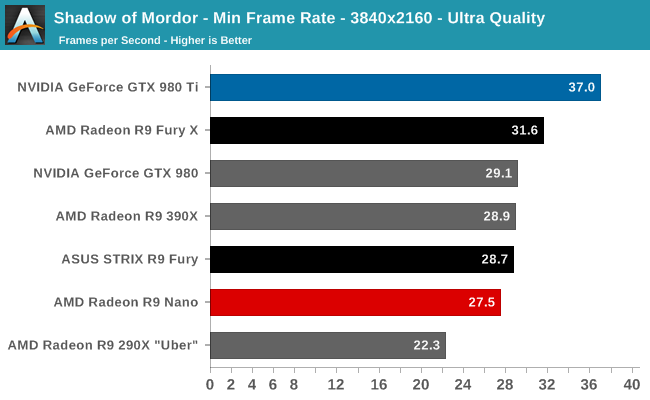
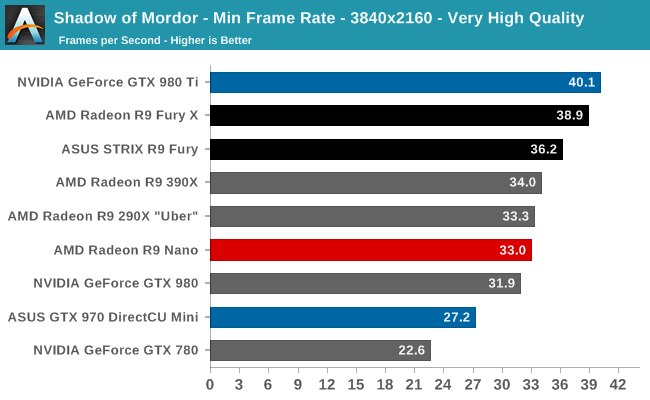
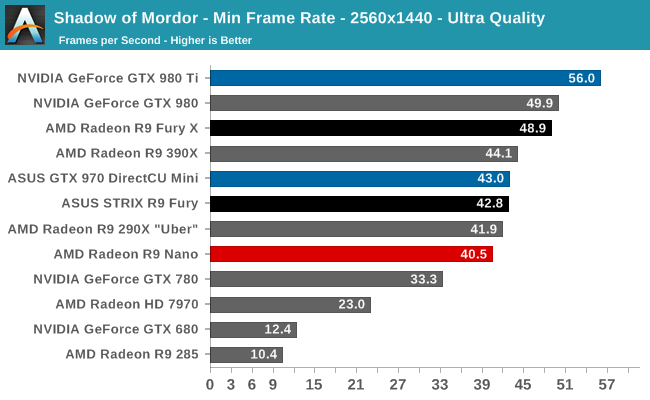
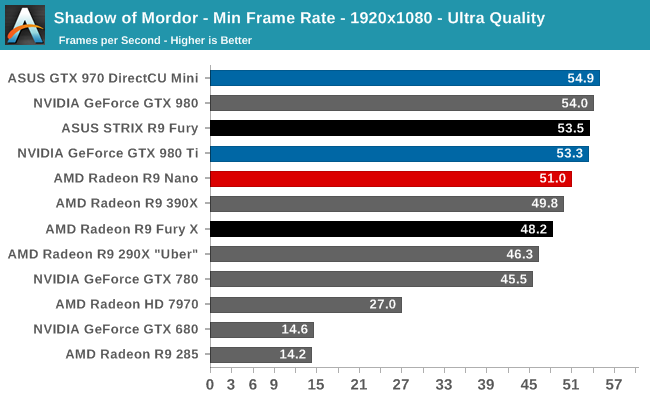
Minimum framerates on the other hand also inherit the other Fiji cards’ weaknesses. AMD actually doesn’t fare too poorly here, however the toll of being slower than the R9 Fury doesn’t do the R9 Nano any favors. Below 3840x2160 the R9 Nano feels the pinch of the GTX 980 and GTX 970 Mini, falling behind these cards.
Originally published at https://www.anandtech.com/show/9621/the-amd-radeon-r9-nano-review (Wayback Machine).