
The AMD Radeon R9 Nano Review: The Power of Size
Overclocking
Finally, no review of a high-end video card would be complete without a look at overclocking performance.
Of all of the Fiji cards overclocking the R9 Nano is perhaps the easiest and certainly the most unusual. Due to the fact that the card is essentially a 1000MHz Fiji card with a heavy power throttle, the card is already validated for clockspeeds that under load it doesn’t have the available power to reach. As a result while one can crank up the clockspeeds, the card isn’t going to move until you increase the power limit. And even then you are more likely to hit the power cap again than you are to break 1000MHz sustained. So overclocking the GPU is something of an academic affair.
| Radeon R9 Fury/Nano Series Overclocking | |||||
| Ref. R9 Fury X | ASUS R9 Fury | Ref. R9 Nano | |||
| Boost Clock | 1125MHz | 1075MHz | 1075MHz | ||
| Memory Clock | 1Gbps (500MHz DDR) | 1.1Gbps (550MHz DDR) | 1.1Gbps (550MHz DDR) | ||
| Power Limit | 100% | 115% | 135% | ||
| Max Voltage | 1.212v | 1.169v | 1.2v | ||
Overall we were able to overclock our sample to 1075MHz on the GPU and 550MHz (1.1Gbps) on the memory. However load clockspeeds were almost always under 1000MHz even with a generous 35% increase in the power target. Overdrive does allow for a larger increase – up to 50% – but with the R9 Nano featuring a less robust power delivery system designed to push less power than R9 Fury or R9 Fury X, we’re hesitant to increase the limit further without a better idea of what the card can safely sustain for extended periods of time.
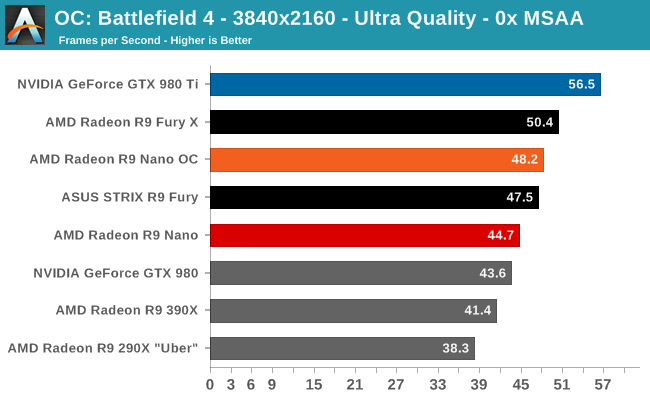
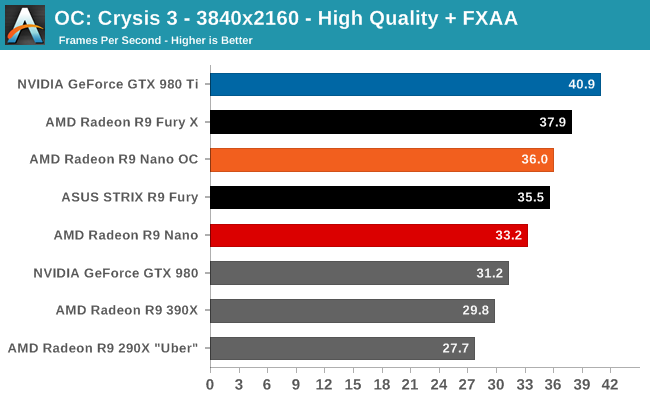
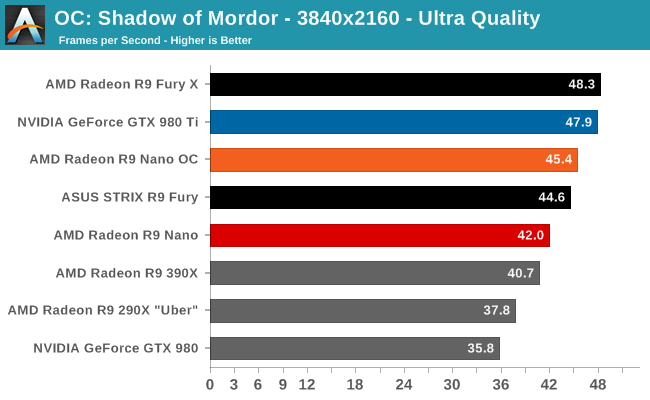
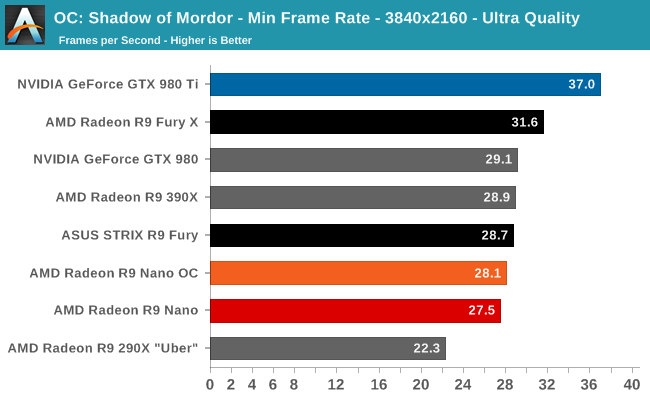
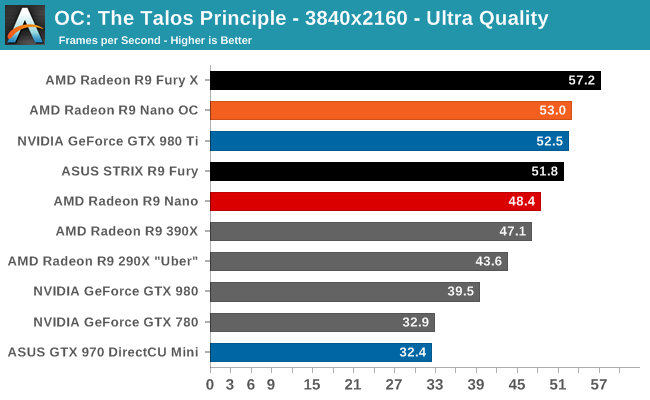
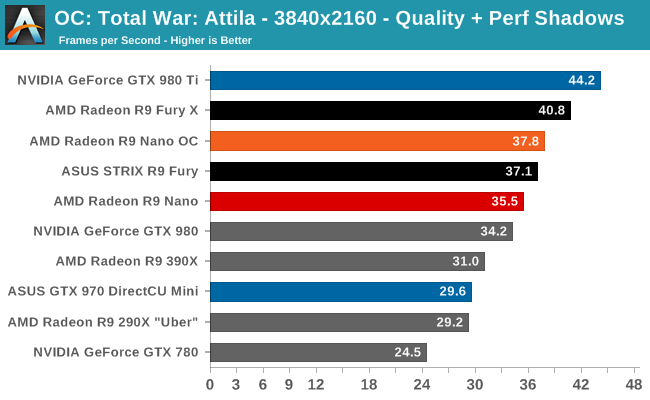
The overall performance gains from overclocking aren’t huge, but at 7-10% they also aren’t too shabby. However since higher clockspeeds quickly ramp up the power requirements due to the higher voltages required, the performance gains won’t be anywhere near the 35% increase in the power limit, despite that we are in fact still power limited.
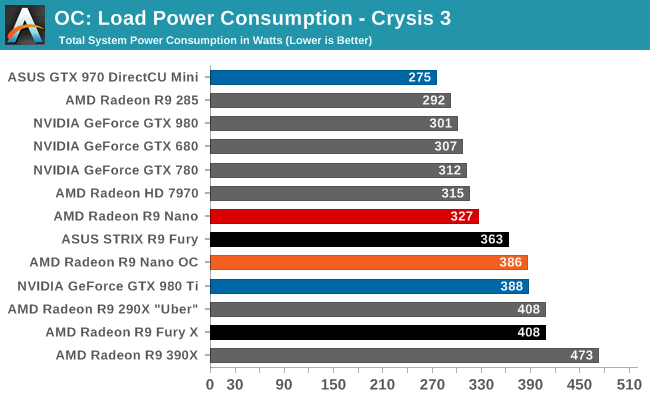
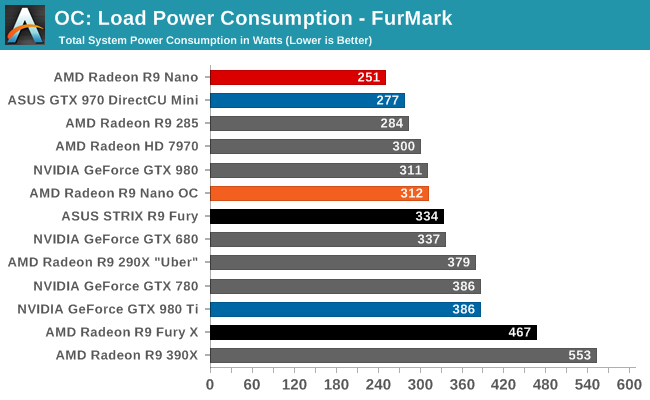
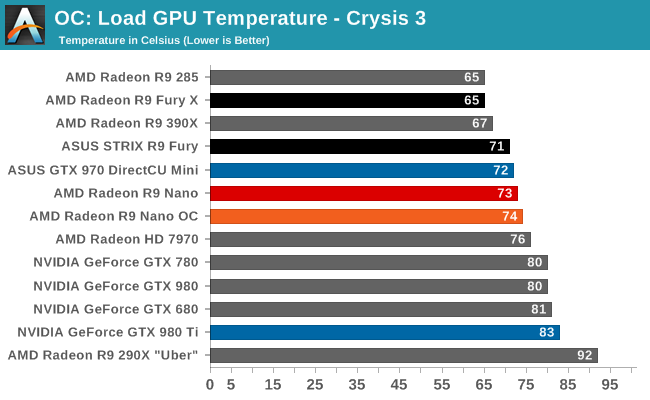
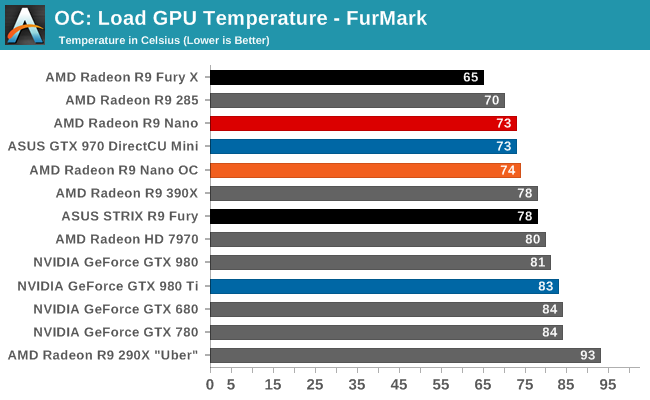
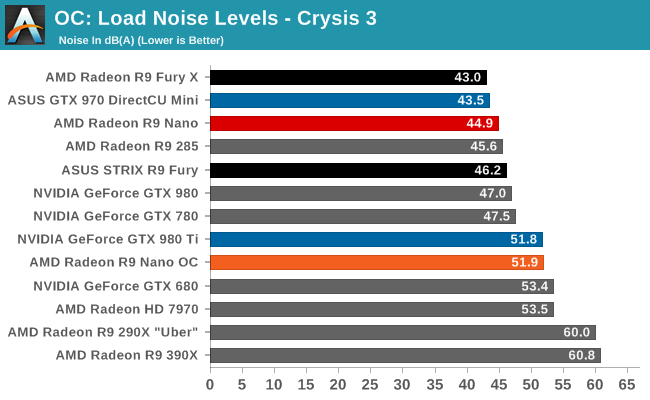
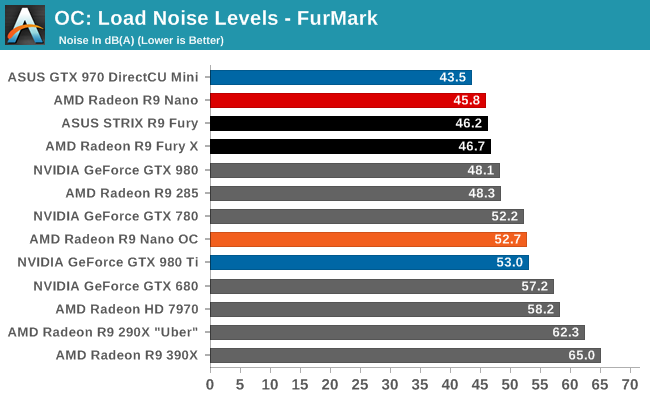
Meanwhile the 35% increase in the power limit has a definite knock-on effect on the cooling system. The R9 Nano’s cooler is able to keep up with the additional load, holding temperatures to 74C, but noise levels are now over 51dB(A). Power consumption at the wall is similarly affected, with the R9 Nano essentially giving up all of its energy efficiency gains in the process.
Originally published at https://www.anandtech.com/show/9621/the-amd-radeon-r9-nano-review (Wayback Machine).