
The AMD Radeon R9 Nano Review: The Power of Size
Synthetics
As always we’ll also take a quick look at synthetic performance. Since R9 Nano is a fully enabled (albeit lower clocked) Fiji part, synthetic performance behaviors should be very close to R9 Fury X after accounting for the clockspeed differences.
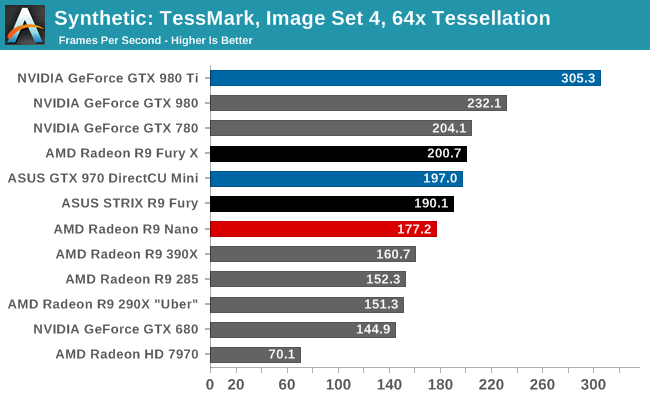
Since the R9 Fury still features a fully enabled geometry frontend, this test is all about clockspeeds. And that means the R9 Nano takes a fairly typical dive here, trailing the R9 Fury X by a bit over 10%, while trailing the R9 Fury by a bit more than we see in games.
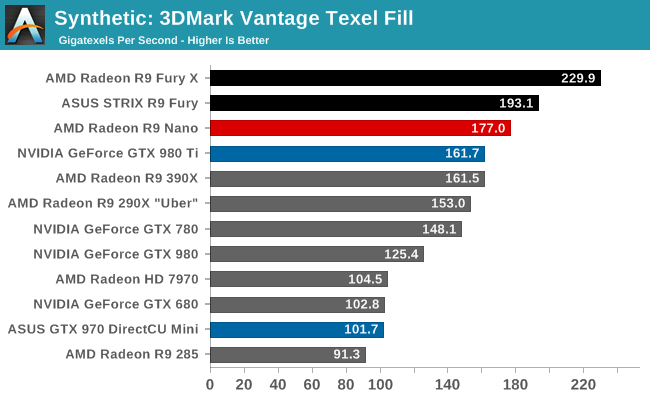
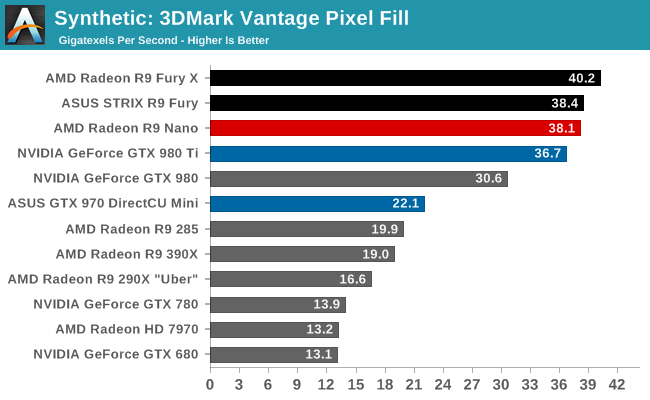
Somewhat surprisingly, the R9 Nano doesn’t do better than what we see here for the texel fillrate test. It still needs to make up for a lack of clockspeed, but it does have more texture units than the R9 Fury since it’s a fully enabled GPU. On the other hand pixel throughput is a bit better than what we were expecting; R9 Nano doesn’t seem too inconvenienced by its clockspeed disadvantage.
Originally published at https://www.anandtech.com/show/9621/the-amd-radeon-r9-nano-review (Wayback Machine).