
The IBM POWER8 Review: Challenging the Intel Xeon
Floating Point: NAMD
After quite a bit of trouble, we managed to port a real floating point application to our POWER8 system: NAMD.
Developed by the Theoretical and Computational Biophysics Group at the University of Illinois Urbana-Champaign, NAMD is a set of parallel molecular dynamics codes for extreme parallellization on thousands of cores. NAMD is also part of SPEC CPU2006 FP.
We used the "NAMD_2.10_Linux-x86_64-multicore" binary for our Xeons. Since there was no LE Linux version for POWER8, we built our own. We got it working with the g++ compiler and used these settings:
-O3 -mcpu=power8 -ftree-vectorize -mpopcntd
These setting should push GCC to generate as much VSX (Vector Scalar eXtenstion) code as possible. We used the most popular benchmark load, apoa1 (Apolipoprotein A1). The results are expressed in simulated nanoseconds per wall-clock day.
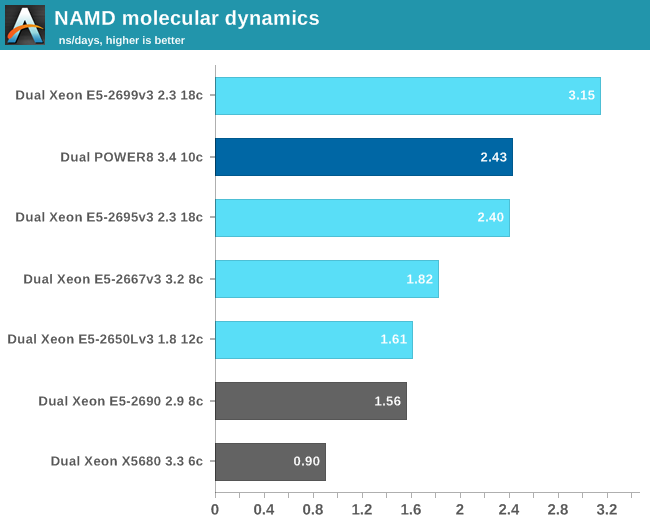
To put this in perspective: an early Xeon Phi (7120 1.2 GHz) scores about 4.4, A top NVIDIA GPU with CUDA based NAMD can score up to 20 and more. So it is clear that this kind of software will be run mostly on GPU accelerated servers.
But it is nonetheless a real world HPC benchmark. The IBM POWER8 is once again on par with the Xeon E5-2695v3. The NAMD binary does not seem to leverage AVX2, as the Xeon E5-2667 (16 cores) does not outperform the Xeon E5-2690 (AVX) with a large margin.
Originally published at https://www.anandtech.com/show/9567/the-power-8-review-challenging-the-intel-xeon- (Wayback Machine).