
ECS LIVA x2 Review: A Compact & Fanless Braswell PC
Networking and Storage Performance
We have recently started devoting a separate section to analyze the storage and networking credentials of the units under review. On the storage side, one option would be repetition of our strenuous SSD review tests on the drive(s) in the PC. Futuremark's PCMark 8 has usually helped us avoid that overkill, thanks to a storage bench where certain common workloads such as loading games and document processing are replayed on the target drive. Unfortunately, our LIVA x2 sample (which started with 18 out of 22.4 GB free upon fresh boot and ended up with around 8 GB free after installing all the Windows 8.1 updates) consistently errored out when running the storage bench (likely due to the non-availability of enough free space in the primary disk). In order to get an idea of the performance of the eMMC storage, we ran a couple of artificial benchmarks, ATTO and CrystalDiskMark, on the OS drive.


The numbers are not as good as even an entry level SSD, but, given the price of the system, it is hard to complain. Users must keep in mind that the choice of eMMC storage and soldered main memory makes it closer to a tablet rather than a full-fledged expandable PC. In particular, one should not expect to install a large number of programs as space is likely to run out. eMMC also requires some free space to keep operating efficiently.
On the networking side, we restricted ourselves to the evaluation of the WLAN component. Our standard test router is the Netgear R7000 Nighthawk configured with both 2.4 GHz and 5 GHz networks. The router is placed approximately 20 ft. away, separated by a drywall (as in a typical US building). A wired client (Zotac ID89-Plus) is connected to the R7000 and serves as one endpoint for iPerf evaluation. The PC under test is made to connect to either the 5 GHz (preferred) or 2.4 GHz SSID and iPerf tests are conducted for both TCP and UDP transfers. It is ensured that the PC under test is the only wireless client for the Netgear R7000. We evaluate total throughput for up to 32 simultaneous TCP connections using iPerf and present the highest number in the graph below.
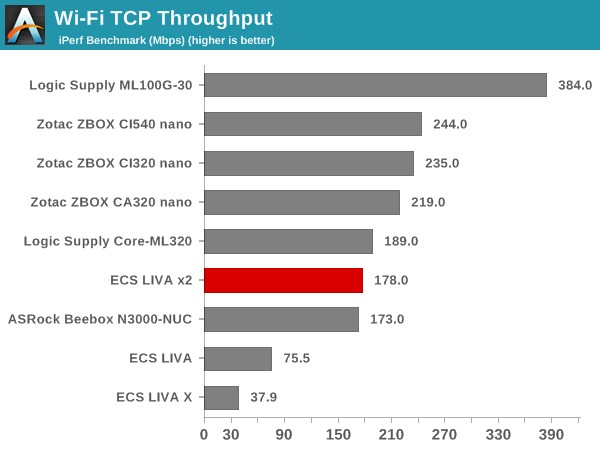
In the UDP case, we try to transfer data at the highest rate possible for which we get less than 1% packet loss.
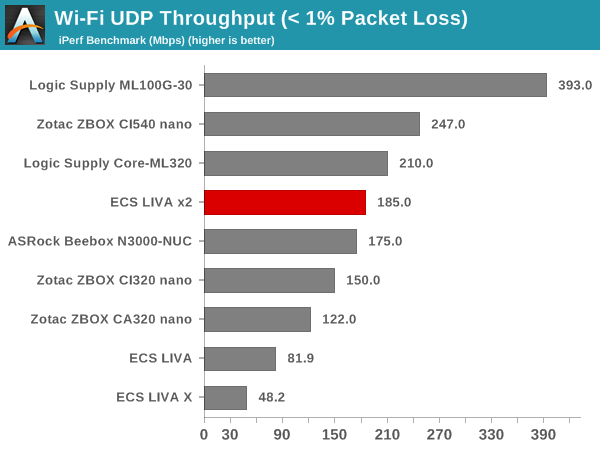
The Realtek 8821AE 1x1 802.11ac / BT 4.0 combo is no stranger to our testbed. We have seen it before in our GIGABYTE BRIX Pro as well as BRIX Gaming reviews. It is also the same WLAN card used in the ASRock Beebox. Unfortunately, the performance of the mPCIe card in the LIVA x2 is similar to that of the Beebox, and nothing to write home about - this could be due to a number of factors such as host CPU limitations (Braswell vs. Core-series) and/or antenna placement.
Originally published at https://www.anandtech.com/show/9554/ecs-liva-x2-review-a-compact-fanless-braswell-pc (Wayback Machine).