
Intel Skylake Z170 Motherboards: A Quick Look at 55+ New Products
EVGA Z170
Over the past few generations of EVGA motherboards, one of the goals has been to emulate the success they achieved during the X58 motherboard era. At that time, the motherboards were highly praised for their overclocking prowess for what was (and still is) a relatively small motherboard manufacturer. EVGA’s historic strengths lie in their legions of fans and a typical expectation that in most of their big markets, they will field the warranty issues rather than the retailer. Z170, like the others, brings on the EVGA wind in the three regular segments.
EVGA Z170 Classified

Aimed at the pure high end, the EVGA Classified might be the most expensive Z170 board on the market. Here they have used a single PLX 8747 chip under that middle heatsink to provide x8/x8/x8/x8 bandwidth to the PCIe slots. Using a PLX 8747 chip on a mid-range motherboard is not new, it was all the rage back in Z77, but what makes it different here is that the company that manufactures the chip has changed hands and now focuses on the enterprise market. As a result, the costs of such a chip are seemingly doubled overnight, making it an unenticing prospect for the consumer market. Nonetheless, EVGA is aiming for an overclocking motherboard with Quad-SLI support and here it is.
Alongside the extensive heatsink configuration to aid both the power delivery and that PLX chip, EVGA equips the board with dual network controllers (I219-V and I210-AT), a Creative Sound Core3D audio solution, two USB 3.1-A ports on the rear panel, an M.2 slot running in PCIe 3.0 x4 mode, seven 4-pin PWM fan headers, triple BIOS support, EZ voltage read points and the onboard readout will output the temperature when in the operating system.
EVGA Z170 FTW

The FTW follows a similar design pattern to the classified in terms of hardware layout, but reduces it all down into a more cost effective market. As a result the PLX chip is gone, the power delivery heatsink arrangement is reduced, a number of the OC features are lifted off and other connectivity is reduced. The single network port is an Intel I219-V, there is no USB 3.1 and we have the base six SATA ports from the chipset. We still keep the M.2 based off of the PCIe 3.0 x4 bandwidth, but the PCIe slots only support up to x8/x4/x4 with the final slot being an x1. This seems a little odd, given how many PICe lanes the chipset can use.
EVGA Z170 Stinger
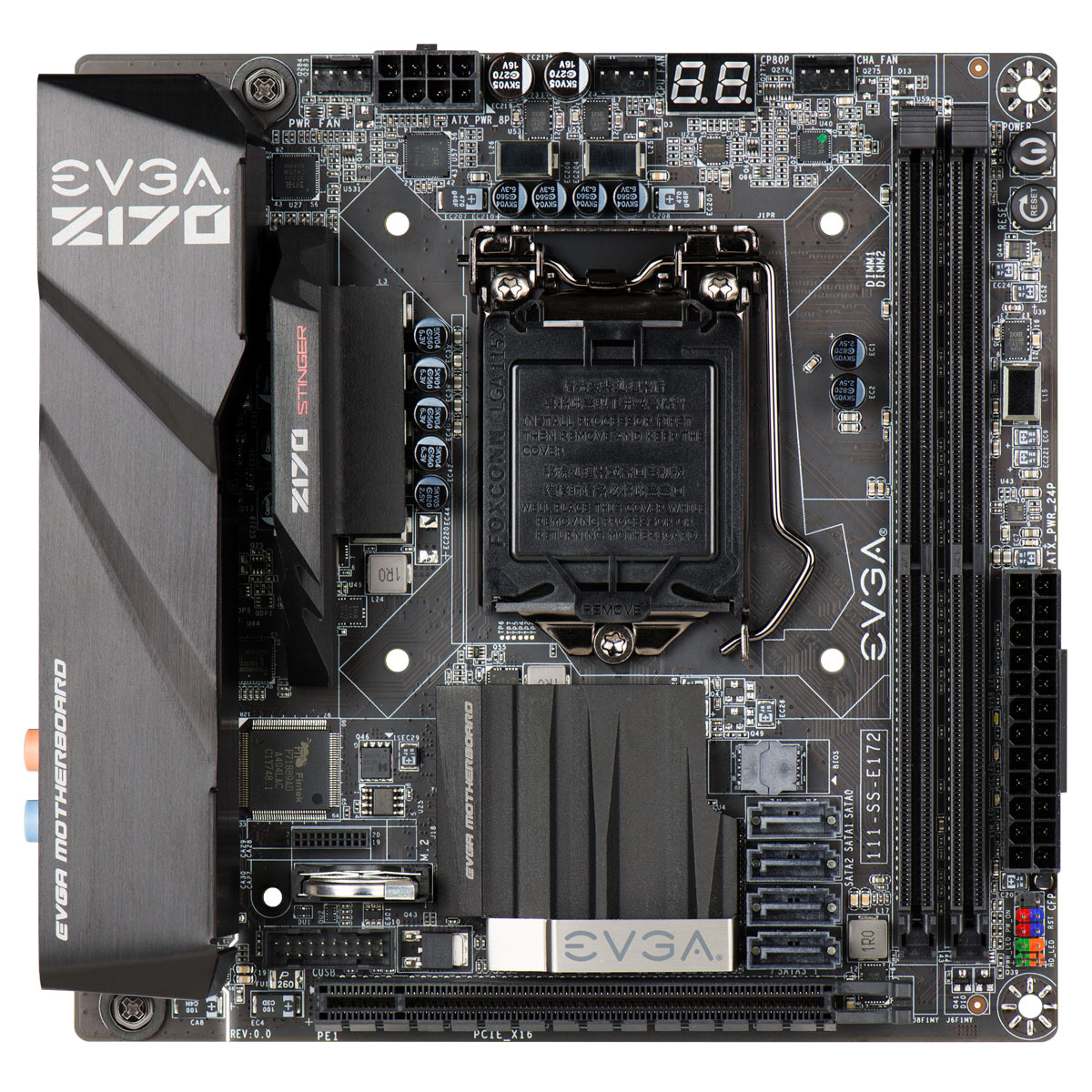
The Stinger is the mini-ITX solution, keeping the line alive after several generations. Taking on board previous comments, the power connectors are now on the outside of the DRAM slots or at the top of the motherboard, along with the important front panel connectors. There seems to be enough space around the CPU slot for larger air coolers, although the SATA connector placement will be a nightmare when locking cables and large PCIe cards are used. EVGA does list the Stinger as having a 10-layer PCB, which might make it one of the mini-ITX motherboards with the most layers, although this just makes the design of the board easier and pushes up cost. Similar to the FTW, we don’t get USB 3.1 on this model with only an Intel I219-V network port and Realtek audio.
Originally published at https://www.anandtech.com/show/9485/intel-skylake-z170-motherboards-asrock-asus-gigabyte-msi-ecs-evga-supermicro (Wayback Machine).