
ADATA XPG SX930 (120GB, 240GB & 480GB) SSD Review: JMicron JMF670H Debuts
Performance Consistency
We've been looking at performance consistency since the Intel SSD DC S3700 review in late 2012 and it has become one of the cornerstones of our SSD reviews. Back in the days many SSD vendors were only focusing on high peak performance, which unfortunately came at the cost of sustained performance. In other words, the drives would push high IOPS in certain synthetic scenarios to provide nice marketing numbers, but as soon as you pushed the drive for more than a few minutes you could easily run into hiccups caused by poor performance consistency.
Once we started exploring IO consistency, nearly all SSD manufacturers made a move to improve consistency and for the 2015 suite, I haven't made any significant changes to the methodology we use to test IO consistency. The biggest change is the move from VDBench to Iometer 1.1.0 as the benchmarking software and I've also extended the test from 2000 seconds to a full hour to ensure that all drives hit steady-state during the test.
For better readability, I now provide bar graphs with the first one being an average IOPS of the last 400 seconds and the second graph displaying the IOPS divided by standard deviation during the same period. Average IOPS provides a quick look into overall performance, but it can easily hide bad consistency, so looking at standard deviation is necessary for a complete look into consistency.
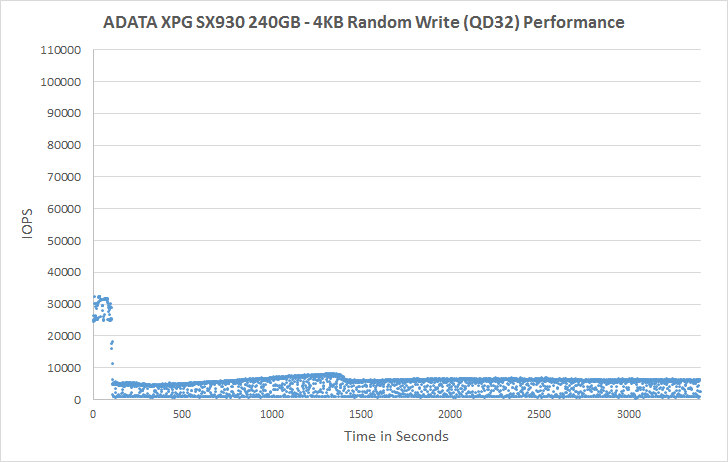
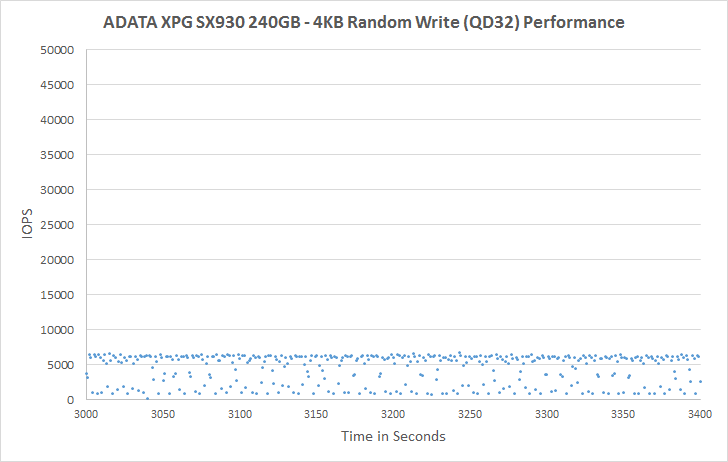
I'm still providing the same scatter graphs too, of course. However, I decided to dump the logarithmic graphs and go linear-only since logarithmic graphs aren't as accurate and can be hard to interpret for those who aren't familiar with them. I provide two graphs: one that includes the whole duration of the test and another that focuses on the last 400 seconds of the test to get a better scope into steady-state performance. These results are for all drives 240GB and up.
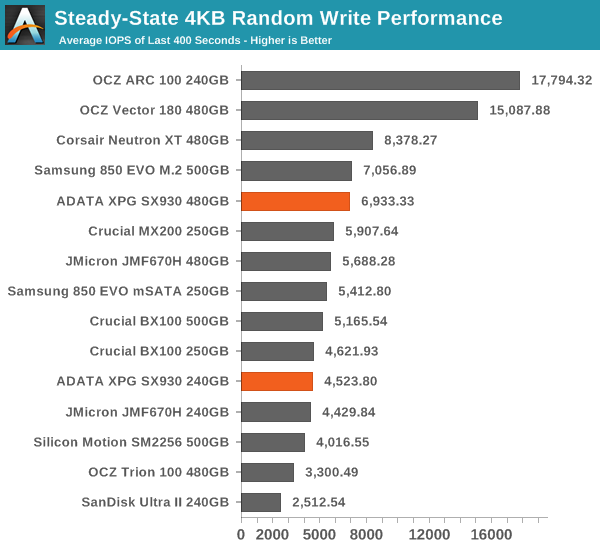
Steady-state performance is fairly good, although given that the SX930 employes 12% over-provisioning it's expected to perform better than drives with only 7%.
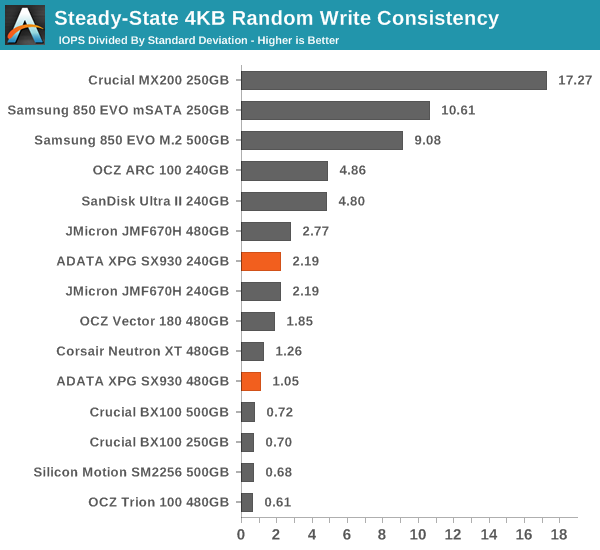
Consistency, on the other hand, isn't that good. The good news is that the JMF670H is more consistent than the SM2246EN in the BX100, but there's a long way to achieve Samsung-level consistency.
 |
|||||||||
| Default | |||||||||
| 25% Over-Provisioning | |||||||||
As the SX930 isn't very consistent, we saw performance dropping below 1,000 IOPS. It seems that consistency is one of the areas that truly separate Samsung and Marvell drives from the rest because JMicron, Silicon Motion and Phison based drives all have trouble sustaining steady performance. Basically, the baseline performance is about 1,000 IOPS for all controllers with frequent peaks of +5,000 IOPS, whereas Samsung and Marvell drives have very little variation in performance. I suspect the controller design itself has something to do with this because Samsung and Marvell controllers are all multi-core, but JMicron and Silicon Motion rely on single-core designs for higher cost efficiency.
 |
|||||||||
| Default | |||||||||
| 25% Over-Provisioning | |||||||||
Originally published at https://www.anandtech.com/show/9433/adata-xpg-sx930-120gb-240gb-480gb-ssd-review (Wayback Machine).