
Micron M510DC (480GB) Enterprise SATA SSD Review
Mixed 4KB Random
In real world, workloads are rarely just pure reads or writes, hence it's important to test mixed performance as it better illustrates the performance under an enterprise workload. The read/write distribution varies greatly depending on the workload, but 70% read and 30% write is often considered as the benchmark for mixed performance. It's a little write heavy to mirror the most read-centric workloads (like media streaming or cloud storage), but it's fairly realistic for mimicking virtual desktop infrastucture (VDI) workloads for example.
The test sequence is similar to the random write benchmark. I start off with a two-hour sequential write pass, which is followed by six hours of 4KB random IOs at QD32 with 70% being reads and 30% writes. I again record the results of the last 500 seconds to ensure that the results represent steady-state performance. I also test queue depth scaling after the six-hour run and as a final test I run a 4KB random IO test (QD32) at six different read/write distributions in order to determine performance for different workloads.
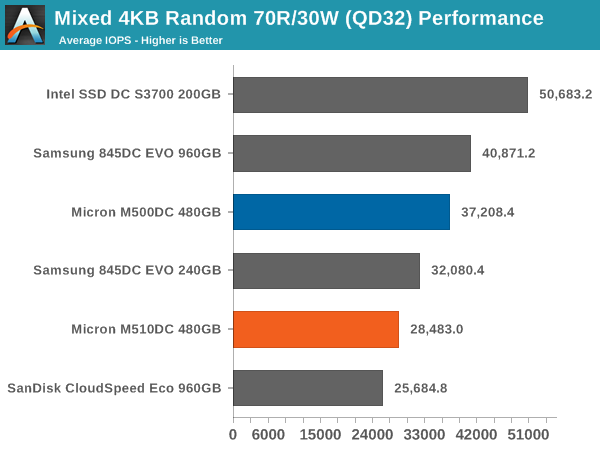
The 70R/30W mixed performance is a slight disappointment. While the M510DC deliver considerably higher random write performance than the 845DC EVO, it cannot match the EVO in mixed performance.

At low queue depths the M510DC actually provides better performance than the EVO, but after QD8 the performance no longer scales optimally, which is inherent in the design as the same scaling phenomenon is present in the M500DC as well.

The performance at different read/write distributions is overall good and on par with the CloudSpeed Eco and 240GB EVO. For performance-focused mixed workloads, the M500DC is a better option, although ultimately the S3700 easily takes the crown here.
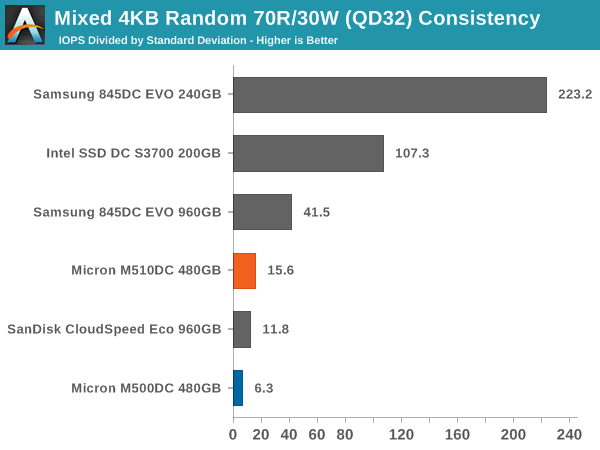
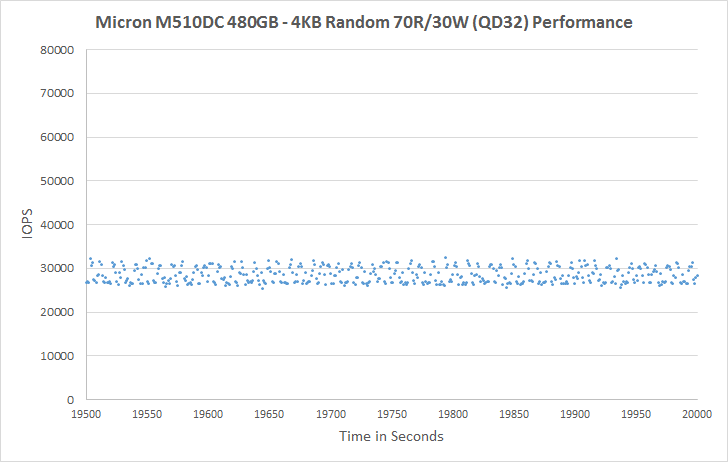
Consistency again leaves something to be desired because compared to the EVOs the M510DC isn't a very consistent drive.
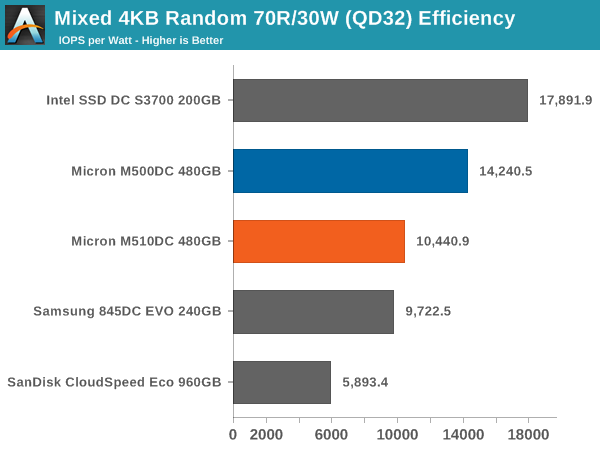
In power efficiency, however, the M510DC is very competitive and considerably better than the CloudSpeed Eco.
 |
|||||||||
| Default | |||||||||
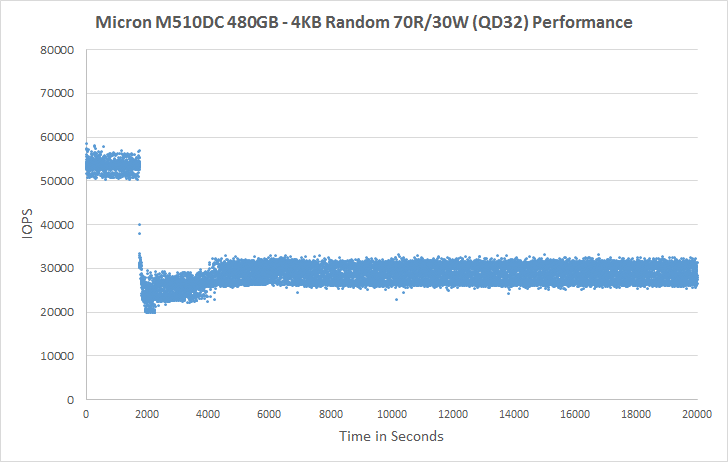
The M510DC is consistently inconsistent. It's not as bad as the M500DC, but given that the 845DC EVO provides better performance at much higher consistency it's hard to recommend the M510DC for applications that require very consistent mixed IO performance.
 |
|||||||||
| Default | |||||||||
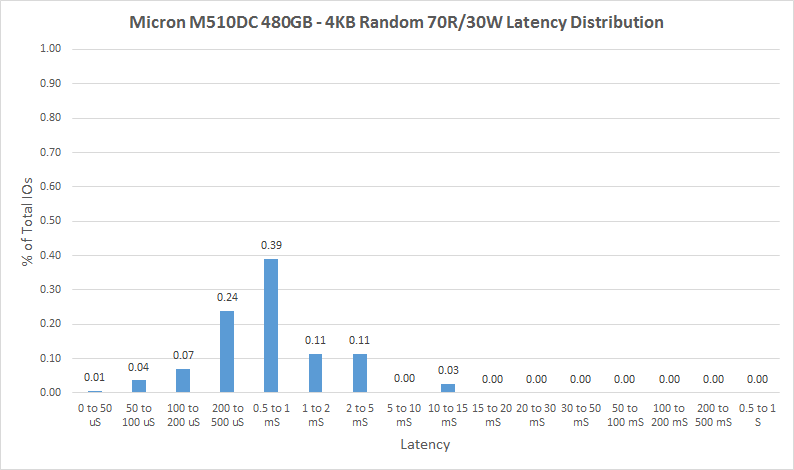
The same is also visible in the latency distribution. While the M510DC has frequent IOs in the range of 100µs, the consistency is again damaged by 3% of >10ms IOs. No other drive has IOs in that range, so it's a bit alarming given how even the CloudSpeed Eco consistently delivers IOs below 10ms.
 |
|||||||||
| Default | |||||||||
Originally published at https://www.anandtech.com/show/9430/micron-m510dc-480gb-enterprise-sata-ssd-review (Wayback Machine).