
The AMD Radeon R9 Fury Review, Feat. Sapphire & ASUS
Grand Theft Auto V
The final game in our review of the R9 Fury X is our most recent addition, Grand Theft Auto V. The latest edition of Rockstar’s venerable series of open world action games, Grand Theft Auto V was originally released to the last-gen consoles back in 2013. However thanks to a rather significant facelift for the current-gen consoles and PCs, along with the ability to greatly turn up rendering distances and add other features like MSAA and more realistic shadows, the end result is a game that is still among the most stressful of our benchmarks when all of its features are turned up. Furthermore, in a move rather uncharacteristic of most open world action games, Grand Theft Auto also includes a very comprehensive benchmark mode, giving us a great chance to look into the performance of an open world action game.
On a quick note about settings, as Grand Theft Auto V doesn't have pre-defined settings tiers, I want to quickly note what settings we're using. For "Very High" quality we have all of the primary graphics settings turned up to their highest setting, with the exception of grass, which is at its own very high setting. Meanwhile 4x MSAA is enabled for direct views and reflections. This setting also involves turning on some of the advanced redering features - the game's long shadows, high resolution shadows, and high definition flight streaming - but not increasing the view distance any further.
Otherwise for "High" quality we take the same basic settings but turn off all MSAA, which significantly reduces the GPU rendering and VRAM requirements.
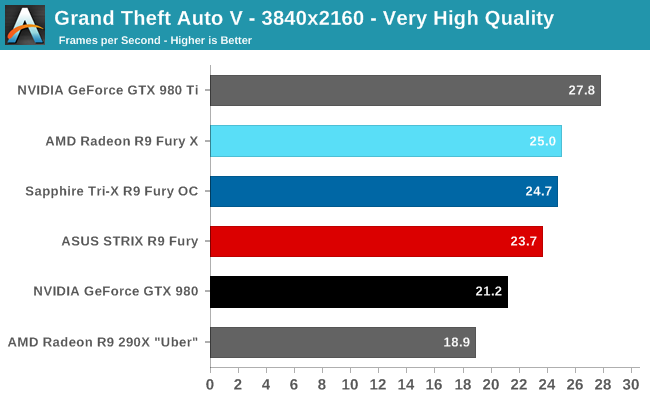
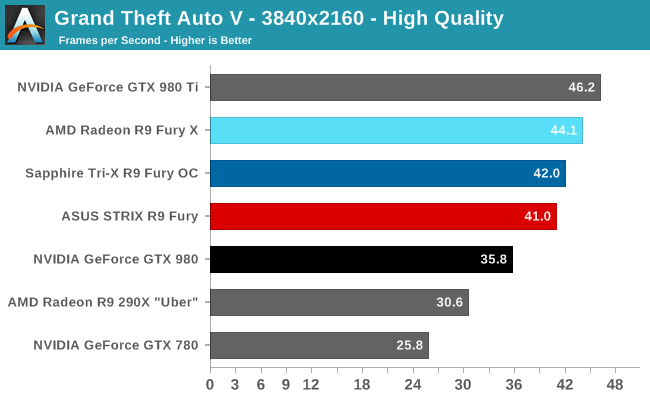
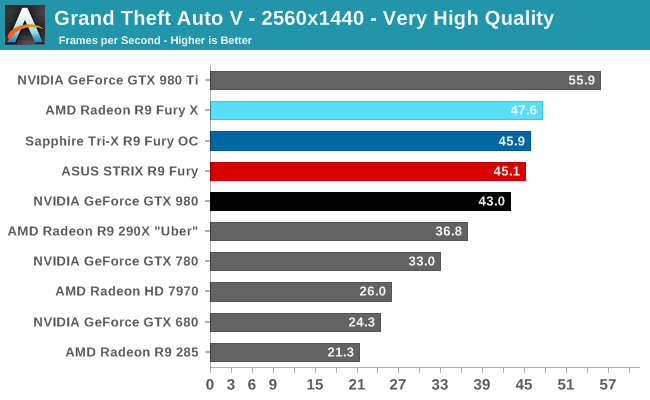
Closing out our gaming benchmarks, the R9 Fury is once again in the lead, besting the GTX 980 by as much as 15%. However GTA V also serves as a reminder that the R9 Fury doesn’t have quite enough power to game at 4K without compromises. And if we do shift back to 1440p, a more comfortable resolution for this card, AMD’s lead is down to just 5%. At that point the R9 Fury isn’t quite covering its price advantage.
Meanwhile compared to the R9 Fury X, we close out roughly where we started. The R9 Fury trails the more powerful R9 Fury X by 5-7% depending on the resolution, a difference that has more to do with GPU clockspeeds than the cut-down CU count. Overall the gap between the two cards has been remarkably consistent and surprisingly narrow.
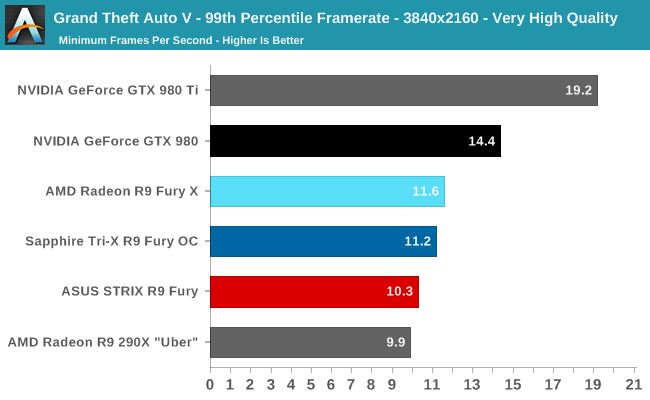
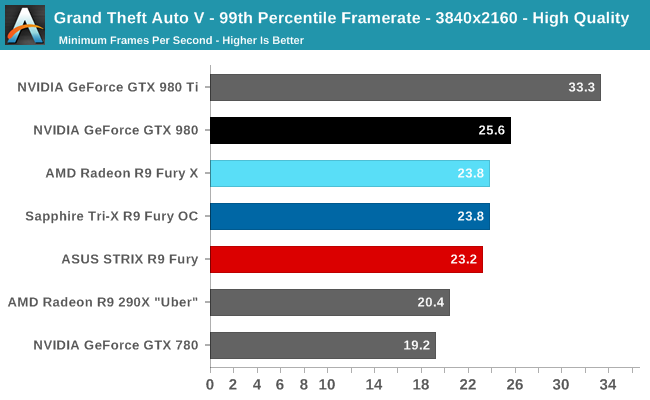
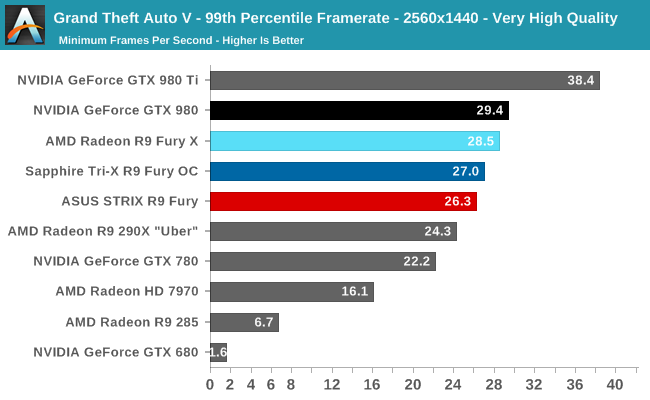
99th percentile framerates however are simply not in AMD’s favor here. Despite AMD’s driver optimizations and the fact that the GTX 980 only has 4GB of VRAM, the R9 Fury X could not pull ahead of the GTX 980, so the R9 Fury understandably fares worse. Even at 1440p the R9 Fury cards can’t quite muster 30fps, though in all fairness even the GTX 980 falls just short of this mark as well.
Originally published at https://www.anandtech.com/show/9421/the-amd-radeon-r9-fury-review-feat-sapphire-asus (Wayback Machine).