
Samsung SM951-NVMe (256GB) PCIe SSD Review
Performance Consistency
We've been looking at performance consistency since the Intel SSD DC S3700 review in late 2012 and it has become one of the cornerstones of our SSD reviews. Back in the days many SSD vendors were only focusing on high peak performance, which unfortunately came at the cost of sustained performance. In other words, the drives would push high IOPS in certain synthetic scenarios to provide nice marketing numbers, but as soon as you pushed the drive for more than a few minutes you could easily run into hiccups caused by poor performance consistency.
Once we started exploring IO consistency, nearly all SSD manufacturers made a move to improve consistency and for the 2015 suite, I haven't made any significant changes to the methodology we use to test IO consistency. The biggest change is the move from VDBench to Iometer 1.1.0 as the benchmarking software and I've also extended the test from 2000 seconds to a full hour to ensure that all drives hit steady-state during the test.
For better readability, I now provide bar graphs with the first one being an average IOPS of the last 400 seconds and the second graph displaying the standard deviation during the same period. Average IOPS provides a quick look into overall performance, but it can easily hide bad consistency, so looking at standard deviation is necessary for a complete look into consistency.
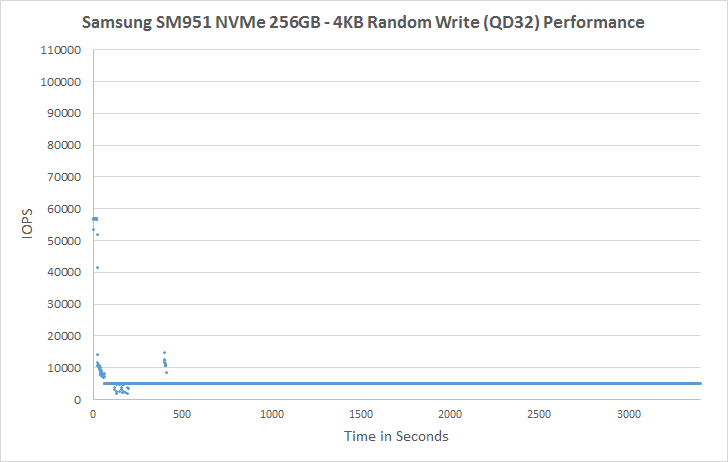
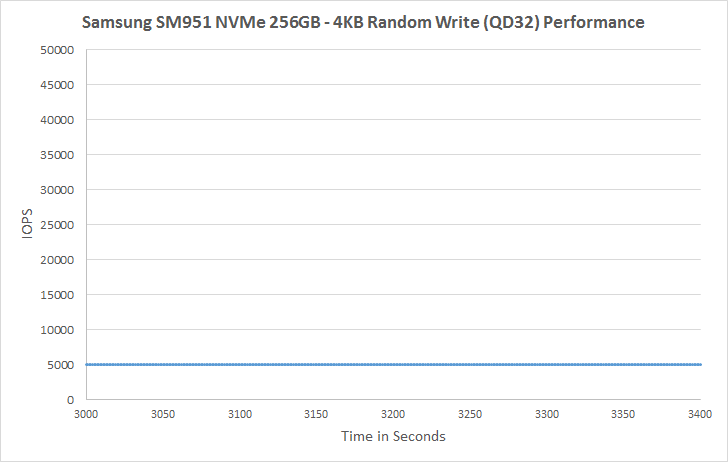
I'm still providing the same scatter graphs too, of course. However, I decided to dump the logarithmic graphs and go linear-only since logarithmic graphs aren't as accurate and can be hard to interpret for those who aren't familiar with them. I provide two graphs: one that includes the whole duration of the test and another that focuses on the last 400 seconds of the test to get a better scope into steady-state performance.
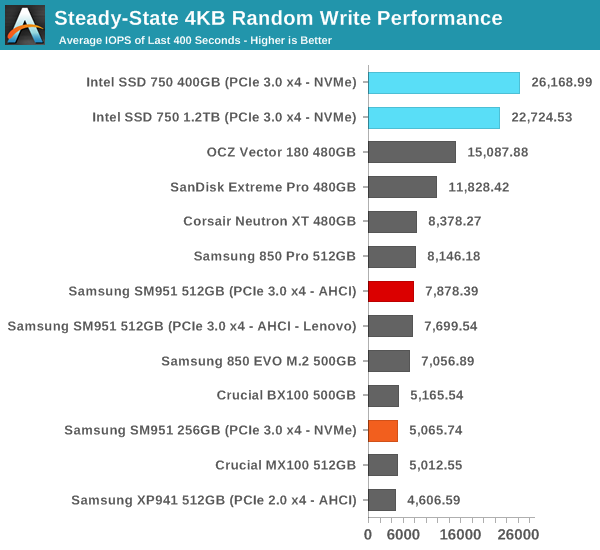
Steady-state performance isn't mind blowing, although it's a little unfair to compare the 256GB SM951-NVMe against a 512GB SM951-AHCI because available NAND throughput can play a major role in steady-state performance with a properly designed controller and firmware.
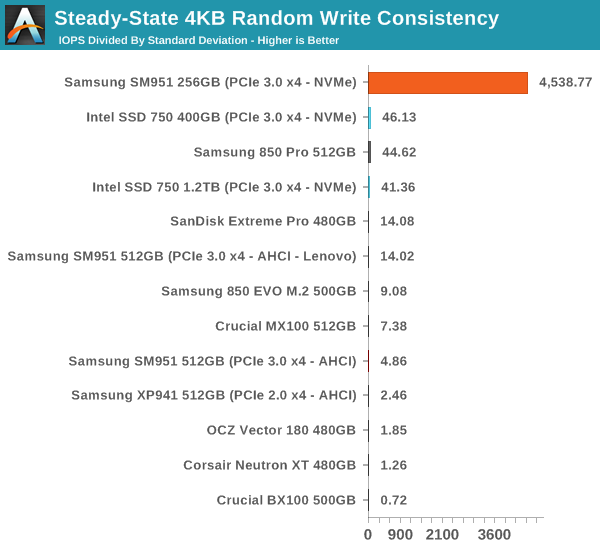
The mediocre steady-state performance is replaced by outstanding consistency, though. During the last 400 seconds, the SM951-NVMe has standard deviation of only 1.12, whereas the next drives are in the order of hundreds with many drives surpassing 1,000.
 |
|||||||||
| Default | |||||||||
As there's practically no variation in performance, the graph is just a straight line after the initial cliff. There are zero up and down swings, which is something I've yet to see even in an enterprise SSD. Samsung has always done well in IO consistency, but in all honesty the SM951-NVMe sets a new bar for consistency. On the downside, I would rather take some variation with higher performance because especially for client workloads such level of consistency isn't really needed, but increased performance can always help with intensive IO workloads. Nevertheless, I'm very happy with the direction Samsung is taking because we still see some controller vendors not paying enough attention to consistency, but it's clearly a high priority for Samsung.
Unfortunately I couldn't run any tests with added over-provisioning because the hdparm commands I use for limiting the capacity do not work with NVMe drives. There are similar commands for NVMe drives too, but for now there is no publicly available utility for issuing those commands.
 |
|||||||||
| Default | |||||||||
Originally published at https://www.anandtech.com/show/9396/samsung-sm951-nvme-256gb-pcie-ssd-review (Wayback Machine).