
The Intel Xeon E7-8800 v3 Review: The POWER8 Killer?
POWER8 Servers: The Reality Check
As we've just seen, the specs of the POWER8 as announced at launch are very impressive. But what about the in the real world? The top models (10-12 at 4 GHz+, 2TB per socket) are still limited to the extremely expensive E870/E880, which typically costs around 3 times as much (or more) as a comparable Xeon E7 system. But there is light at the end of the tunnel: "PowerLinux" quad socket systems are more expensive than comparable x86 systems, but only by 10 to 30%.
The real competition for x86 must probably come from the third parties of the OpenPower Fondation. IBM sells them POWER8 chips at much more reasonable prices ($2k - $3k), so it is possible to build a reasonably priced POWER8 system. The POWER8 chips sold to third parties are somewhat "lighter" versions, but that is more an advantage than you would think. For example, by keeping the clockspeed a bit lower, the power consumption is lower (190W TDP). These chips also have only 4 (instead of 8) memory buffer chips, which "limits" them to 1 TB of memory, but again this saves quite a bit of power, between 50W and 80W. In other words, the POWER8 chips available to third parties are much more reasonable and even more competitive than the power gobbling, ultra expensive behemoths that got all the attention at launch.
Tyan already has an one socket server and several Taiwanese (Wistron) and Chinese vendors are developing 2 socket systems. Quad socket models are not yet on the horizon as far as we know, but is probably going to change soon.
POWER8 vs. Xeon E5 v3: SPECing It Out
Unfortunately we did not have access to a full blown POWER8 system at this time. But as our loyal readers know, we do not limit our server testing to the x86 world (see here and here) . So until a POWER8 system arrives, we'll have to check out the available industry standard benchmarks. To that end we looked up the SPEC CPU2006 numbers for a single socket CPU.
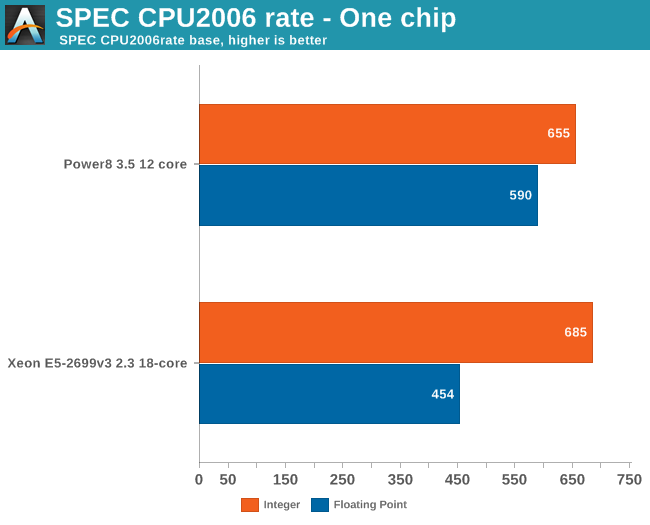
The 12 cores inside the POWER8 - the single socket chips found in the more reasonable priced servers - perform very well. The integer performance is only a few percentages lower than the Intel chip and POWER8's floating point performance is well ahead of the Xeon.
Overall the POWER8 is quite capable of keeping up with the Xeon E5-2699v3. And don't let the "2.3 GHz" official clockspeed fool you into thinking that the Xeons are clocked unnecessarily low, either: in SPECint, the XEON is running at 2.8 GHz most of the time.
Ultimately, the POWER8 is able to offer slightly higher raw performance than the Intel CPUs, however it just won't be able to do so at the same performance/watt. Meanwhile the reasonable pricing of the POWER8 chips should result in third party servers that are strongly competitive with the Xeon on a performance-per-dollar basis. Reasonably priced, well performing dual and quad socket Linux on Power servers should be possible very soon.
Originally published at https://www.anandtech.com/show/9193/the-xeon-e78800-v3-review (Wayback Machine).