
The Intel Xeon E7-8800 v3 Review: The POWER8 Killer?
HPC: OpenFoam
Computational Fluid Dynamics is a very important part of the HPC world. Several readers told us that we should look into OpenFoam, and my lab was able to work with the professionals of Actiflow. Actiflow specializes in combining aerodynamics and product design. Calculating aerodynamics involves the use of CFD software, and Actiflow uses OpenFoam to accomplish this. To give you an idea what these skilled engineers can do, they worked with Ferrari to improve the underbody airflow of the Ferrari 599 and increase its downforce.
We were allowed to use one of their test cases as a benchmark, but we are not allowed to discuss the specific solver. All tests were done on OpenFoam 2.2.1 and openmpi-1.6.3.
Many CFD calculations do not scale well on clusters, that is unless you use InfiniBand. InfiniBand switches are quite expensive and even then there are limits to scaling. We do not have an InfiniBand switch in the lab, unfortunately. Although it's not as low latency as InfiniBand, we do have a good 10G Ethernet infrastructure, which performs rather well. So we can compare our newest Xeon server with a basic cluster.
We also found AVX code inside OpenFoam 2.2.1, so we assume that this is one of the cases where AVX improves FP performance.
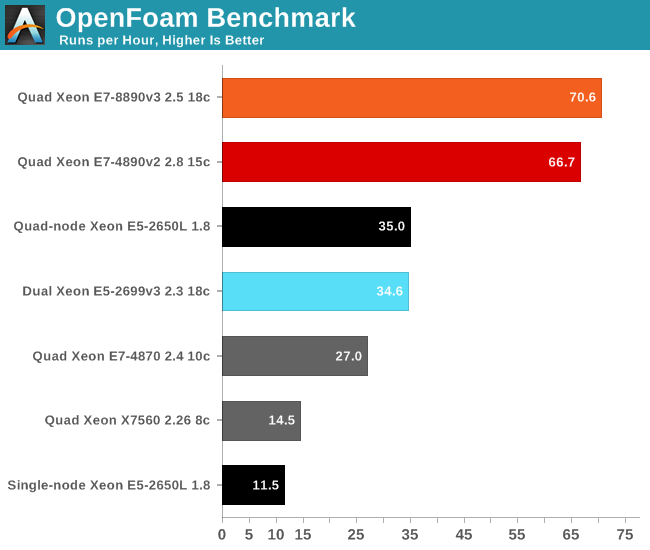
Unless you recompile and tune your code for AVX2, the new Xeon E7 v3 is hardly faster than the previous one. The reason may be that the new Xeon can sometimes go as low as 2.1 GHz running AVX code due to the immense power load AVX2 workloads can cause, while the older E7 v2 is capable of sustaining 2.8 GHz.
Originally published at https://www.anandtech.com/show/9193/the-xeon-e78800-v3-review (Wayback Machine).