
The Intel Xeon D Review: Performance Per Watt Server SoC Champion?
- Posted in
- CPUs
- Intel
- Xeon-D
- Broadwell-DE
Single-Threaded Integer Performance
The LZMA compression benchmark only measures a part of the performance of some real-world server applications (file server, backup, etc.). The reason why we keep using this benchmark is that it allows us to isolate the "hard to extract instruction level parallelism (ILP)" and "sensitive to memory parallelism and latency" integer performance. That is the kind of integer performance you need in most server applications.
One more reason to test performance in this manner is that the 7-zip source code is available under the GNU LGPL license. That allows us to recompile the source code on every machine with the -O2 optimization with gcc 4.8.2.
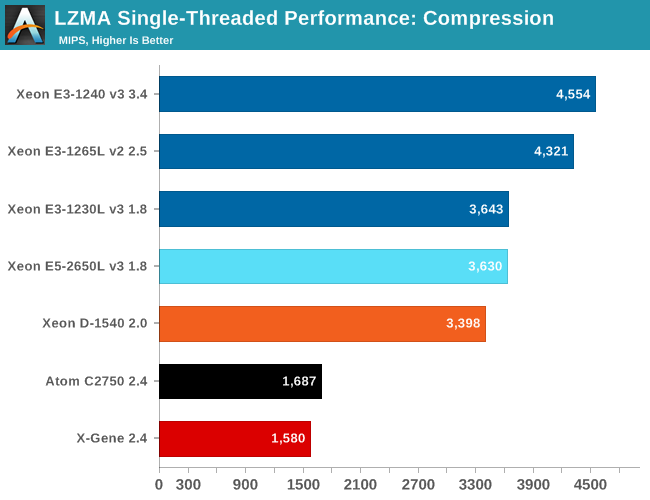
The Xeon E5-2650L Haswell core is only able to boost to 2.5 GHz, while the Xeon D has a newer core (Broadwell) and is capable of 2.6 GHz. Still, the Xeon E5 is 6% faster. The most likely explanation is that the Xeon E5-2650L (65W TDP) keeps turboboost higher for a longer time than the Xeon D (45W TDP).
The Xeon D and Atom C2750 run at the same clockspeed in this single threaded task (2.6 GHz), but you can see how much difference a wide complex architecture makes. The Broadwell Core is able to run about twice as many instructions in parallel as the Silvermont core. The Haswell/Broadwell core results clearly show that well designed wide architectures remain quite capable, even in "low ILP" (Instruction Level Parallelism) code.
Let's see how the chips compare in decompression. Decompression is an even lower IPC (Instructions Per Clock) workload, as it is pretty branch intensive and depends on the latencies of the multiply and shift instructions.
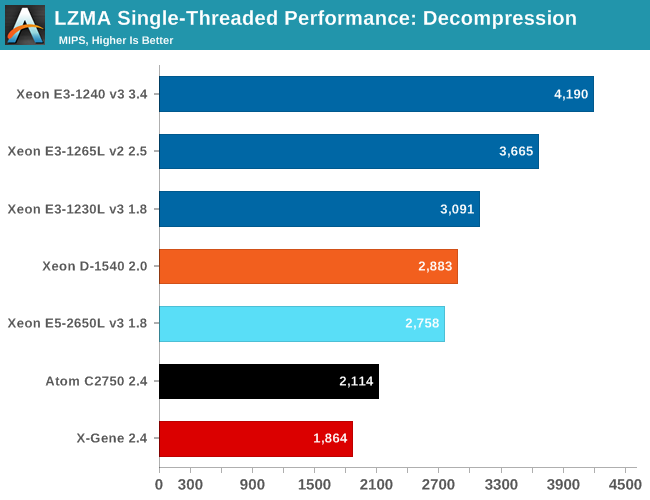
The Xeon E5 runs at 2.5 GHz, the Xeon D at 2.6 GHz, the Xeon E3-1230L at 2.8 GHz, The Xeon E3-1265L can reach 3.7 GHz. The decompression results follow the same logic. There does not seem to be a difference between a Broadwell, Haswell or Ivy Bridge core: performance is almost linear with (turboboost) clockspeed. The only exception is the Xeon E3-1240 which turboboost to 3.8 GHz, but outperforms the other by a larger than expected. The explanation is pretty simple: the higher TDP (80 W) allows the chip to sustain turbo boost clock speeds for much longer.
Originally published at https://www.anandtech.com/show/9185/intel-xeon-d-review-performance-per-watt-server-soc-champion (Wayback Machine).