
The Intel Xeon D Review: Performance Per Watt Server SoC Champion?
- Posted in
- CPUs
- Intel
- Xeon-D
- Broadwell-DE
Memory Subsystem: Bandwidth
As more memory channels complicate motherboard design and can be a problem for dense servers, the Xeon-D, Xeon E3 and Atom C2000 only have two memory channels. This makes quad channel operation a good way to differentiate up to the Xeon E5. The Xeon E3 and Atom are limited to DDR3-1600 as per JEDEC specifications, whereas the Xeon D should be able to command more bandwidth due to the use of DDR4-2133 DIMMs.
We measured the memory bandwidth in Linux. The binary was compiled with the Open64 compiler 5.0 (Opencc). It is a multi-threaded, OpenMP based, 64-bit binary. The following compiler switches were used:
-Ofast -mp -ipa
To keep things simple, we only report the Triad sub-benchmark of our OpenMP enabled Stream benchmark.
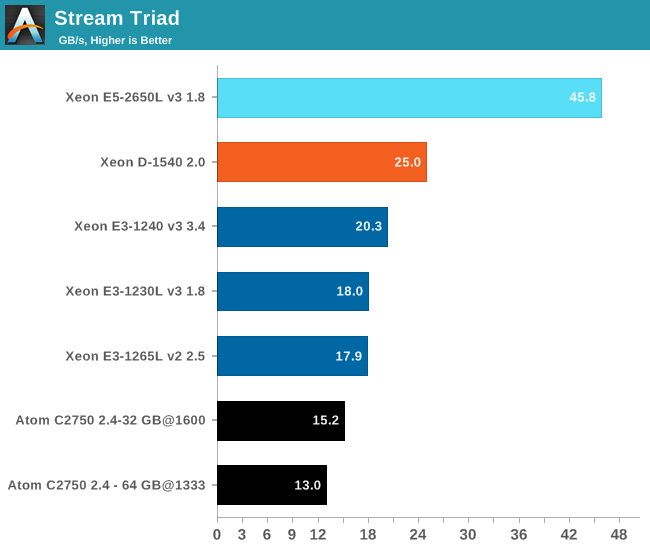
Using DIMMs with a 33% higher clock, the Xeon D gets a 25-38% boost in bandwidth compared to the Xeon E3. Basically, every percent increase in clock speed is translated in higher bandwidth. The Xeon E5 has almost twice as much bandwidth for only 50% more cores and should as result do better in some bandwidth intensive applications (mostly HPC).
Originally published at https://www.anandtech.com/show/9185/intel-xeon-d-review-performance-per-watt-server-soc-champion (Wayback Machine).