
The Next Generation Open Compute Hardware: Tried and Tested
Networking
Server contributions aren't the only things happening under the Open Compute project. Over the last couple of years a new focus on networking was added. Accton, Alpha Networks, Broadcom, Mellanox and Intel have each released a draft specification of a bare-metal switch to the OCP networking group. The premise of standardized bare-metal switches is simple: you can source standard switch models from multiple vendors, and run the OS of your choosing on it, along with your own management tools like Puppet. No lock-in and almost no migration path to be concerned with when implementing different equipment.
To that end, Facebook created Wedge, a 40G QSFP+ ToR switch together with the Linux-based FBOSS switch operating system to spur development in the switching industry, and, as always, to offer a better value for the price. FBOSS (along with Wedge) was recently open sourced, and in the process accomplished something far bigger: convincing Broadcom to release OpenNSL, an open SDK for their Trident II switching ASIC. Wedge's main purpose is to decrease vendor dependency (e.g. choose between an Intel or ARM CPU, choice of switching silicon) and allow consistency across part vendors. FBOSS lets the switch be managed with Facebook's standard fleet management tools. And it's not Facebook alone who can play with Wedge anymore, as Accton announced it will bring a Wedge based switch to market.
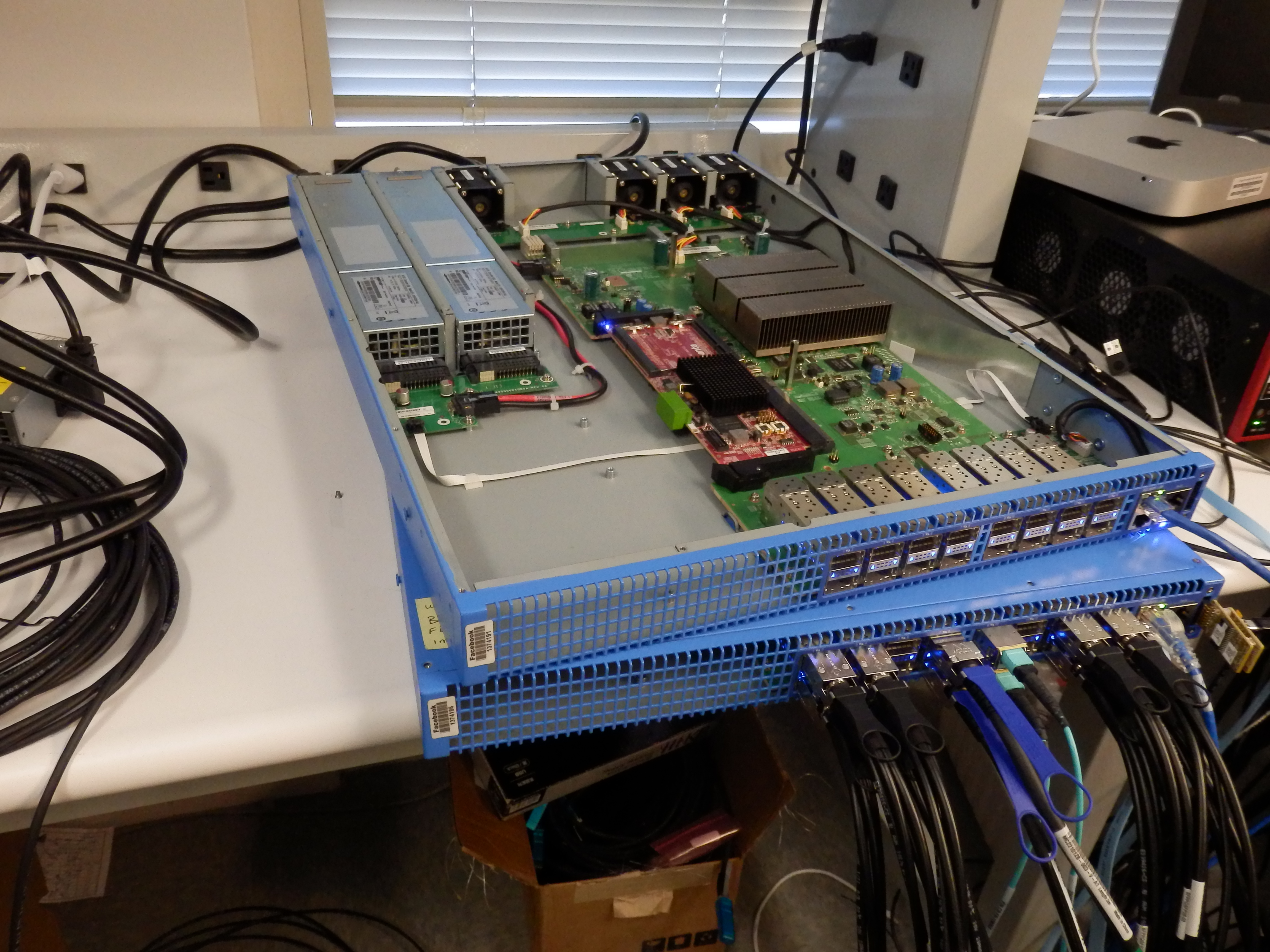
Facebook Wedge in all its glory
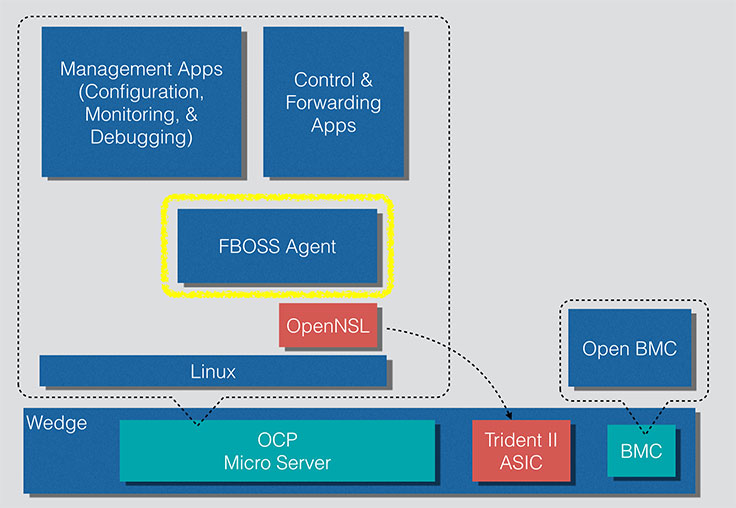
Logical structure of the Wedge software stack
But in Facebook's leaf-spine network design, you need some heavier core switches as well, connecting all the individual ToR switches to build the datacenter fabric. Traditionally those high-capacity switches are sold by the big network gear vendors like Cisco and Juniper, and at no small cost. You might then be able to guess what happens next: a few days ago Facebook launched '6-pack', its modular, high-capacity switch.
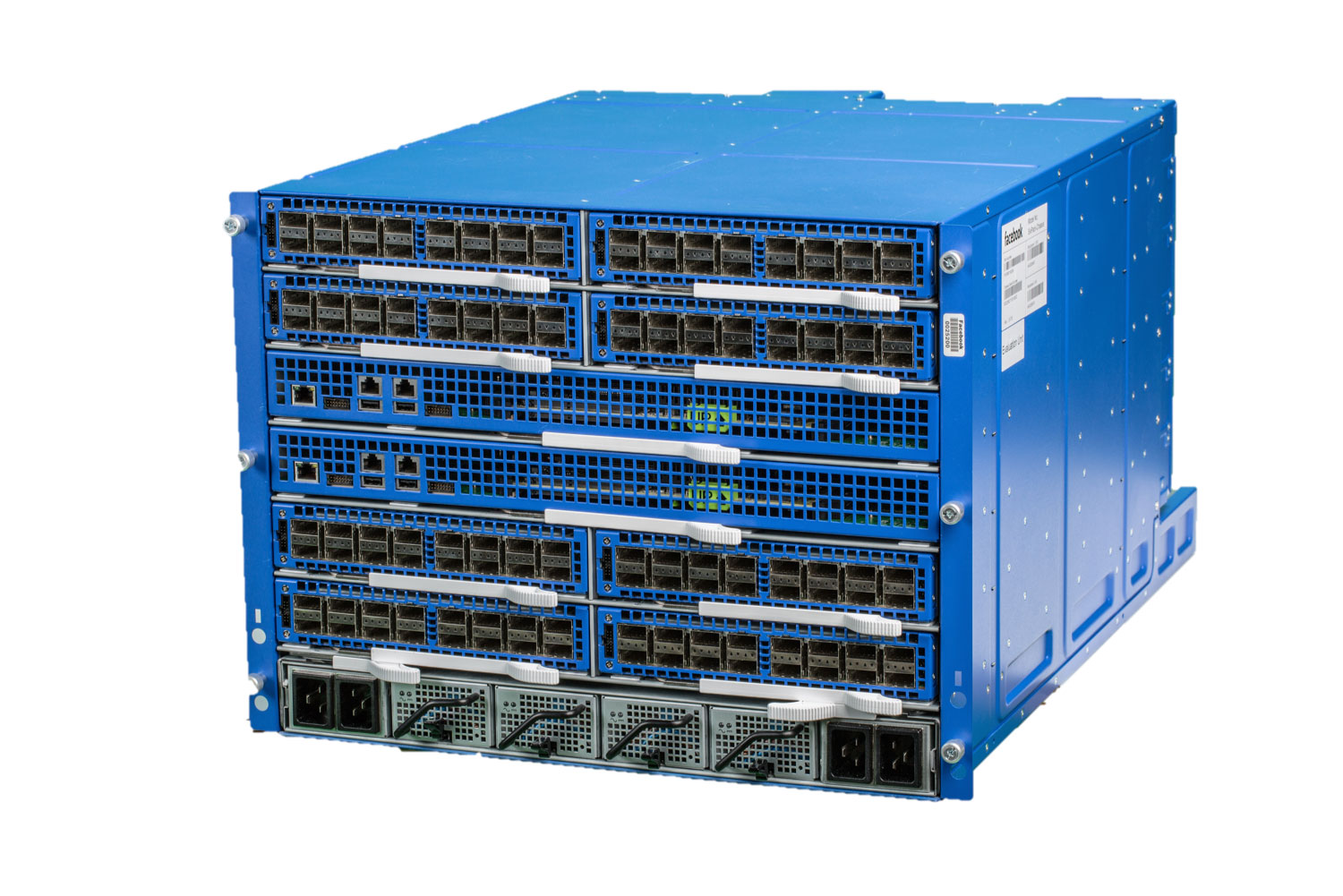
Facebook 6-pack, with 2 groups of line/fabric cards
A '6-pack' switch consists of two module types: line cards and fabric cards. A line card is not so different from a Wegde ToR switch, where 16 40GbE QSFP+ ports at the front are supplied with 640Gbps of the 1.2Tbps ASIC's switching capacity; the main difference with Wedge is the remaining 640Gbps is linked to a new backside Ethernet-based interconnect, all in a smaller form factor. The line card also has a Panther micro server with BMC for ASIC management. In the chassis, there are two rows of two line cards in one group, each operating independently of the other.
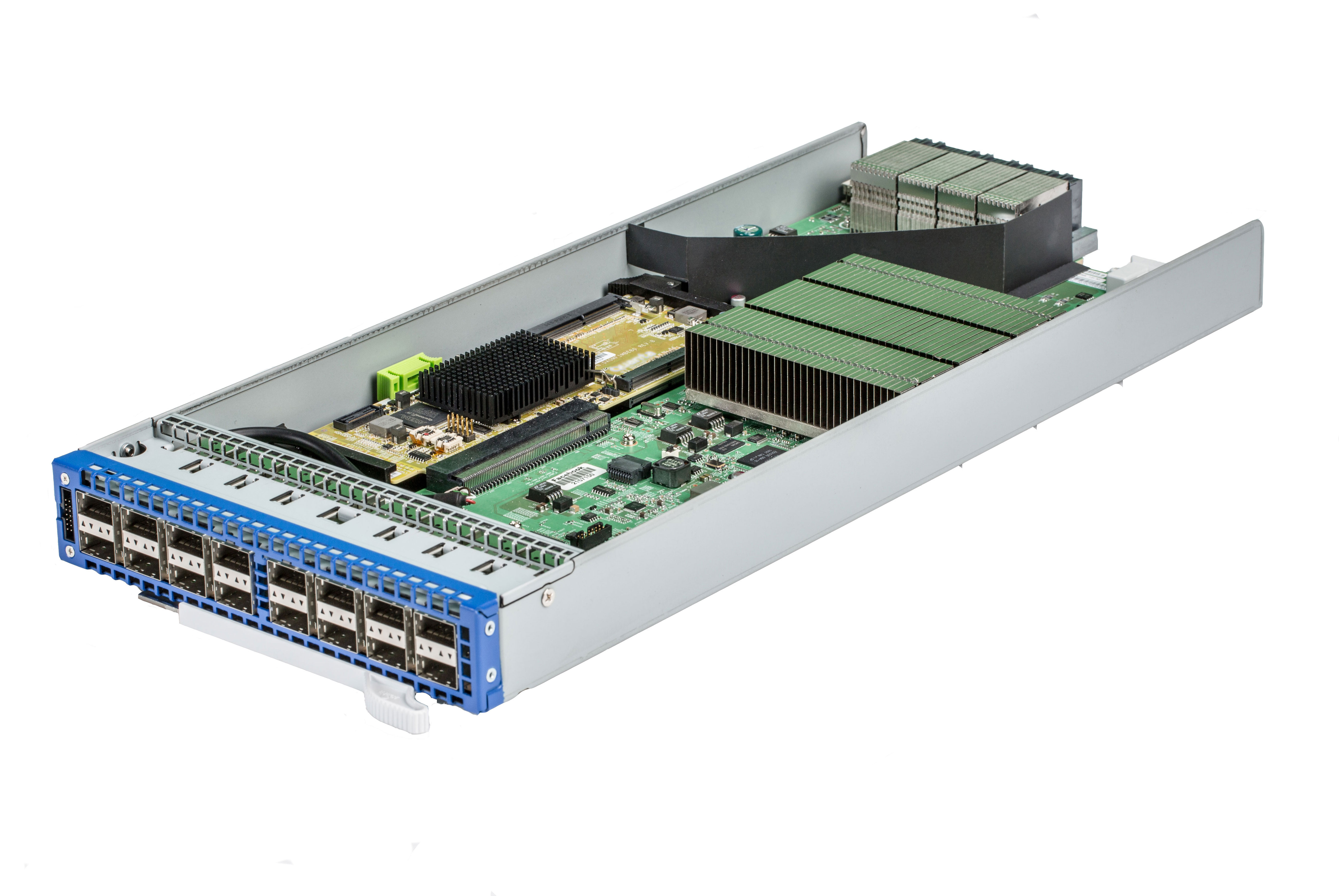
Line card (note the debug header pins left to the QSFP+ ports)
The fabric card is the bit connecting all of the line cards together, and thus the center part of the fabric. Though the fabric switch appears to be one module, it actually contains two switches (two 1.2Tbps packet crunchers, each paired to a Panther microcontroller), and like the line cards, they operate separate from each other. The only thing being shared is the management networking path, used by the Panthers and their BMCs, along with the management ports for each of the line cards.
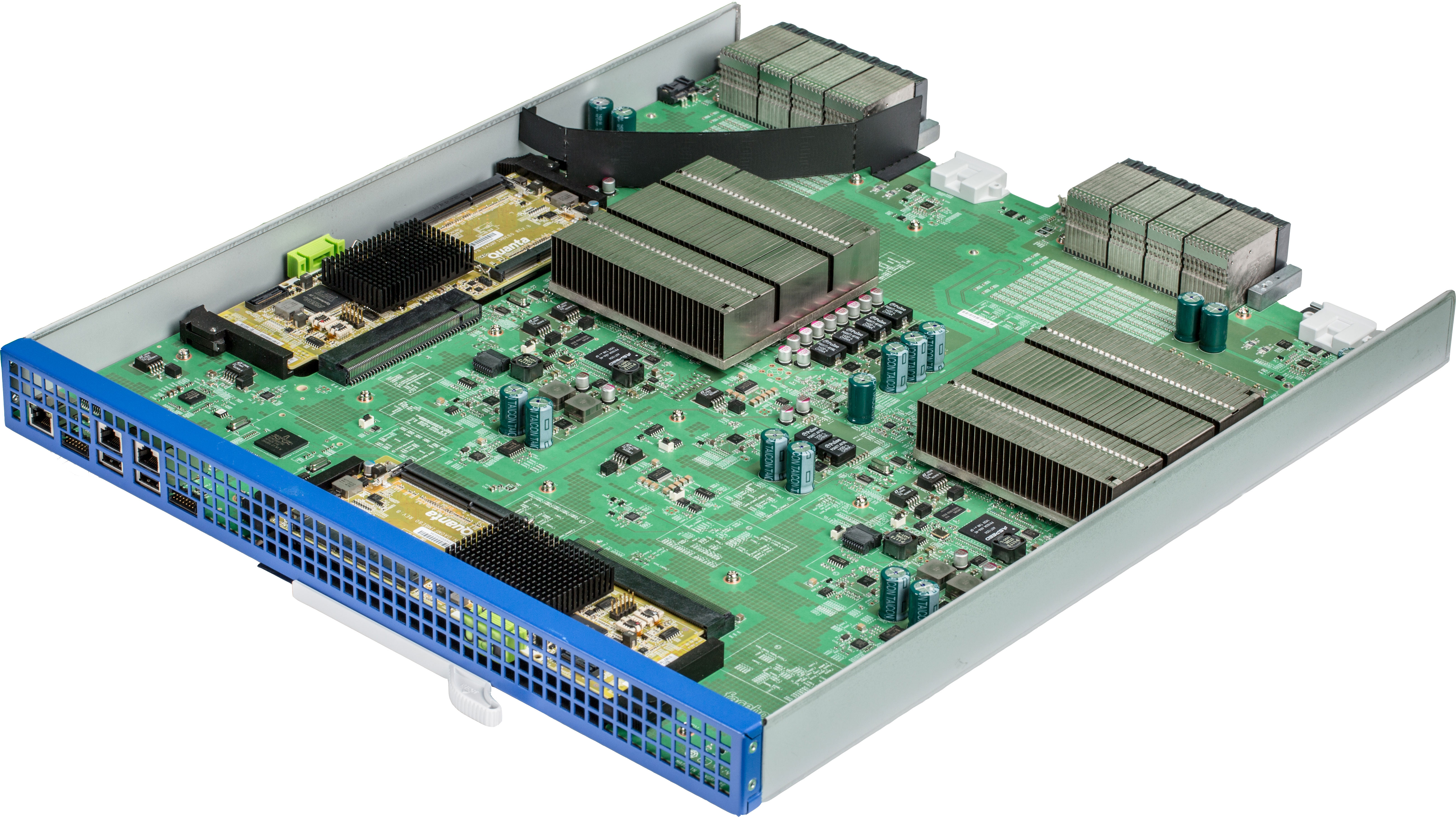
Fabric card, with management ports and debug headers for the Panther cards
With these systems, Facebook has come a long way towards making its entire datacenter networking built with open, commodity components and running it using open software. The networking vendors are likely to notice these developments, and not only because of their pretty blue color.
ONIE
An effort to increase modularity even more is ONIE, short for the Open Network Install Environment. ONIE is focused on eliminating operating system lock-in by providing an environment for installing common operating systems like CentOS and Ubuntu on your switching equipment. ONIE is baked into the switch firmware, and after installation the onboard bootloader (GRUB) directly boots the OS. But before you start writing your Puppet or Chef recipes to manage your switches, a small but important side-note needs to be added: to operate the switching silicon of the Trident ASIC you need a proprietary firmware blob from Broadcom. And up until very recently, Broadcom would not give you the firmware blob unless you have some kind of agreement with them. This is why, currently, the only OSs you can install on ONIE enabled switches are commercial OSes like BigSwitch and Cumulus, who have agreements in place with the silicon vendors.
Luckily, Microsoft, Dell, Facebook, Broadcom, Intel and Mellanox have started work on a Switch Abstraction Interface (proposals), which would obviate the need for any custom firmware blobs and allow standard cross-vendor compatibility, though it remains to be seen to which degree this can completely replace proprietary firmware.
Originally published at https://www.anandtech.com/show/9138/open-compute-hardware-tried-and-tested (Wayback Machine).