
Analyzing Intel Core M Performance: How 5Y10 can beat 5Y71 & the OEMs' Dilemma
Cinebench R15 Single-Threaded Results
Cinebench will run the CPU up to 100% load for the duration of the test. As this is the single-threaded run, only one core will be active, which should in theory provide more headroom for that one core than when all cores (physical and virtual) are loaded. There is no burst workload here at all, and sustained single-threaded performance is the key for this test.
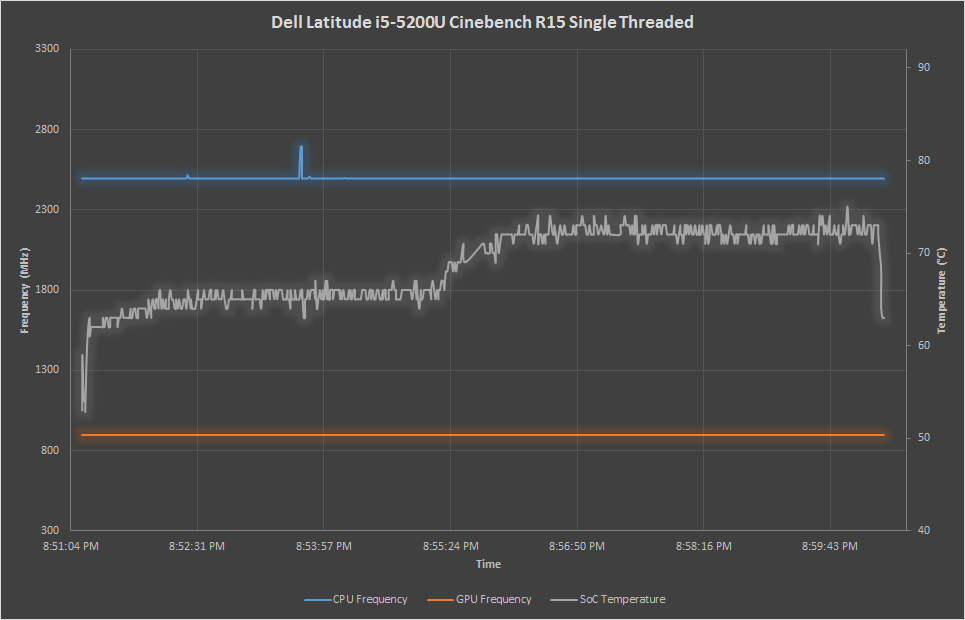
The Core i5 does exactly what would be expected for this benchmark. With just a single core loaded, the cooling system has no issues keeping the CPU from throttling. It maintains an extremely consistent CPU frequency during the run. This cannot be said of the two Core M-5Y71 devices though. The Dell Venue 11 Pro starts off with quite a high frequency, but as the temperature increases, the CPU drops in frequency to keep below the threshold of 90°C set on the SoC. At any opportunity, it increases its CPU frequency to try to increase performance, but generally that does not last for very long, and it ends up falling back down. The Yoga 3 Pro on the other hand, has a much lower allowed SoC temperature, with Lenovo locking in on 65°C as their maximum target temperature. This keeps the frequency down.
The ASUS Zenbook has an entirely flat CPU line though. The excellent heat dissipation of the chassis allows it to run for the duration of the benchmark with no throttling at all. It has to be noted though that the maximum CPU frequency is a quite a bit lower than the 5Y71 devices, topping out at 2.0 GHz versus 2.9 GHz for 5Y71. It would be very interesting to see how the UX305 would do with the faster CPU inside, and if it would run into throttling issues as well.
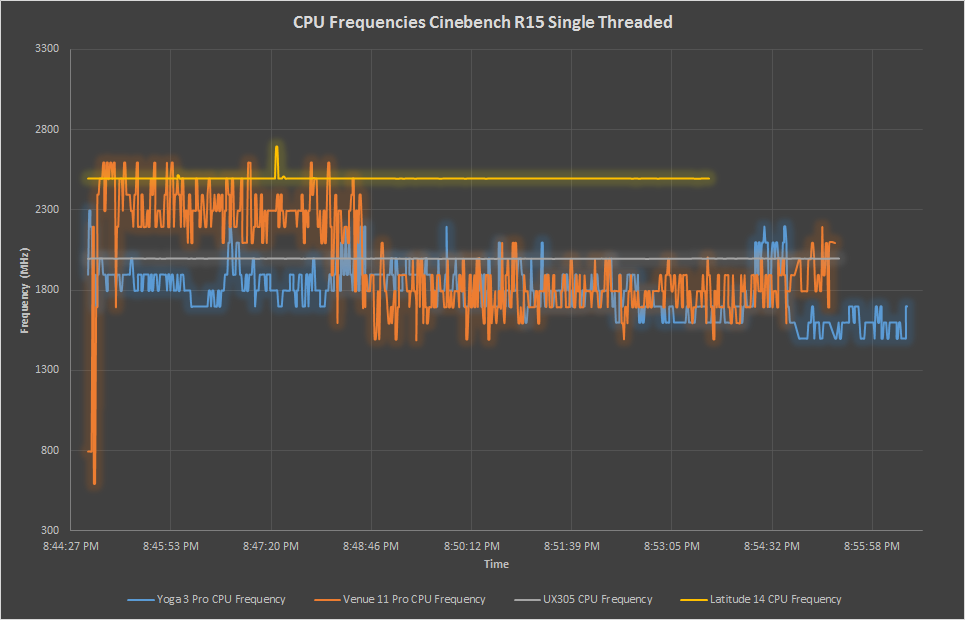
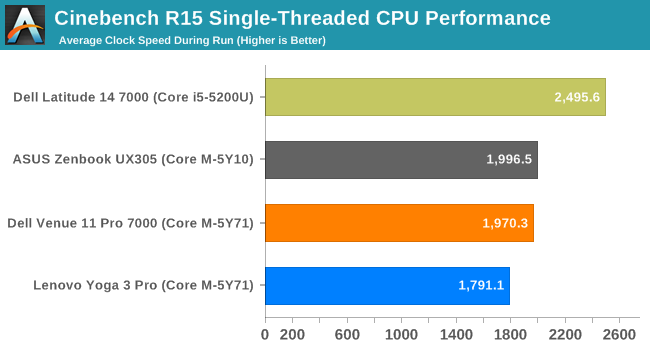
Looking at the average CPU frequency over the run shows that the i5 clearly has the most headroom, which is not surprising. Averages are only part of the story though, with both of the 5Y71 devices being able to jump past the 5Y10's frequency several times during the test.
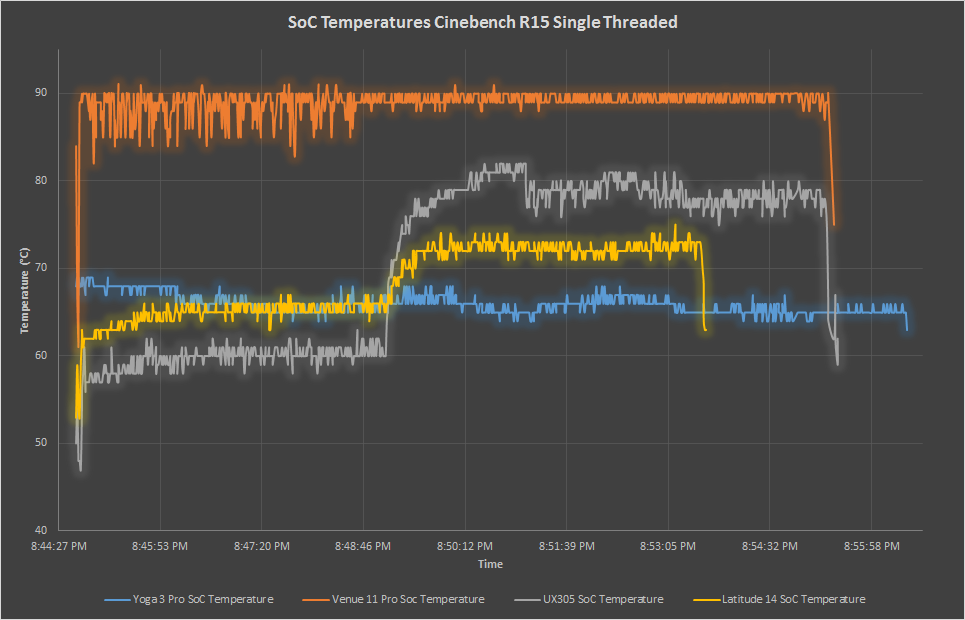
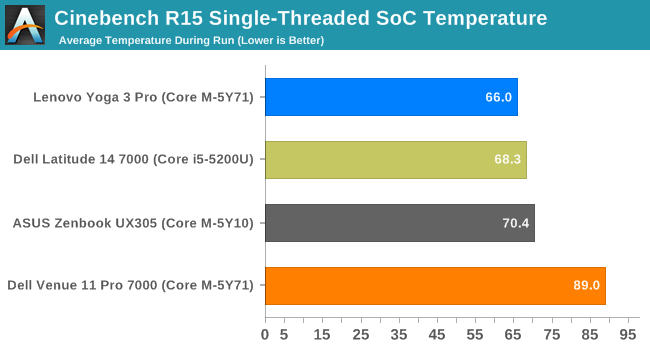
Looking at temperatures, it's interesting to note that the Dell Venue 11 Pro has the top-tier Core M-5Y71, but it puts that processor in what is the smallest chassis and with a plastic exterior. Consequently it quickly loads up to its maximum temperature and stays there for the duration. The rest of the devices stay much cooler with just a single core loaded.
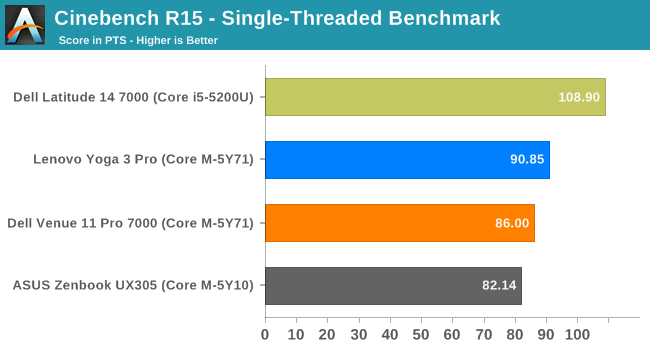
Here we have the actual benchmark results. On single-threaded workloads, the 5Y71 can and does outperform 5Y10. Despite the average CPU frequencies being lower on both 5Y71 devices, they had enough headroom when necessary to jump past the very consistent 5Y10. None of them can match the Core i5 in this test. It is actually very interesting that the highest scoring Core M in this test has the lowest average CPU frequency.
Originally published at https://www.anandtech.com/show/9117/analyzing-intel-core-m-performance (Wayback Machine).