
Intel SSD 750 PCIe SSD Review: NVMe for the Client
Sequential Read Performance
Our sequential tests are conducted in the same manner as our random IO tests. Each queue depth is tested for three minutes without any idle time in between the tests and the IOs are 4K aligned similar to what you would experience in a typical desktop OS.
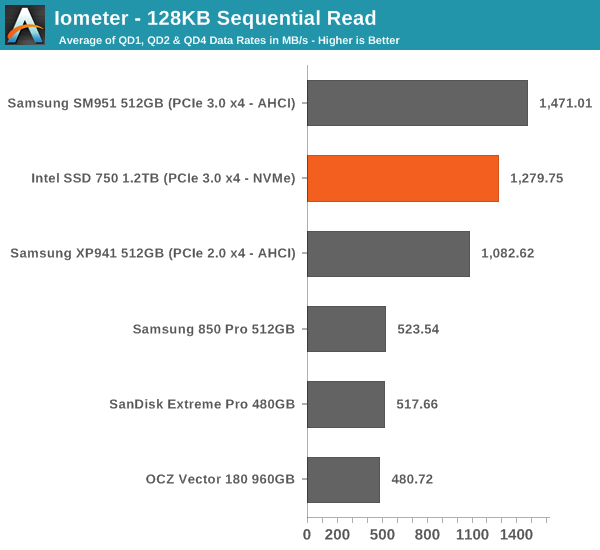
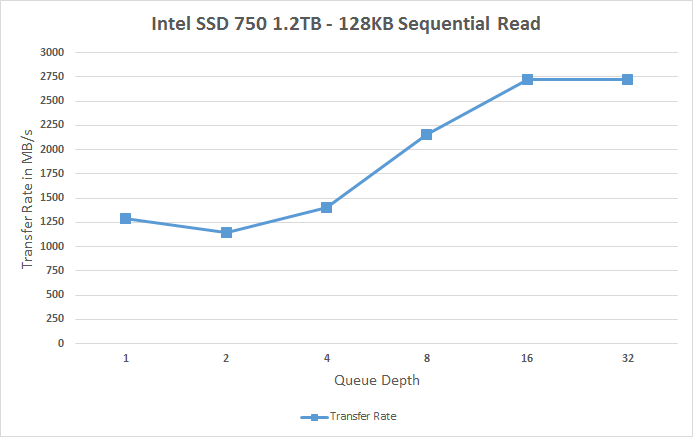
In sequential read performance the SM951 keeps its lead. While the SSD 750 reaches up to 2.75GB/s at high queue depths, the scaling at small queue depths is very poor. I think this is an area where Intel should have put in a little more effort because it would translate to better performance in more typical workloads.
 |
|||||||||
Sequential Write Performance
Sequential write testing differs from random testing in the sense that the LBA span is not limited. That's because sequential IOs don't fragment the drive, so the performance will be at its peak regardless.
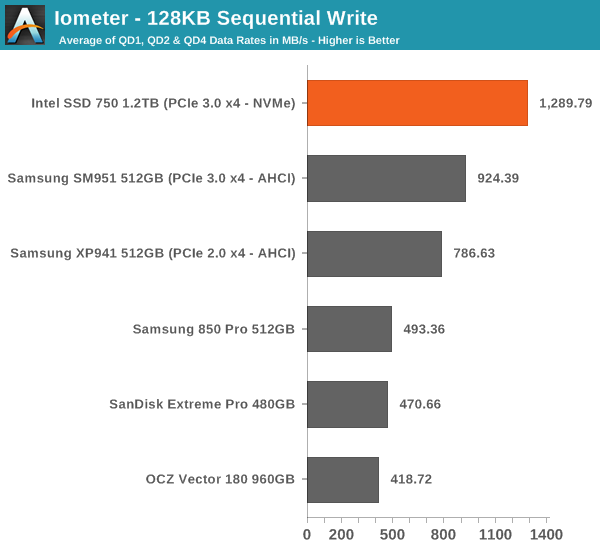
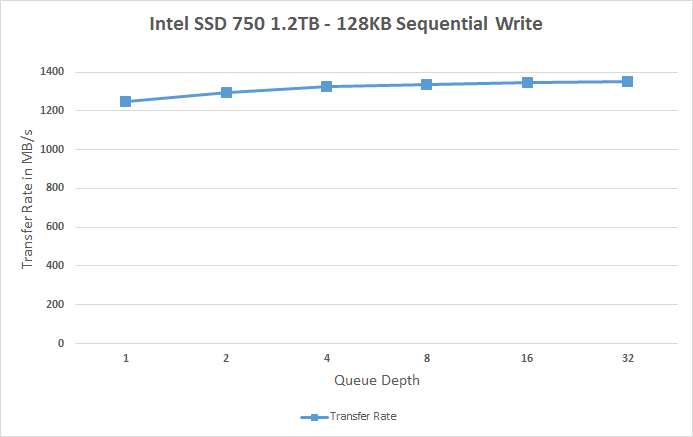
The SSD 750 is faster in sequential writes than the SM951, but the difference isn't all that big when you take into account that the SSD 750 has more than twice the amount of NAND. The SM951 did have some throttling issues as you can see in the graph below and I bet that with a heatsink and proper cooling the two would be quite identical because at queue depth of 1 the SSD 750 is only marginally faster. It's again a bit disappointing that the SSD 750 isn't that well optimized for sequential IO because there's prcatically no scaling at all and the drive maxes out at ~1350MB/s.
 |
|||||||||
Originally published at https://www.anandtech.com/show/9090/intel-ssd-750-pcie-ssd-review-nvme-for-the-client (Wayback Machine).