
The NVIDIA GeForce GTX Titan X Review
Middle Earth: Shadow of Mordor
Our next benchmark is Monolith’s popular open-world action game, Middle Earth: Shadow of Mordor. One of our current-gen console multiplatform titles, Shadow of Mordor is plenty punishing on its own, and at Ultra settings it absolutely devours VRAM, showcasing the knock-on effect of current-gen consoles have on VRAM requirements.
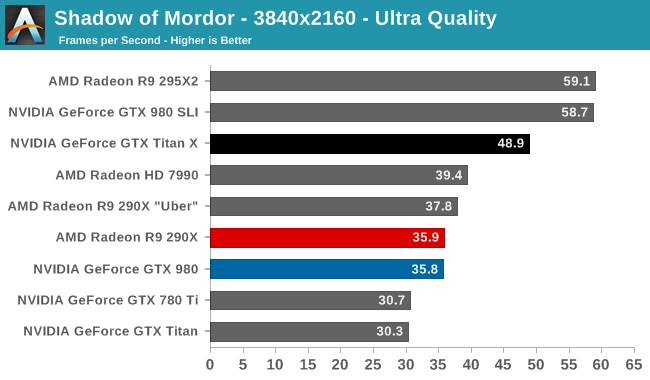
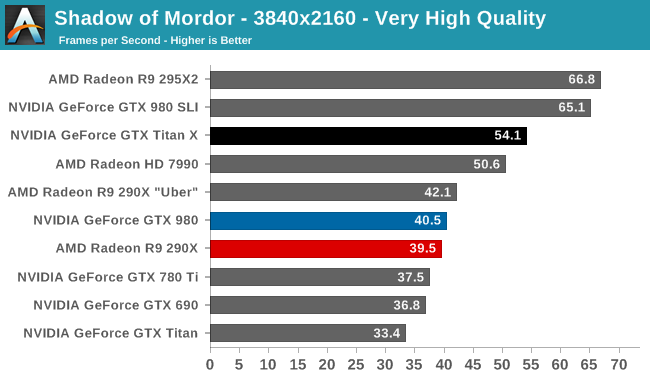
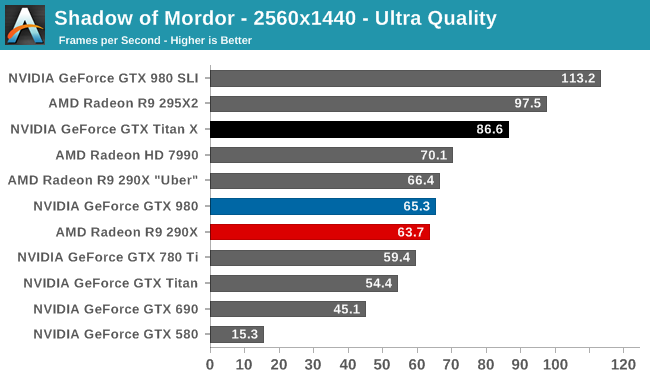
Once again even GTX Titan X won’t be enough for 60fps at 4K, but at 48.9fps it’s closer to 60fps than 30fps, representing a significant improvement in 4K performance in only a generation. Compared to the GTX 980 and NVIDIA’s other cards the GTX Titan X is once more in a comfortable lead, overtaking its smaller sibling by around 33% and the older GK110 cards at 45-60%.
Turning down the game’s quality settings to Very High does improve performance a bit, but at 54.1fps it’s still not quite enough for 60fps. The biggest advantage of Very High quality is alleviating some of the high VRAM requirements, something the GTX Titan cards don’t suffer from in the first place. Otherwise dropping to 1440p will give us a significant bump in performance, pushing framerates over 80fps once again.
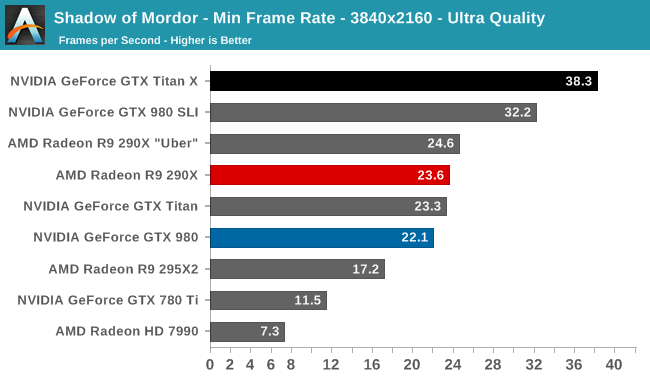
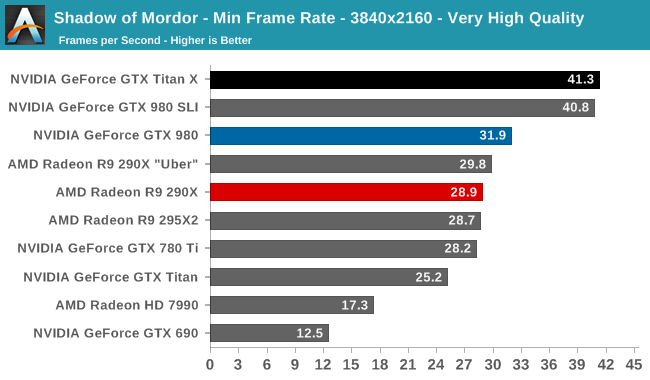
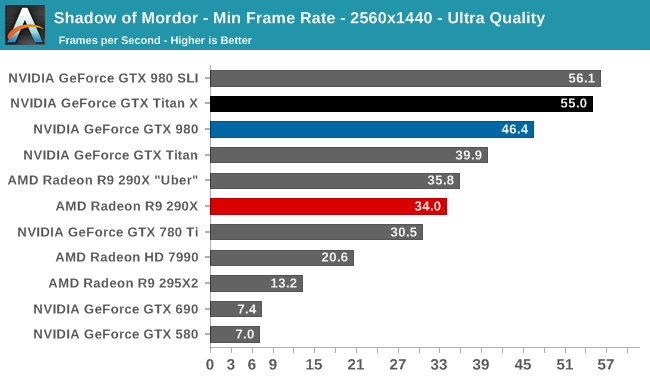
Meanwhile the game’s minimum framerate further elaborates on the performance hit from the game’s high VRAM usage at Ultra quality. 3GB cards collapse here, leaving the 4GB cards and the 6GB original Titan much higher in our charts. Multi-GPU performance also struggles here, even with 4GB cards, reminding us that while multi-GPU setups can be potent, they do introduce performance consistency issues that single-GPU cards can avoid.
Originally published at https://www.anandtech.com/show/9059/the-nvidia-geforce-gtx-titan-x-review (Wayback Machine).