
The OCZ Vector 180 (240GB, 480GB & 960GB) SSD Review
- Posted in
- Storage
- SSDs
- OCZ
- Barefoot 3
- Vector 180
Performance Consistency
We've been looking at performance consistency since the Intel SSD DC S3700 review in late 2012 and it has become one of the cornerstones of our SSD reviews. Back in the days many SSD vendors were only focusing on high peak performance, which unfortunately came at the cost of sustained performance. In other words, the drives would push high IOPS in certain synthetic scenarios to provide nice marketing numbers, but as soon as you pushed the drive for more than a few minutes you could easily run into hiccups caused by poor performance consistency.
Once we started exploring IO consistency, nearly all SSD manufacturers made a move to improve consistency and for the 2015 suite, I haven't made any significant changes to the methodology we use to test IO consistency. The biggest change is the move from VDBench to Iometer 1.1.0 as the benchmarking software and I've also extended the test from 2000 seconds to a full hour to ensure that all drives hit steady-state during the test.
For better readability, I now provide bar graphs with the first one being an average IOPS of the last 400 seconds and the second graph displaying the standard deviation during the same period. Average IOPS provides a quick look into overall performance, but it can easily hide bad consistency, so looking at standard deviation is necessary for a complete look into consistency.
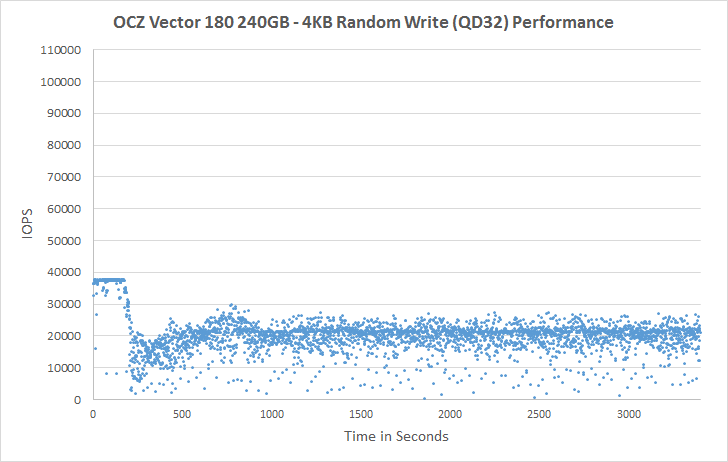
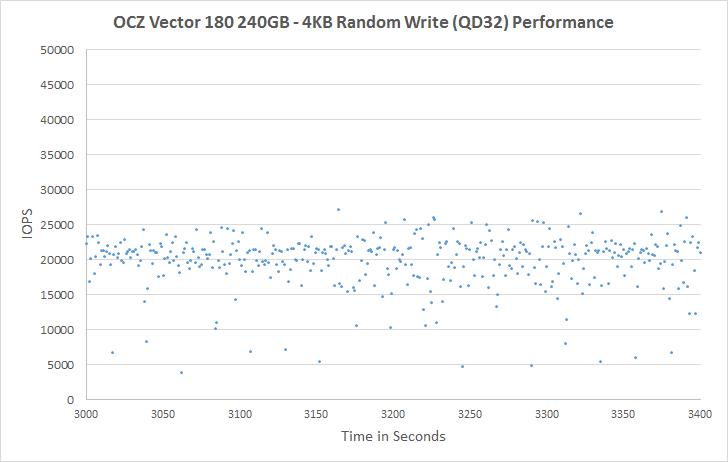
I'm still providing the same scatter graphs too, of course. However, I decided to dump the logarithmic graphs and go linear-only since logarithmic graphs aren't as accurate and can be hard to interpret for those who aren't familiar with them. I provide two graphs: one that includes the whole duration of the test and another that focuses on the last 400 seconds of the test to get a better scope into steady-state performance.
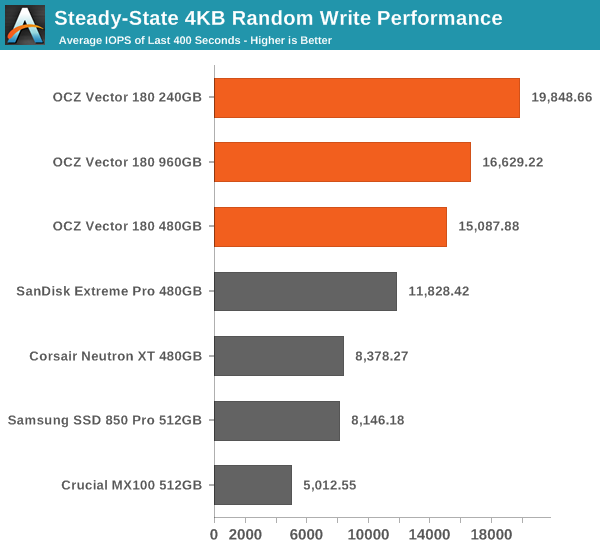
Barefoot 3 has always done well in steady-state performance and the Vector 180 is no exception. It provides the highest average IOPS by far and the advantage is rather significant at ~2x compared to other drives.
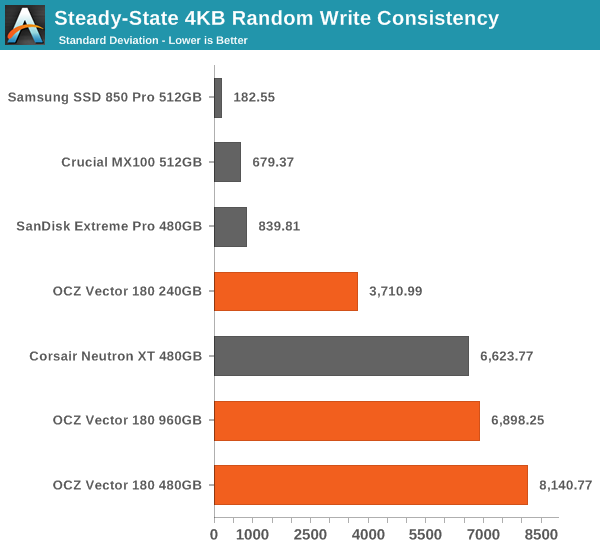
But on the down side, the Vector 180 also has the highest variation in performance. While the 850 Pro, MX100 and Extreme Pro are all slower in terms of average IOPS, they are a lot more consistent and what's notable about the Vector 180 is how the consistency decreases as the capacity goes up.
 |
|||||||||
| Default | |||||||||
| 25% Over-Provisioning | |||||||||
Looking at the scatter graph reveals the source of poor consistency: the IOPS reduce to zero or near zero even before we hit any type of steady state. This is known behavior of the Barefoot 3 platform, but what's alarming is how the 480GB and 960GB drives frequently drop to zero IOPS. I don't find that acceptable for a modern high-end SSD, no matter how good the average IOPS is. Increasing the over-provisioning helps a bit by shifting the dots up, but it's still clear that 240GB is the optimal capacity for Barefoot 3 because after that the platform starts to run into issues with consistency due to metadata handling.
 |
|||||||||
| Default | |||||||||
| 25% Over-Provisioning | |||||||||
Originally published at https://www.anandtech.com/show/9009/ocz-vector-180-240gb-480gb-960gb-ssd-review (Wayback Machine).