
Samsung SM951 (512GB) PCIe SSD Review
Mixed Random Read/Write Performance
Mixed read/write tests are also a new addition to our test suite. In real world applications a significant portion of workloads are mixed, meaning that there are both read and write IOs. Our Storage Bench benchmarks already illustrate mixed workloads by being based on actual real world IO traces, but until now we haven't had a proper synthetic way to measure mixed performance.
The benchmark is divided into two tests. The first one tests mixed performance with 4KB random IOs at six different read/write distributions starting at 100% reads and adding 20% of writes in each phase. Because we are dealing with a mixed workload that contains reads, the drive is first filled with 128KB sequential data to ensure valid results. Similarly, because the IO pattern is random, I've limited the LBA span to 16GB to ensure that the results aren't affected by IO consistency. The queue depth of the 4KB random test is three.
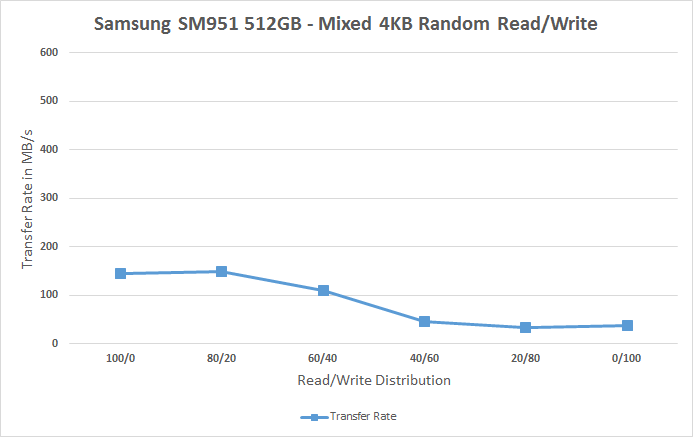
Again, for the sake of readability, I provide both an average based bar graph as well as a line graph with the full data on it. The bar graph represents an average of all six read/write distribution data rates for quick comparison, whereas the line graph includes a separate data point for each tested distribution.
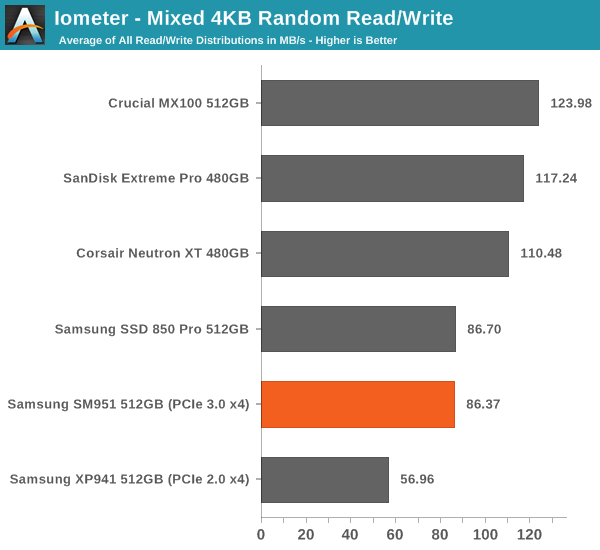
Quite surprisingly the SM951 and Samsung drives in general don't do very well with mixed data.
 |
|||||||||
The reason lies in the fact that the performance of Samsung drives plummets when the share of writes is increased. At 80/20 read/write, the Samsung drives manage to do pretty well, but after that the performance declines to about 40MB/s. What's odd is that the performance is also bad with 100% writes, whereas with other drives we usually see a spike here. I'm guessing there's some garbage collection going on here that causes the performance degradation.
Mixed Sequential Read/Write Performance
The sequential mixed workload tests are also tested with a full drive, but I've not limited the LBA range as that's not needed with sequential data patterns. The queue depth for the tests is one.
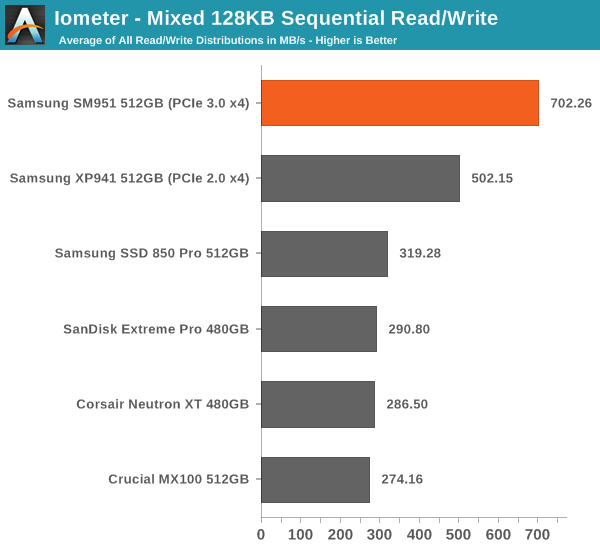
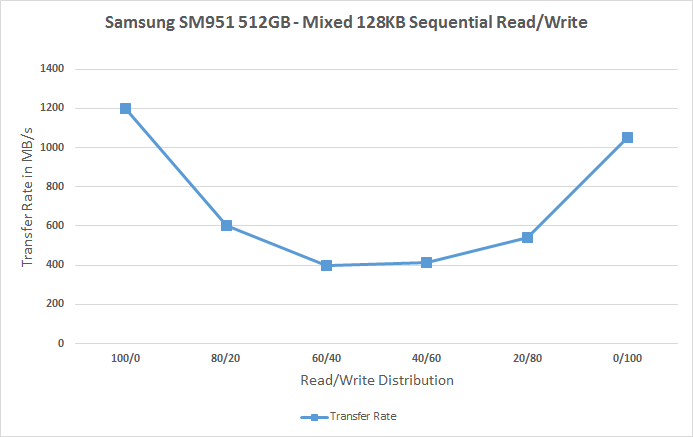
With 128KB sequential data, however, the SM951 is the king of the hill. There's a clear difference between PCIe and SATA based drives, although it's worthy to note that the difference is mostly due to PCIe drives having much higher throughput at 100% reads and writes (i.e. the infamous bathtub curve).
 |
|||||||||
Originally published at https://www.anandtech.com/show/8979/samsung-sm951-512-gb-review (Wayback Machine).