
MSI X99S MPower Review: Sting Like a Bee
- Posted in
- Motherboards
- Intel
- MSI
- Overclocking
- X99
MSI X99S MPower Conclusion
There are two types of overclocking enthusiasts. The bigger camp contains those that overclock for better daily performance, but the more interesting side attempts to push hardware to the limit for records. Ultimately what ends up happening is that a motherboard manufacturer has to cater for both, and the casual overclocking crowd brings in the money while the extreme users supply the glory.
Unfortunately this dichotomy raises a few questions. In 2015, most motherboards overclock the same on the CPU side for 24/7, perhaps all within 5% or 200 MHz at the absolute most, and the major factor here is more the luck or nature of the CPU itself. That means a cheap overclocking motherboard can actually be a good thing. The flip side of this is that extreme overclockers need an element of over engineering to deal with -150ºC temperatures with liquid nitrogen, which pushes up the cost. For the 24/7 overclockers, these high end boards might offer a lot of superfluous features in terms of engineering, and the recommendation for these users is not positive when the product is over $400 for X99.
With that being said, a well-positioned high-end motherboard can drive sales lower down the stack. We have seen motherboards like the Rampage X79 Extreme drive high-end sales, or the Z87X-OC aggressively attack the mid-range overclockers and be very successful. While the X99S MPower in this review performed well, it doesn't have the wow factor that the true hall-of-fame boards have had.
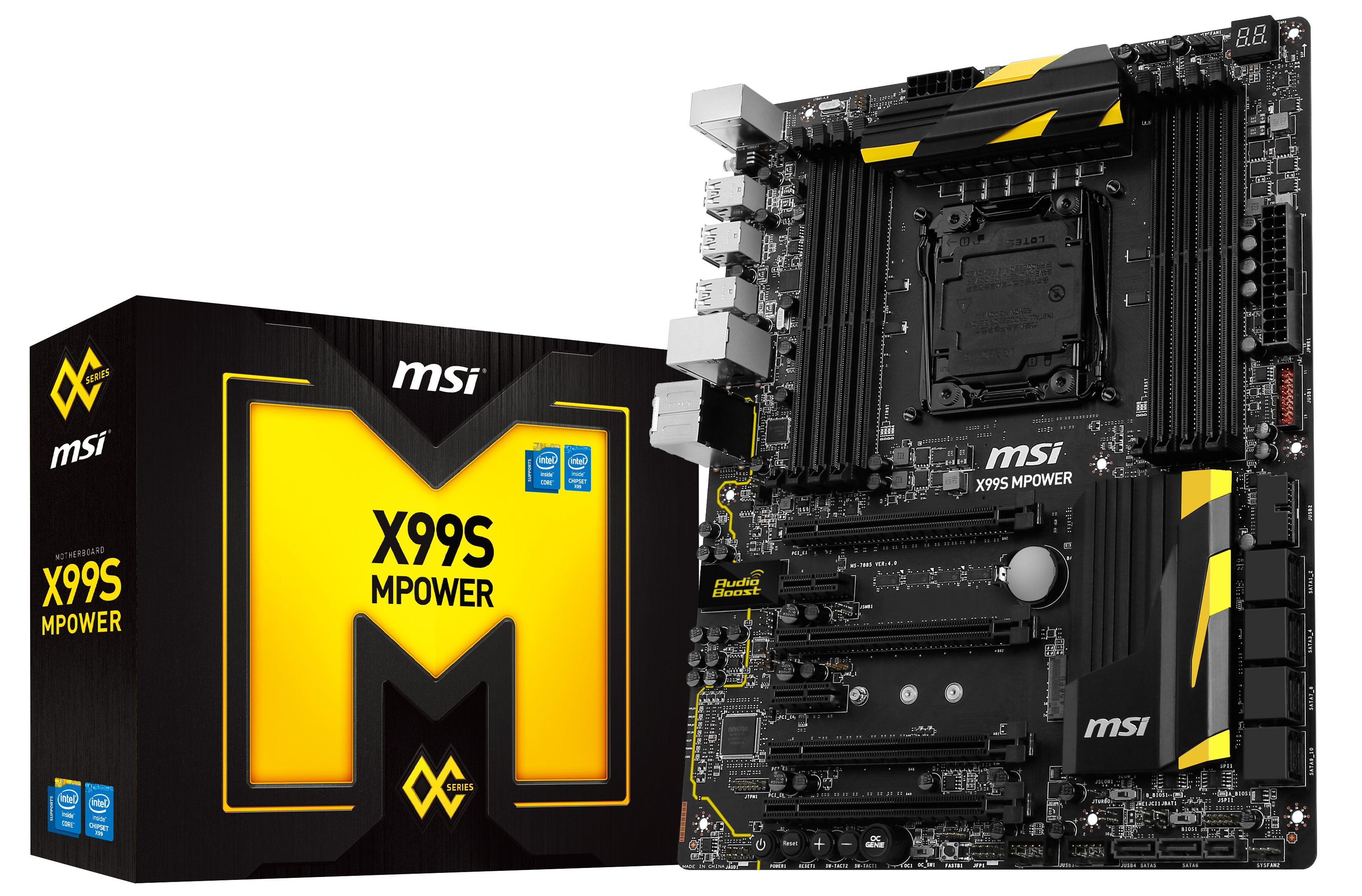
On the hardware side, the MSI X99S MPower promotes its overclocking credentials through the two-stage OC Genie button, onboard OC buttons as well as an easier to use overclocking BIOS compared to previous generations. Other hardware over the default configuration include Audio Boost (an upgraded Realtek ALC1150 audio solution with an EMI shield, PCB separation and additional filter caps), a SATA Express port, an M.2 PCIe 3.0 x4 port, support for multiple graphics cards and the yellow/black livery and styling. MSI likes its bundles, so there is a stick-on chassis shield included along with a door hanger and cable stickers. The usual array of SLI bridges are also part of the package, although one too few for 3-way SLI requiring users to go and get another.
Nothing untoward occurs in our benchmark numbers, although for a non-multicore turbo base BIOS it does come across as an aggressive implementation. The DPC Latency comes in at under 100 microseconds, and the audio solution comes on the top half of the comparison points, but the idle power numbers join the MSI X99 SLI PLUS at the bottom of the leaderboard. The BIOS still has some nice fan control interaction, as well as a rearranged overclocking section to make things easier compared to previous MSI chipsets, and the software still has one of the best auto-update tools available. It is a shame that the control software makes it too easy to push up the voltage to ridiculous levels.
Competition for the MSI X99S MPower comes from many different angles, such as the X99-SOC Champion, the X99 OC Formula and some of the more general gaming models. $300 is a big battle ground for X99, switching over from the cheaper end to the more mid-range, and the MSI X99S MPower has a number of positive points to make it worth considering. There is not one killer feature like some of the other models, but MSI has historically played it safe on that front, preferring to spend extra on the style and experience instead.
Originally published at https://www.anandtech.com/show/8978/msi-x99s-mpower-review (Wayback Machine).