
AMD's Athlon XP 2100+ The Last of the Palominos
- Posted in
- CPUs
| General
Usage Performance Office Productivity SYSMark 2002 |
|||||||||||||
|

 165
The performance picture changes considerably in the Office Productivity test suite. Only the Northwoods are able to outperform the Athlon XP 2000+ and 2100+ in this test, the additional L2 cache helps offset the long pipeline penalties of the Pentium 4 among other inefficiencies when it comes to executing conventional integer code.
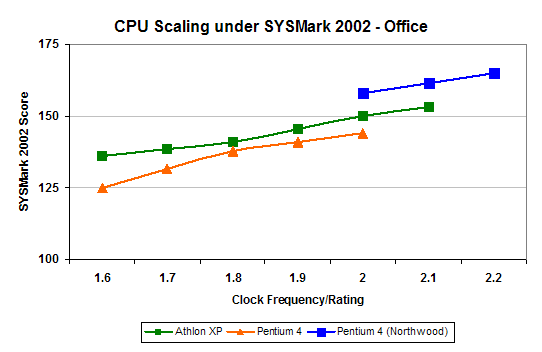
Here we see that the Athlon XP has the ability to scale quite well in this benchmark even as clock speeds increase beyond 1.73GHz (2100+). Additional L2 cache will be necessary however to bridge the gap between the Athlon XP and the Northwood, which could point at a reason for outfitting the Thoroughbred core with more cache.
| Overall
System Performance SYSMark 2002 |
|||||||||||||
|
The overall performance score is derived from the ICC and Office Productivity tests and thus there are no surprises here.
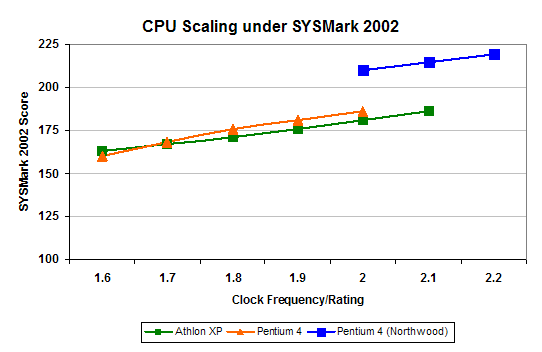
The Pentium 4 and Athlon XP performance curves run pretty much along the same path until the Pentium 4 gets the additional L2 cache courtesy of the Northwood core.
Originally published at https://www.anandtech.com/show/887 (Wayback Machine).