
GIGABYTE X99-SOC Champion Motherboard Review: Low Cost X99 Overclocking
GIGABYTE X99-SOC Champion Conclusion
As a competitive overclocker, I appreciate the overclocking motherboard market. When I started overclocking it was to get better day-to-day performance and get a boost in game frame rates. Back then it was fairly nice to say you had a 40-50% overclock on a dual core system, especially when plowing through a dozen rounds of Counter-Strike. It was about that time when overclocking became more of competition and users decided to see how far they could push their hardware, both for 24/7 running and pushing benchmark stability. When I joined the competitive overclocking crowd, getting a higher number than the other person was always the goal.
Skip forward to 2014, and competitive overclocking has a reasonable sized following with at least half-a-dozen global competitions with four or five figure prize money as well as plenty of smaller competitions for lower end hardware. The holy grails for these live competitions or for the overclockers in general are the world records. This means getting the best score ever in a particular benchmark (3DMark Fire Strike, for example) no matter what the hardware. Because these records are highly sought after, and offer various marketing and bragging rights, companies such as GIGABYTE either sponsor or seed overclockers with premium hardware or hire them directly and turn them professional in order to build the products that break these records. GIGABYTE employs former world #1 HiCookie and top overclocker Sofos at their headquarters as well as leveraging the skills of Dino, one of their regional marketing managers well known in the overclocking community, for this purpose. For the modern gaming benchmarks, the best hardware typically revolves around an X99 based system with three or four big GPUs, all overclocked. So while not everyone can buy $4000 of overclocking equipment, perhaps those with $2000 might invest in a high end single or dual GPU overclocked system. This is where the GIGABYTE X99-SOC Champion comes in.
The X99-SOC Champion is a cut down version of the X99-SOC Force and aims at the more 'budget' oriented X99 overclocker, if such a market exists. I am a fan of good, cheap overclocking motherboards in this segment, and the X99-SOC Champion's birth started with 9 world records and 17 other hardware firsts due to an invite-only overclocking camp held at GIGABYTE HQ in Taiwan.
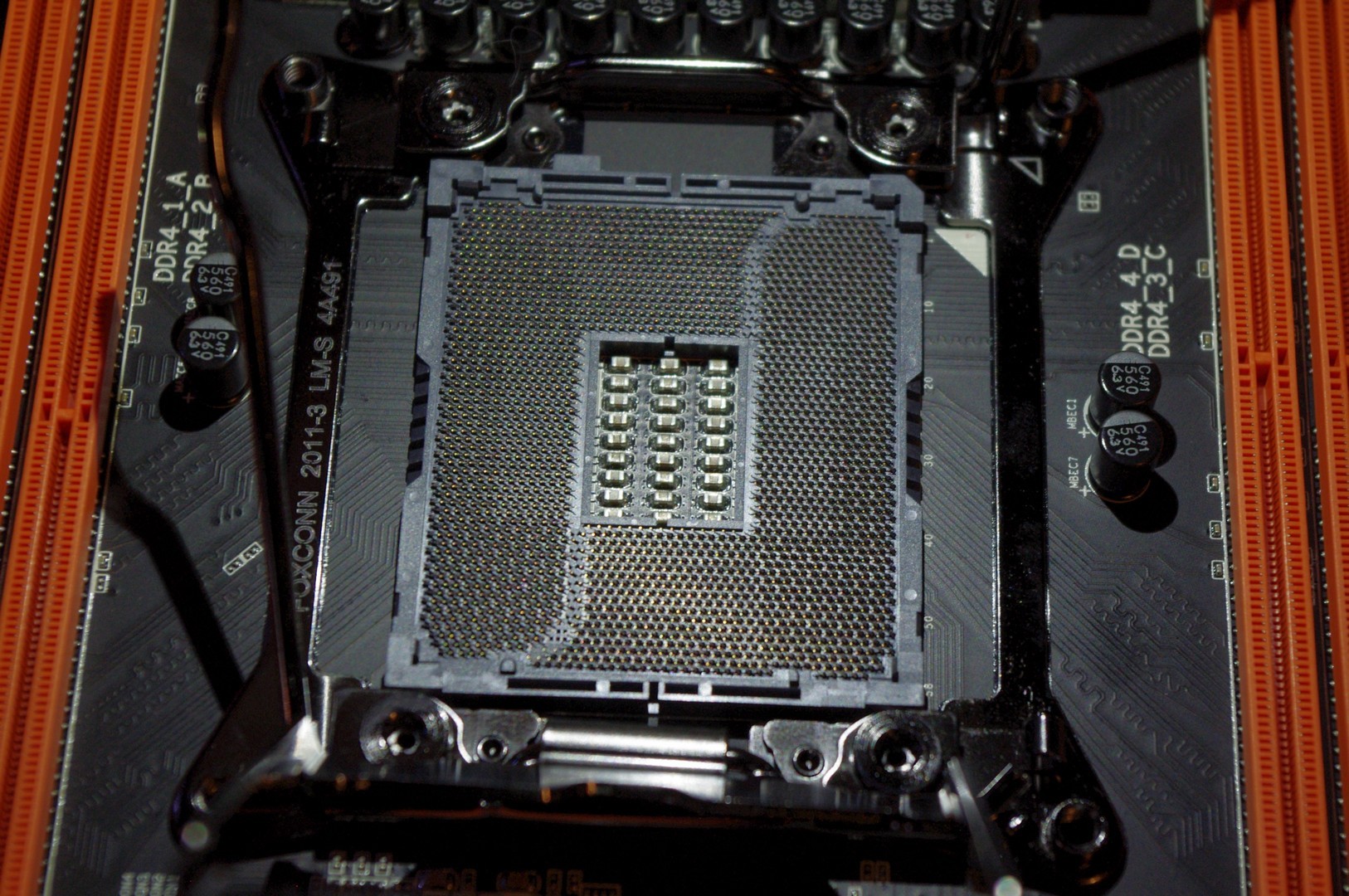
One of the major features for the board is the socket which runs in a default LGA2011 mode but can be switched into LGA2083 mode with an onboard switch. These extra pins are activated to give more access to the voltages inside the CPU, particularly those for uncore and stability, which can be especially useful if the system is on the edge. Their use for regular overclockers in that regard is somewhat limited as either the CPU or the temperatures are the limiting factor in 24/7 overclocking. It is also worth noting that the concept of an LGA2083 overclocking socket is currently being patented by one of GIGABYTE's competitors, so we are unsure as to the legal status of the product or the issues therein.
The socket and slots also come with 30 micron gold contacts which is 6x more than standard and 2x more than most of the competition, to improve longevity against constant replacement as well as corrosion. The socket area also has access to an overclocking set of buttons, giving control of the DualBIOS system as well as LN2 modes. There is an additional header onboard for GIGABYTE's custom overclocking handheld device, although this comes separately.
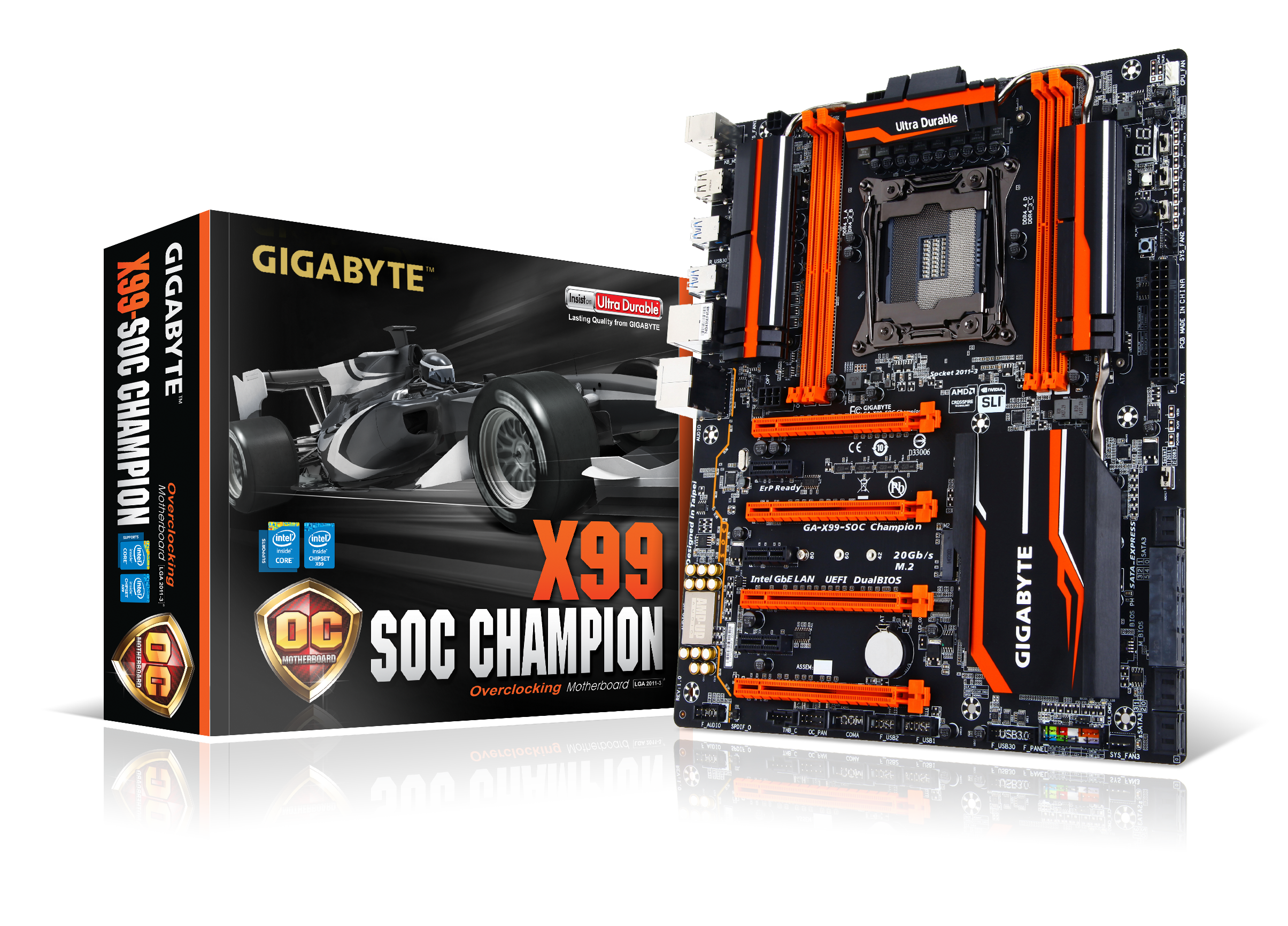
In terms of regular functionality we get a full-bandwidth quad GPU arrangement offering x16/x16/x8 and x8/x8/x16/x8, 10 SATA ports, SATA Express, an M.2 2.0 x4, an Intel I218-V network controller and an enhanced Realtek ALC1150 audio solution with PCB separation, an EM shield and additional filter caps.
On the benchmark front the GIGABYTE performs well in our power consumption tests and very well in POST time. Our audio test had issues at 100% volume but 57% results were reasonable, but the USB speeds were slower than expected. The overclocking the presets worked first time and we had a good 24/7 overclock for our mediocre processor.
In the end, alongside expectations of performance, the price of the product determines the success. For Z97, the $200 market for overclocking is a hot battleground with some success, however the fear is that X99 brings that up to $300 due to the increased cost of the chipset and IO functionality. Extra gold in the sockets and timing circuitry for full-bandwidth four-way GPU is not cheap. If the SOC Champion comes out at $250, it's a great bargain. At $275 it has some more competition but is still worth a good look. At $300 it starts migrating into the more serious overclocking and gaming setups. At the time of writing this we do not know the MSRP and are awaiting information for the final piece of the puzzle. Latest pricing on Newegg, when it arrives in stock, can be found at this link.
Edit: At CES it would seem that the MSRP will be in the $300 mark, but will be actively pursued for potential discounts depending on the retailer.
Originally published at https://www.anandtech.com/show/8804/gigabyte-x99-soc-champion-motherboard-review-low-cost-x99-overclocking (Wayback Machine).