
The Meizu MX4 Pro Review
- Posted in
- Smartphones
- Exynos
- Mobile
- Meizu
GPU Performance
The Exynos 5430's Mali T628MP6 at 600MHz should be a predictable test candidate now that we have scores from Note 4's Exynos 5433 and Huawei's Kirin 920 devices. The MX4 Pro should perform slightly worse than the 5433. Meizu maintains the ALU load percentage based scaling logic that I've covered in the Note 4 Exynos review, meaning that ALU heavy loads allow the GPU to scale up to 600MHz while more traditional loads will limit the GPU to 550MHz.
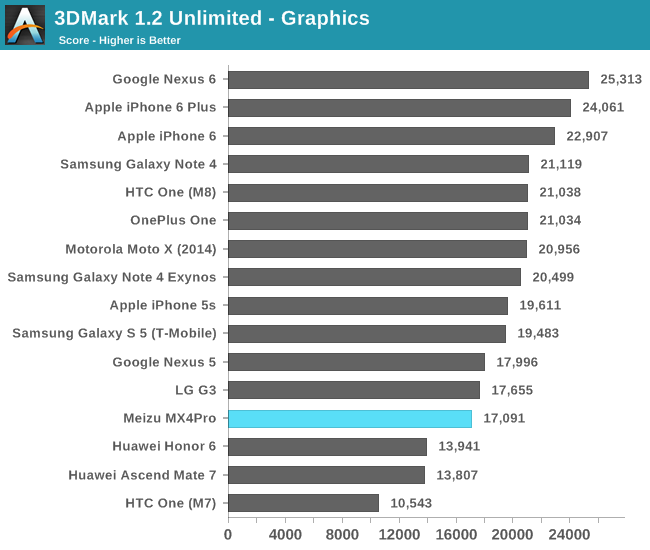
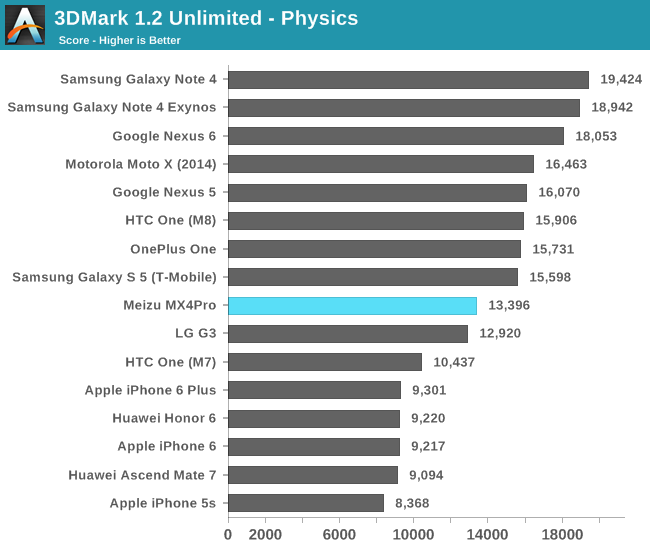
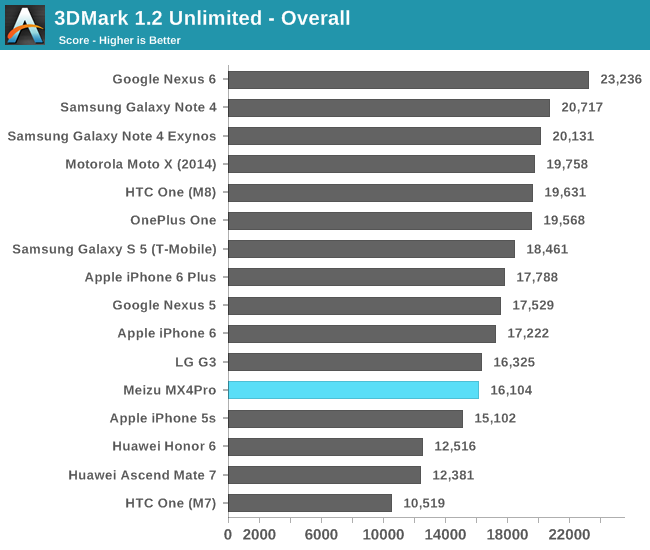
In the 3DMark Unlimited Graphics test we see how the Mali lands more or less where we expected it, worse than the Note 4 and better than the Huawei units. The physics score is still a strongly CPU-bound test and the weaker A7 cores of the 5430 are what is used during most 3D loads.
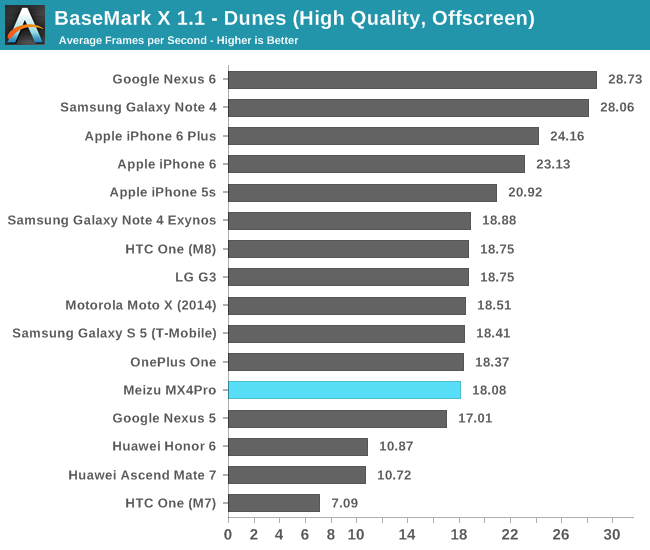
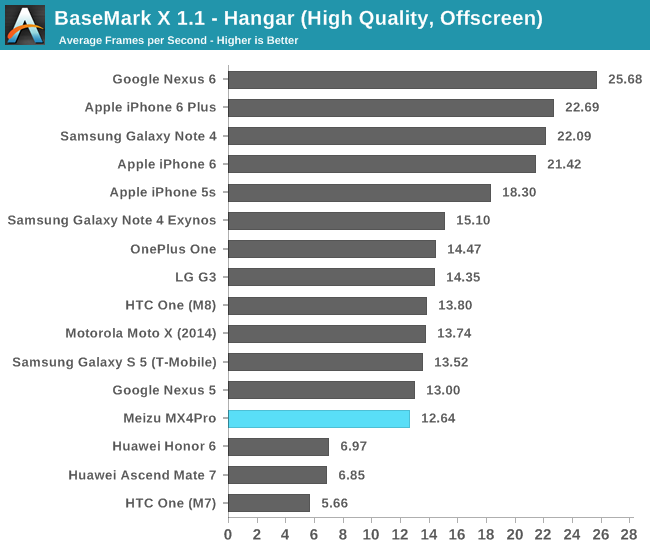
As we move on to BaseMark X, we're getting into more pure 3D loads that are not as affected by CPU speeds. Here we see the Mali T628MP6 outperform the Kirin 920 by much more than what we would expect from 50% more cores on the MP4 configuration. I've mentioned in the Note 4 review that Samsung has dedicated and added a lot of cache in the Mali's in the 543X Exynos SoCs, and this delta might very well be a result of the modified implementation. The MX4 Pro is on the heels of Adreno 330 devices.
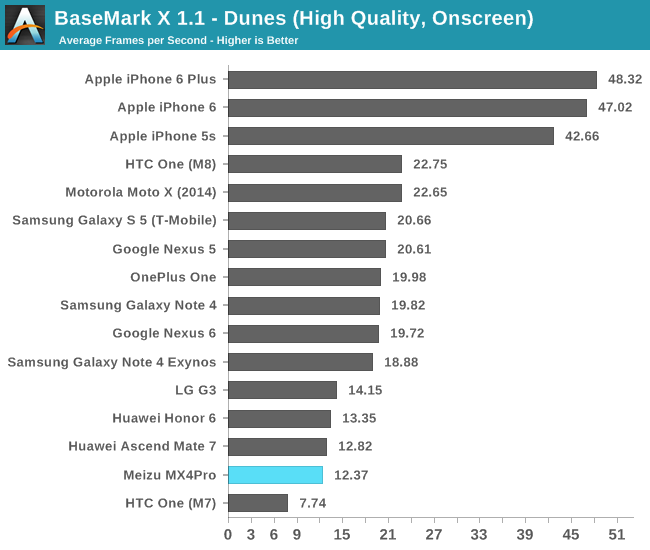
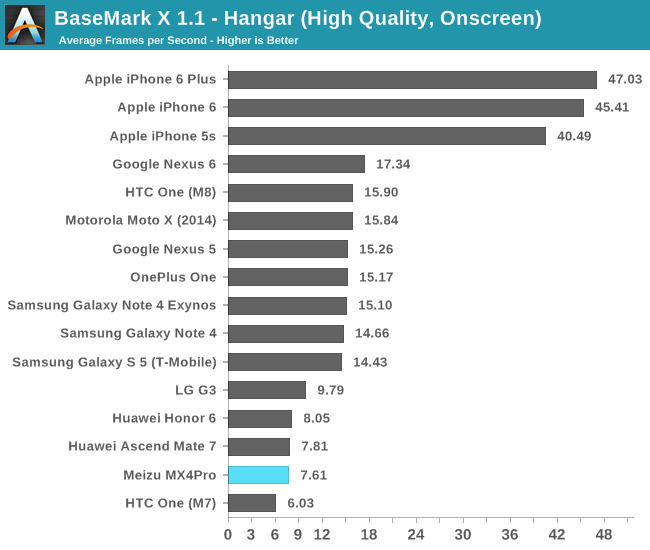
The higher-than-QHD resolution of the MX4 Pro drags down the on-screen scores by a significant amount. There seems to be a bandwidth bottleneck here as the device doesn't manage to outperform the Kirin devices.
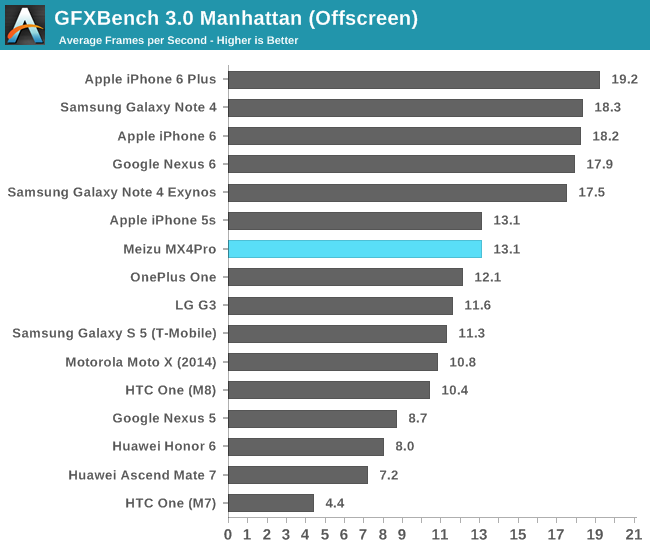
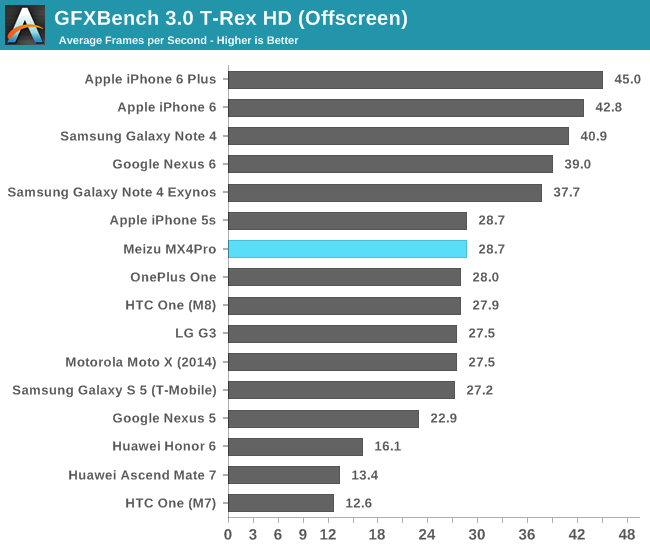
The Manhattan and T-Rex off-screen scores again put the Exynos 5430 at the level of the Adreno 330.
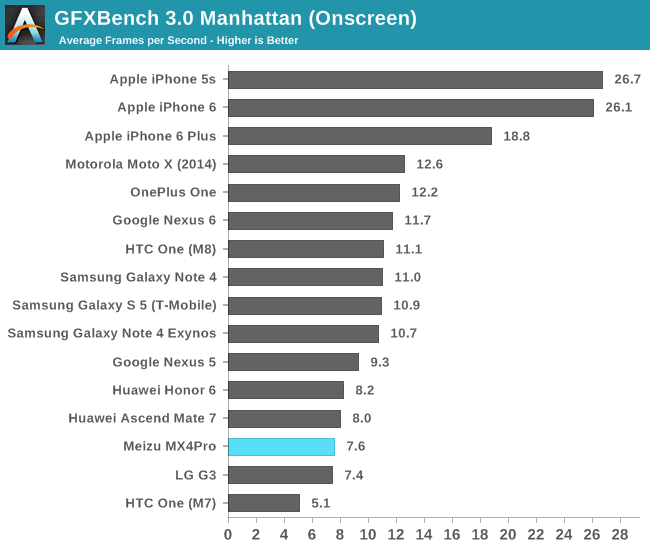
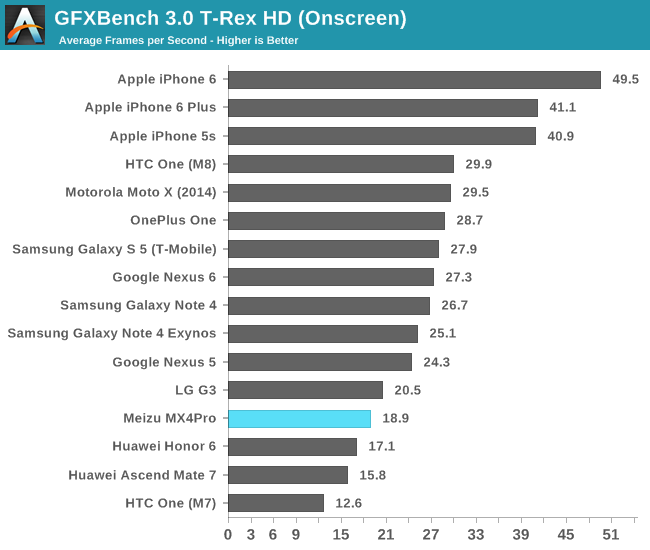
The onscreen scores again reverse the scores and put the Mali at a greater disadvantage. It seems while the Exynos 5430 is able to properly keep up at 1080p resolution, the performance degradation when switching to 1560p is quite large.
GPU Power
The Note 4 review started something that I hope to continue in the future whenever a device allows me to do a full power analysis. The MX4 Pro is luckily one of those devices, and I was able to measure some interesting figures that I'll be getting into more in the battery life section. For now, I present some isolated GPU power figures employing the same methodology that I've used for the Exynos 5433, meaning the system is limited to the little cores and the device's screen power is subtracted from the off-screen tests of GFXBench.

While the MX4 Pro and the Galaxy Alpha both employ the same SoC, the rather massive difference between the two comes from the fact that my Alpha test unit had the second-worst chip bin possible, having much higher voltages than what the MX4 Pro is running on its Exynos 5430. My Meizu unit has a median-tier bin, which is something that a larger amount of people should be able to enjoy. On average we see a 62.5mV voltage drop throughout all the GPU frequencies.
The end result is that the MX4 Pro roughly consumes a full 1W less than the Alpha. Shaving off 25% of power consumption just by having a different chip bin demonstrates how volatile device benchmarking can be, as the review units we receive can be very different to what another site tests, not to mention user devices. As I continue to collect more data I hope that we can do a full competitive analysis of the SoC market in the future.
Originally published at https://www.anandtech.com/show/8800/the-meizu-mx4-pro-review (Wayback Machine).