
MSI B85M ECO Review: Aiming Green at $73
- Posted in
- Motherboards
- MSI
- B85
- ECO
MSI B85M ECO Conclusion
Striving for better power efficiency is a goal we should all aim towards. A lot of people can do what they do at the same rate but consume less energy if they had access to more efficient components. Given the global climate, MSI has produced a range of motherboards to cater to businesses with a green mindset from the ground up.
Unfortunately the best plans of mice and men 'gang aft agley’ (often go awry), and in the world of electronics and business, money is the big talker. Few businesses will spend $20 to save $1 a year, so the concept also has to make financial sense to the end user. In order to launch a product that would sell to more than those with the best intentions, MSI had to create the motherboards to save significant power each year and fit within an upgrade cycle. That can be difficult when the gains are small and the cycles are short.
We used MSI’s base numbers (which in the world of marketing usually show the product in the best light possible), and calculated that in comparison to a standard range motherboard the MSI ECO can make financial sense to users with a 4-5 year upgrade cycle. Any shorter and it won’t make sense, though arguably our own numbers showed that the more the system is used in terms of loading, the better the financial outcome. If businesses are sticking to a 3 year upgrade cycle, this might not be enough of a saving to make sense.
By using the B85 chipset, the B85M ECO is aiming at Intel’s Small Business Advantage market. These can be medium volume customers purchasing for businesses making under-the-desk PCs for offices but still have a level of control or need vPro style management. This allows MSI to build the motherboard with office usage in mind – fewer power phases, smaller heatsinks, few PCIe slots but plenty of DRAM or storage if needed (as long as the locking cables don’t get in the way). At the end of the day, compared to all the previous Haswell-capable motherboards we have reviewed, the MSI B85M ECO uses the least power in long idle, idle and OCCT load, including against mini-ITX motherboards.
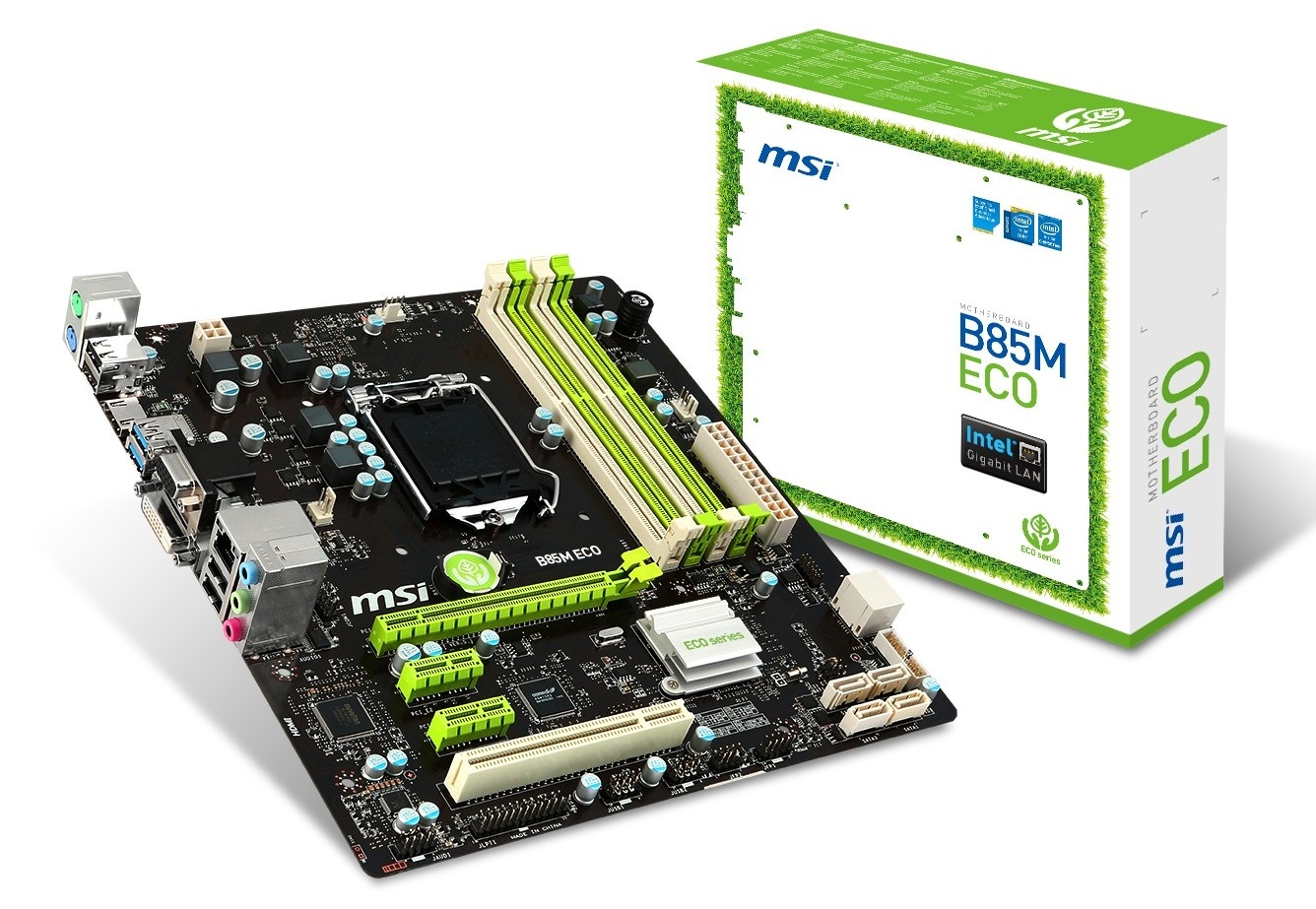
MSI is keen to point out its TÜV certification, and currently this motherboard is available from Newegg for $73. While the white/green PCBs from the initial Computex showing have not made it through to this model, the white and green matching across the board, box, BIOS and software maintain that mentality of ‘green is good for everyone’.
The BIOS does feel light compared to the overclocking BIOSes we have used on MSI motherboards in the past, and there are a couple of superfluous BIOS options, but it works as it should and we still get good fan controls in there. The software revolves around ECO Center Pro which is an update of previous ECO Center software we have seen but a little more extreme. One thing I would like to see in the future is MSI add in a testing mode that deals with CPU loading and fan loading. By testing enough permutations, the system could figure out the most power efficient fan curve for the system at every point.
One of the points in the review was the inability to select a lower CPU voltage. Both voltage and frequency have a role in total system power consumption, but when full performance is still needed, voltage is the only variable left to modify. I posed this question to MSI, and received the following response:
“We actually did try to do some testing with lower CPU voltage settings. The reason why we didn’t include it into the current BIOS is because we think Intel’s current FIVR architecture puts too many limits inside their design and we [would] rather use Intel’s integrated power saving features like C-State (Up to C7) and also SVID power. But it’s still a good suggestion that we can request our R&D to do more testing and check if we can fine tune better settings to enhance the power saving ability.”
The final question should be ‘well, does it work?’. Over a standard motherboard, the power savings are clear from both MSI’s numbers and our own. The biggest hurdle MSI will have to overcome is the price difference to a standard motherboard that takes 4-5 years to break even financially in ‘light’ office use, or the added cost of efficient 300W power supplies. Depending on the company refresh cycle, it might not make sense, but they might see another added benefit of being able to promote a ‘green’ computing strategy.
I believe this is a market MSI should pursue, and it will be interesting to see how it develops from both a hardware and software standpoint. If MSI were to publish the exact differences in PCB component selection, that we be golden, but I would assume that is part of their secret sauce and not up for sharing.
MSI is still interested in taking comments on the ECO line, so if you see something you like/dislike or have a few ideas on what you want to see, please leave a comment in this review. Personally I like the color scheme, and it might be interesting to see it on an ATX sized model. A dual GPU system might not exactly be green (unless it’s NVIDIA), but it might be worth trying to make it an efficient rig with a pair of Maxwells and DDR3L.
Originally published at https://www.anandtech.com/show/8746/msi-b85m-eco-review-aiming-green-at-73 (Wayback Machine).