
The Google Nexus 9 Review
WiFi Performance
On most tablets, WiFi performance is perhaps one of the most crucial parts of the experience as WiFi is often the primary method of connectivity. Without working WiFi, a tablet is basically useless as the only alternative is either cellular (which is quite rare on most tablets) or Ethernet over USB-OTG, which destroys most of the value of a mobile device.
In the case of the Nexus 9, we see that HTC has fitted this device with a BCM4354 WiFi module to enable two spatial stream 802.11ac. Interestingly, there is some evidence to suggest that HTC has also adopted Cypress Semiconductor’s CapSense controller to enable antenna tuning for the WiFi antennas. However, it’s probable that this solution is only for HTC devices without a Qualcomm Gobi modem as we’ve seen the use of the QFE15xx antenna tuner in previous HTC products. In order to test how the Nexus 9’s WiFi solution performs, we turn to iperf on Android to test throughput across the network, and utilize Asus’ RT-AC68U router to ensure that the device under test will be able to reach maximum performance.
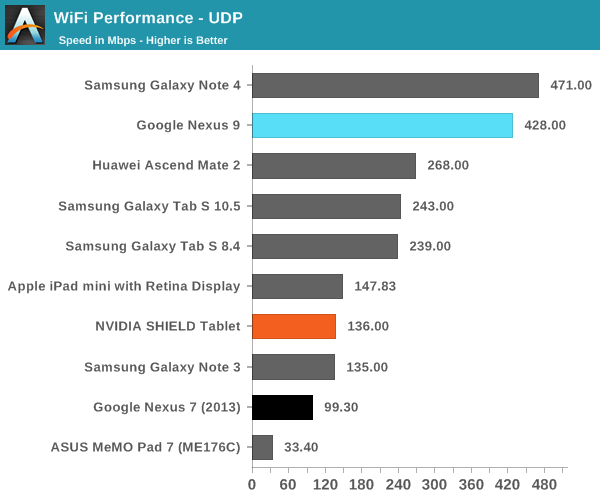
The Nexus 9's WiFi solution performs about as well as one might expect from a BCM4354 solution. For the most part I haven't noticed any reception issues, even when touching/detuning the WiFi antennas.
GNSS

While most of the GNSS solutions that we’ve looked at this year use Qualcomm’s GPSOne/IZat due to the presence of a Qualcomm Gobi Modem, the same isn’t true for the Nexus 9. Instead, Broadcom’s BCM4752 is used here. While this shouldn’t have a massive impact on the speed with which first lock is acquired, in practice Qualcomm’s solution is noticeably faster here as the modem can often provide data to make for a hot fix. At any rate, the Nexus 9 does perform acceptably in this regard. I don’t see any major issues with location performance, although it does seem that the GPS tends to report lower accuracy levels than the Qualcomm solutions that I'm used to. Other than this, the GNSS solution is quite usable.
Misc
While we don't have a proper audio quality test yet, it's clear that the audio codec used is the same Realtek RT5677 codec that we saw in the SHIELD Tablet. Outside of the code, we also see an RT5506 2.55V amp on the 3.5mm jack, along with two NXP TFA9895 amps on the speakers, which are quite good due to their front-facing placement. In practice I don't really see much issue with loudness or quality here, as the speakers can get even louder than the M8 in some situations. We also see a Broadcom BCM2079x NFC chip, which means HCE is fully supported out of the box. Interestingly, the VCM controller is exposed to the OS and is said to be a Texas Instruments DRV201 chip.
Originally published at https://www.anandtech.com/show/8701/the-google-nexus-9-review (Wayback Machine).