
VIA KT266A Motherboard Roundup - January 2002
- Posted in
- Motherboards
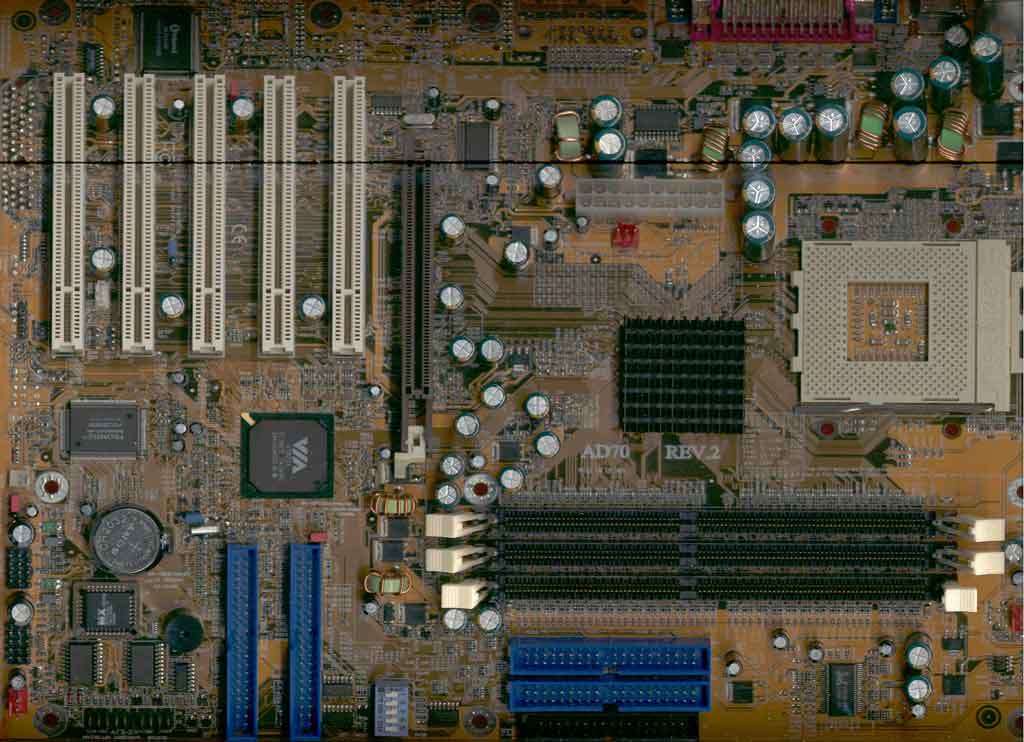
DFI AD70-SR
|
DFI AD70-SR |
|
|
CPU
Interface
|
Socket-A
|
|
Chipset
|
VT8366A
North Bridge
VT8233 South Bridge |
|
Form
Factor
|
ATX
|
|
Bus
Speeds
|
100
- 250MHz (in 1MHz increments)
|
|
Core
Voltages Supported
|
1.500
- 1.850V (in 0.025V increments)
|
|
I/O
Voltages Supported
|
Not
Configurable
|
|
DRAM
Voltages Supported
|
Not
Configurable
|
|
Memory
Slots
|
3
184-pin DDR DIMM Slots
|
|
Expansion
Slots
|
1
AGP Slot
5 PCI Slots |
|
Onboard
RAID
|
Promise
PDC 20265
|
|
Onboard
USB 2.0/IEEE-1394
|
N/A
|
|
Onboard
Audio
|
N/A
|
Recently DFI has started to pick up the pace in the enthusiasts market, and we continue to see this trend in the AD70-SR. The AD70-SR recently got its name changed to distinguish itself from its older KT266 brother, the AD70.
The AD70-SR has a very wide range of FSB speeds from 100MHz to 250MHz. Although the 100/133MHz jumper is still present on the board, the wide range of speeds available is already a big jump for DFI. There are no voltage settings for I/O and memory on the AD70-SR, while a decent range of settings are available for CPU core.
One important feature DFI implemented on the board was the asynchronous memory setting, allowing you to run your memory slower than the FSB speed as you continue to increase the FSB. Although the board couldn't hit very high FSB values without compensating the stability, this is a nice option provided by DFI.
The board also comes in with the Promise PDC 20265 RAID controller supporting ATA100. In order to reduce the cost DFI decided not to put an integrated sound chip on the AD70-SR, and the result is a 100-dollar board that is very stable with RAID functions.
Originally published at https://www.anandtech.com/show/870 (Wayback Machine).