
Synology DS1815+ 8-bay Intel Rangeley SMB NAS Review
Miscellaneous Aspects and Final Words
In order to keep testing consistent across all 8-bay units, we performed all our expansion / rebuild testing as well as power consumption evaluation with the unit configured in RAID-5. The disks used for benchmarking (Western Digital WD4000FYYZ) were also used in this section. The table below presents the average power consumption of the unit as well as time taken for various RAID-related activities.
| Synology DS1815+ RAID Expansion and Rebuild / Power Consumption | ||
| Activity | Duration (HH:MM:SS) | Avg. Power (W) |
| Single Disk Init | 0:10:42 | 32.14 W |
| JBOD to RAID-1 Migration | 11:17:58 | 42.34 W |
| RAID-1 (2D) to RAID-5 (3D) Migration | 35:53:15 | 51.68 W |
| RAID-5 (3D) to RAID-5 (4D) Expansion | 25:1:4 | 62.48 W |
| RAID-5 (4D) to RAID-5 (5D) Expansion | 23:32:53 | 73.78 W |
| RAID-5 (5D) to RAID-5 (6D) Expansion | 23:6:12 | 84.07 W |
| RAID-5 (6D) to RAID-5 (7D) Expansion | 24:28:29 | 94.58 W |
| RAID-5 (7D) to RAID-5 (8D) Expansion | 27:7:26 | 104.72 W |
| RAID-5 (8D) Rebuild | 14:21:12 | 103.44 W |
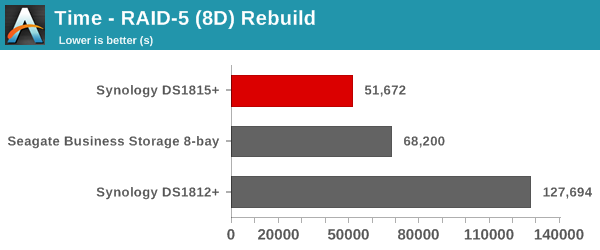
The graphs below show the power consumption and rebuild duration when repairing a RAID-5 volume for the various 8-bay NAS units that have been evaluated before.
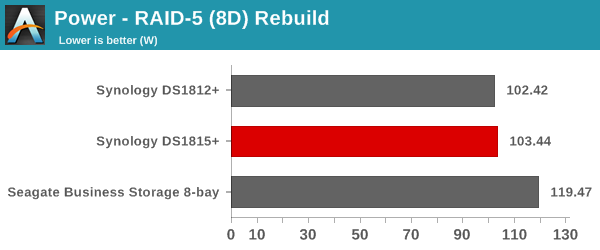
Even though the DS1815+ is not as power efficient as the DS1812+, the unit turns out to be better by a huge margin thanks to the cut-down in the rebuild duration. That said, it does look like Synology can optimize RAID rebuild and expansion durations further.
Concluding Remarks
The SMB / SOHO / prosumer COTS NAS market is interestingly poised. With the previous generation Atom platforms, NAS vendors had to differentiate themselves with the software. However, with their 22nm silicon, Intel has provided them with multiple options. We have already looked at QNAP using Bay Trail-D with extra focus on the multimedia transcoding and virtualization aspects. Asustor has opted to go the Haswell route, with a Core i3 CPU for the 70-series. With the DSx15+ series, Synology has placed its bets on the Intel Rangeley platform.
The new Rangeley platform has made up for the drawbacks of the previous generation x86 platforms at this price point. Equipped with the Atom C2538, the DS1815+ excels in three areas: multi-client performance, encryption capabilities and power efficiency. Synology's DSM is quite mature and it has no problems in bringing out the potential of Intel's Rangeley for the NAS market. The latest version of DSM brings deeper cloud integration (more cloud vendors supported for backup), better sync control, an advanced multi-platform note-taking solution in Note Stations / DS Note and improved security features (such as digital signing for packages). For the SMB market that Synology is targeting with the DS1815+, DSM 5.1 also brings SSD caching to high-availability clusters, VMware VAAI for NFS (in addition to the already existing iSCSI support) and scheduled iSCSI LUN snapshots.
Multi-client performance in terms of average response times is better because of the highly integrated I/O compared to other solutions which use bridge chips and have bottlenecks in connecting to the CPU. The appearance of AES-NI in the Atom-class SoCs has finally delivered power efficient encryption capabilities. Obviously, the 22 nm fabrication process as well as tight I/O integration greatly help in reducing the power consumption of the platform compared to other solutions in the market.
The above advantages aside, there are certain areas where Synology could improve:
- The DS1815+ needs to ship with 4 GB of RAM by default. Users running multiple apps would benefit tremendously.
- Even though the iSCSI feature set is quite advanced and ahead of the competitors, performance for the 'multiple LUNs on RAID' case could do with some improvement
- In terms of hardware / chassis design, a USB port (even 2.0 would suffice) on the front would be nice to have.
At $1050 for a diskless unit, the pricing is not unreasonable (given the premiums usually associated with Synology units). The Atom C2538 is one of the more powerful Rangeley SoCs and it helps the DS1815+ pack quite a punch for the SMB / SOHO market. We will shortly be reviewing a couple of 8-bay NAS units from other vendors. They will help us get a better understanding of where the DS1815+ stands when contemporary NAS units are taken into consideration.
Originally published at https://www.anandtech.com/show/8693/synology-ds1815-8bay-intel-rangeley-smb-nas-review (Wayback Machine).