As virtualization becomes more and more popular even in home / power user settings, the importance of the iSCSI feature set of any COTS NAS can't be overstated. Starting with our ioSafe 1513+ review, we have started devoting a separate section (in the reviews of NAS units targeting SMBs and SMEs) to the evaluation of iSCSI performance. Since we have already looked at the way iSCSI LUNs are implemented in DSM in the ioSafe 1513+ review, it won't be discussed in detail.
We evaluated the performance of the DS1815+ with file-based LUNs as well as configuring a RAID-5 disk group in multiple LUNs mode and single LUN mode. The standard IOMeter benchmarks that we used for multi-client CIFS evaluation were utilized for iSCSI evaluation also. The main difference to note is that the CIFS evaluation was performed on a mounted network share, while the iSCSI evaluation was done on a 'clean physical disk' (from the viewpoint of the virtual machine).
Performance Numbers
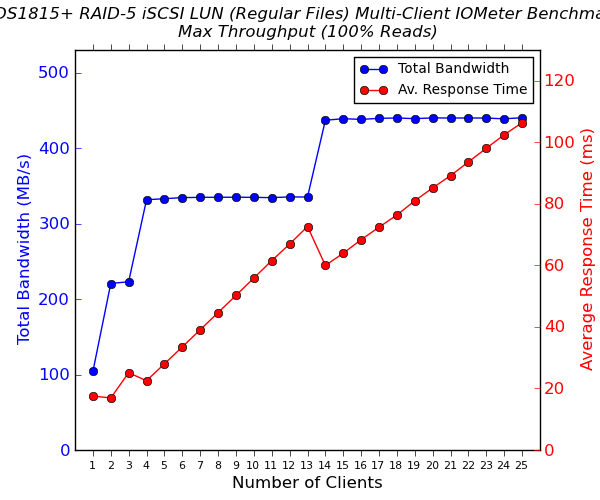
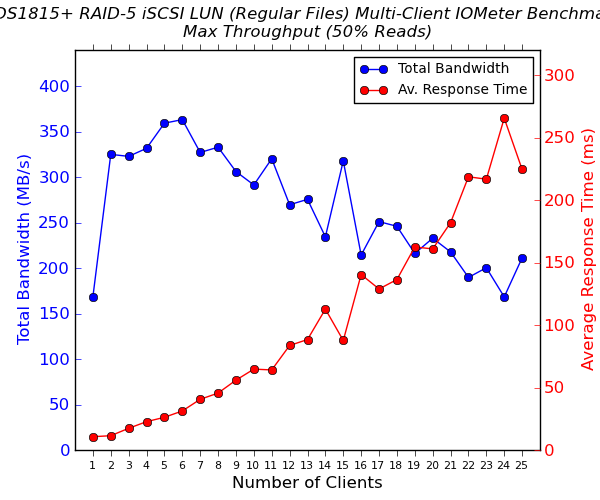
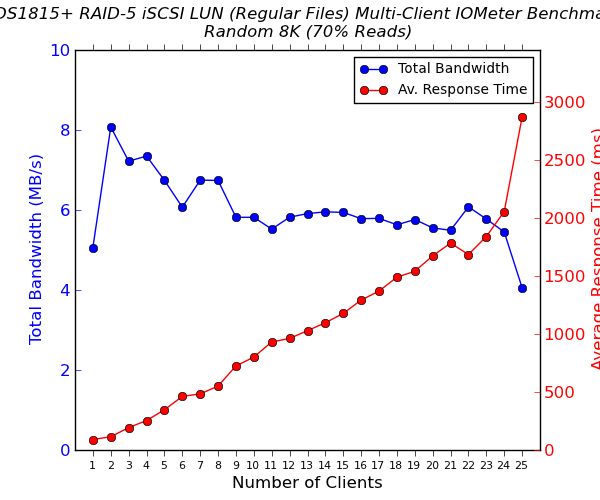
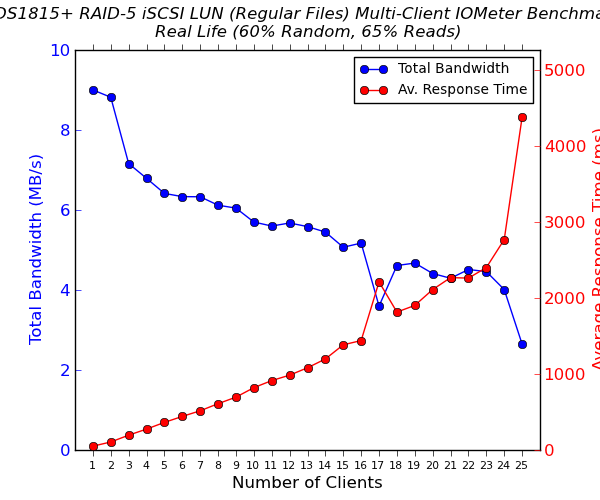
The four IOMeter traces were run on the physical disk manifested by mapping the iSCSI target on each VM. The benchmarking started with one VM accessing the NAS. The number of VMs simultaneously playing out the trace was incremented one by one till we had all 25 VMs in the fray. Detailed listings of the IOMeter benchmark numbers (including IOPS and maximum response times) for each configuration are linked below:
Since the number of NAS units that we have put through this evaluation is limited, we have a couple of 4-bay NAS units in the comparison drop-downs above. Unfortunately, we have no graphs for apples-to-apples comparison. That said, we do see the 'single LUN on RAID' mode delivering the best performance. For some strange reason, the multiple LUNs on RAID configuration is never able to take advantage of the bonded network ports. Even the simultaneous multi-client sequential reads test always stay below 125 MBps.
File-based LUNs give maximum flexibility - thin provisioning, support for VMWare VAAI and Windows ODX. The latest versions of DSM have improved on the iSCSI feature set quite a bit. Synology's competitors have a bit of catching up to do in the iSCSI feature set area.
As more NAS units are processed, we hope this section will provide readers with a way to quickly get an idea of the competitive performance of a particular NAS unit when it comes to iSCSI support.