
Intel Xeon E5-2687W v3 and E5-2650 v3 Review: Haswell-EP with 10 Cores
Competition and Market
As Johan mentioned in our initial Haswell-EP coverage, Intel’s main competition is with itself. Some other server CPU manufacturers focus on particular hardware and software combinations, while AMD has not updated their server line in over 2 years. ARM is making some inroads into the low end or the highly parallel market, but for the majority of workstations or servers, Intel has the market. The only downside to this strategy is that Intel has to convince that upgrading is worth it. One way to implement this is infrequent updates, although the customers demand a certain level of consistency over time such that updates are not super frequent.
| Intel Xeon E5 v2 versus v3 2-socket SKU Comparison | |||||||||
| Xeon E5 | Cores/ Threads |
TDP | Clock Speed (GHz) |
Price | Xeon E5 | Cores/ Threads |
TDP | Clock Speed (GHz) |
Price |
| High Performance (20 – 30MB LLC) | High Performance (35-45MB LLC) | ||||||||
| 2699 v3 | 18/36 | 145W | 2.3-3.6 | $4115 | |||||
| 2698 v3 | 16/32 | 135W | 2.3-3.6 | $3226 | |||||
| 2697 v2 | 12/24 | 130W | 2.7-3.5 | $2614 | 2697 v3 | 14/28 | 145W | 2.6-3.6 | $2702 |
| 2695 v2 | 12/24 | 115W | 2.4-3.2 | $2336 | 2695 v3 | 14/28 | 120W | 2.3-3.3 | $2424 |
| "Advanced" (20-30MB LLC) | |||||||||
| 2690 v2 | 10/20 | 130W | 3-3.6 | $2057 | 2690 v3 | 12/24 | 135W | 2.6-3.5 | $2090 |
| 2680 v2 | 10/20 | 115W | 2.8-3.6 | $1723 | 2680 v3 | 12/24 | 120W | 2.5-3.3 | $1745 |
| 2660 v2 | 10/20 | 115W | 2.2-3.0 | $1389 | 2660 v3 | 10/20 | 105W | 2.6-3.3 | $1445 |
| 2650 v2 | 8/16 | 95W | 2.6-3.4 | $1166 | 2650 v3 | 10/20 | 105W | 2.3-3.0 | $1167 |
| Midrange (10-20MB LLC) | Midrange (15-25MB LLC) | ||||||||
| 2640 v2 | 8/16 | 95W | 2.0-2.5 | $885 | 2640 v3 | 8/16 | 90W | 2.6-3.4 | $939 |
| 2630 v2 | 6/12 | 80W | 2.6-3.1 | $612 | 2630 v3 | 8/16 | 85W | 2.4-3.2 | $667 |
| 2620 v2 | 6/12 | 80W | 2.1-2.6 | $410 | 2620 v3 | 6/12 | 85W | 2.4-3.2 | $422 |
| Frequency optimized (15-25MB LLC) | Frequency optimized (10-20MB LLC) | ||||||||
| 2687W v2 | 8/16 | 150W | 3.4-4.0 | $2108 | 2687W v3 | 10/20 | 160W | 3.1-3.5 | $2141 |
| 2667 v2 | 8/16 | 130W | 3.3-4.0 | $2057 | 2667 v3 | 8/16 | 135W | 3.2-3.6 | $2057 |
| 2643 v2 | 6/12 | 130W | 3.5-3.8 | $1552 | 2643 v3 | 6/12 | 135W | 3.4-3.7 | $1552 |
| 2637 v2 | 4/12 | 130W | 3.5-3.8 | $996 | 2637 v3 | 4/8 | 135W | 3.5-3.7 | $996 |
| Budget (15MB LLC) | Budget (15MB LLC) | ||||||||
| 2609 v2 | 4/4 | 80W | 2.5 | $294 | 2609 v3 | 6/6 | 85W | 1.9 | $306 |
| 2603 v2 | 4/4 | 80W | 1.8 | $202 | 2603 v3 | 6/6 | 85W | 1.6 | $213 |
| Power Optimized (15 – 25MB LLC) | Power Optimized (20-30MB LLC) | ||||||||
| 2650L v2 | 10/20 | 70W | 1.7-2.1 | $1219 | 2650L v3 | 12/24 | 65W | 1.8-2.5 | $1329 |
| 2630L v2 | 6/12 | 70W | 2.4-2.8 | $612 | 2630L v3 | 8/16 | 55W | 1.8-2.9 | $612 |
Test Setup
For our testing, it is worth noting that our CPU samples arrived at different times. Due to the testing setup at those times, certain benchmarks were unable to be run due to updates required. As a result, we have no power data or single GPU benchmarks for the E5-2650 v3.
| Test Setup | |
| Processor | Intel Xeon E5-2687W v3 (160W), 10C/20T : 3.1 GHz (3.5 GHz Turbo) Intel Xeon E5-2650 v3 (105W), 10C/20T : 2.3 GHz (3.0 GHz Turbo) |
| Motherboards | ASUS X99-Deluxe ASRock X99 Extreme6 |
| Cooling | Cooler Master Nepton 140XL Corsair H80i Thermalright TRUE Copper |
| Power Supply | OCZ 1250W Gold ZX Series Corsair AX1200i Platinum PSU |
| Memory | Corsair DDR4-2133 C15 4x8 GB 1.2V G.Skill Ripjaws 4 DDR4-2133 C15 4x8 GB 1.2V |
| Memory Settings | JEDEC @ 2133 |
| Video Cards | MSI GTX 770 Lightning 2GB (1150/1202 Boost) |
| Video Drivers | NVIDIA Drivers 332.21 |
| Hard Drive | OCZ Vertex 3 256GB |
| Optical Drive | LG GH22NS50 |
| Case | Open Test Bed |
| Operating System | Windows 7 64-bit SP1 |
Many thanks to...
We must thank the following companies for kindly providing hardware for our test bed:
Thank you to OCZ for providing us with PSUs and SSDs.
Thank you to G.Skill for providing us with memory.
Thank you to Corsair for providing us with an AX1200i PSU and a Corsair H80i CLC.
Thank you to MSI for providing us with the NVIDIA GTX 770 Lightning GPUs.
Thank you to Rosewill for providing us with PSUs and RK-9100 keyboards.
Thank you to ASRock for providing us with some IO testing kit.
Thank you to Cooler Master for providing us with Nepton 140XL CLCs.
Load Delta Power Consumption
Power consumption was tested on the system while in a single MSI GTX 770 Lightning GPU configuration with a wall meter connected to the OCZ 1250W power supply. This power supply is Gold rated, and as I am in the UK on a 230-240 V supply, leads to ~75% efficiency > 50W, and 90%+ efficiency at 250W, suitable for both idle and multi-GPU loading. This method of power reading allows us to compare the power management of the UEFI and the board to supply components with power under load, and includes typical PSU losses due to efficiency.
We take the power delta difference between idle and load as our tested value, giving an indication of the power increase from the CPU when placed under stress.
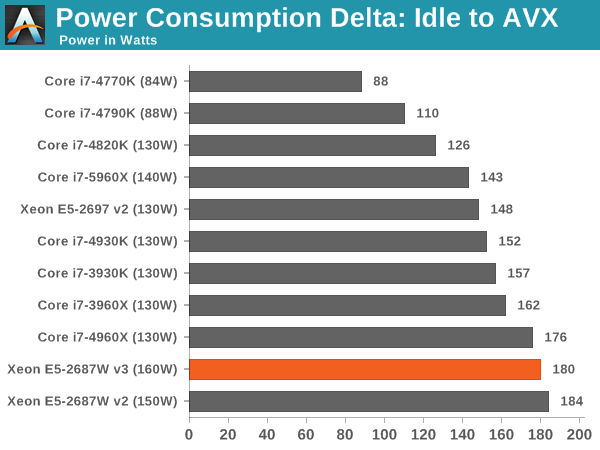
The E5-2687W v3 is listed at 160W, which aside from a pair of AMD CPUs is the highest TDP for a CPU we have seen. Nevertheless, there are certain efficiencies exploited in the new platform and the v3 version of this CPU has a lower power delta than the v2 does, even with the higher TDP. Unfortunately due to limitations we were unable to measure power consumption while we had the E5-2650 v3 in for testing.
Overclocking...?
As per Intel's Xeon policy, the E5-26xx v3 processors are multiplier locked. For competitive overclockers, this is rather frustrating given that the Xeon processor line are often the better selected dies that also can pack a punch. So while multiplier overclocking is not possible, for motherboards with overclocking oriented BIOS options we can adjust the BCLK. While we never published the data at the time, the Ivy Bridge-EP processors we had in to test were good for 113 MHz (+13%), although 110 MHz had a good balance of overclock and stability.
For this review, I put the E5-2687W v3 through its paces:

Moving up to 104 MHz is not a lot. It does afford some DRAM movement as well, but our system refused to POST at 105 MHz. This might purely be a result of the processor, so in our future Xeon reviews we will see if more movement is possible with other SKUs.
Originally published at https://www.anandtech.com/show/8584/intel-xeon-e5-2687w-v3-and-e5-2650-v3-review-haswell-ep-with-10-cores (Wayback Machine).