
Hardware Behind the Consoles - Part II: Nintendo's GameCube
- Posted in
- Systems
Flipper makes noises
Flipper is also home to a custom Macronix DSP that essentially does the job of NVIDIA's APU in the Xbox. The only difference is that the Macronix DSP is not powerful enough to perform real-time Dolby Digital Encoding without significant latency penalties. The latency induced by the encoding on the Xbox is minimal at worst and we have confirmed this through our extensive testing of the nForce APU; we could not determine any induced delays in our tests.
Nintendo doesn't provide a digital output on the console itself so there's no way for a developer to perform the real-time encoding if they felt they had the extra power left over to do so, which is exactly what EA did with DTS encoding on the Playstation 2. We have seen one developer implement something beyond the regular Stereo or Pro Logic audio output with Dolby Pro Logic II in Star Wars Rogue Squadron II.
Dolby's Pro Logic II is an algorithm that extracts 5.1 audio out of a stereo signal by comparing the differences and similarities between the two signals. This is known as matrix surround decoder since it produces more channels than are in the original signal. Although it's not nearly as good as the 5.1 discrete audio signals found with Dolby Digital or DTS, it's far better than the original Pro Logic, which has its roots in the 1970's. It's also backwards and forwards compatible with the original Pro Logic, meaning that a Pro Logic II encoded signal can be played back on a Pro Logic receiver and vice versa.
In the case of the Game Cube, the Pro Logic II encoded signal can be played back on a stereo or Pro Logic device as well for compatibility, although the Pro Logic decoded version will only have a mono surround and a bandwidth limited center and surround channels (a low pass filter at 7kHz is applied in the Pro Logic decoder to these channels). Further, channel separation is not nearly as good with a standard Pro Logic decoder.
A discrete 5.1 signal, on the other hand, is full bandwidth for the 5 main channels and by its very nature supports complete channel separation with targeting of a specific sound to a specific channel.
Pro Logic II is only available on some of the very latest surround sound receivers, while Dolby Digital has been available on most receivers for the past few years. Pro Logic II will eventually be a standard on all receivers, but probably not for another year or two. Any receiver with Pro Logic II will also have Dolby Digital and DTS support. The original Pro Logic has been included on just about every surround sound receiver over the past 15 years.
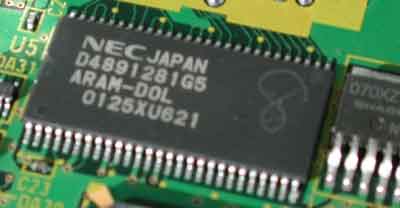
An interesting thing about the audio processor is that it is connected to 16MB of DRAM via an 8-bit memory bus running at 81MHz (1/2 of Flipper's operating frequency). Obviously, 16MB of memory is a lot of memory for audio processing so developers are able to use any part of that memory as regular storage of data that doesn't need that much memory bandwidth since there is only 81MB/s of bandwidth to this audio DRAM.
Originally published at https://www.anandtech.com/show/858 (Wayback Machine).