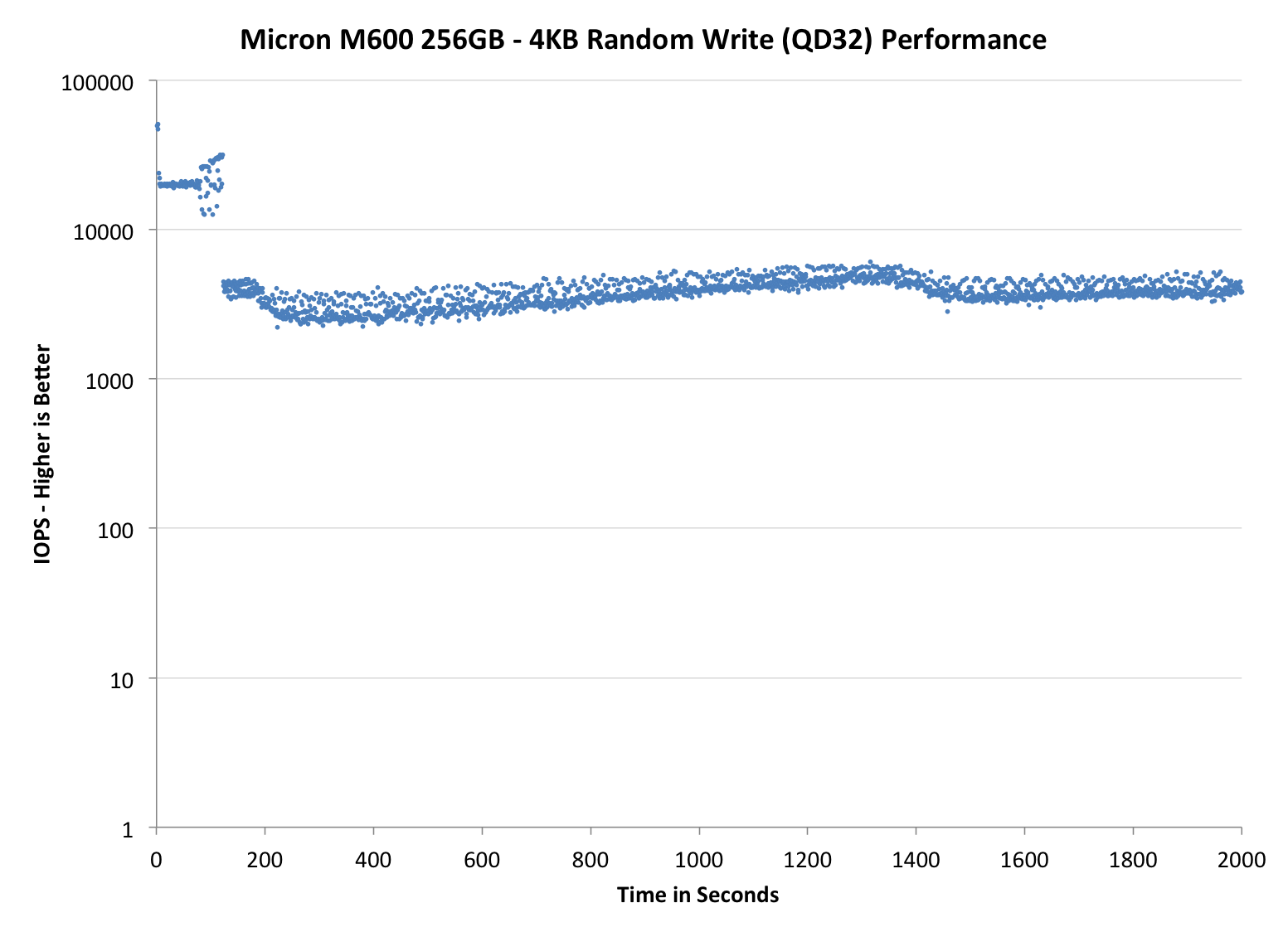
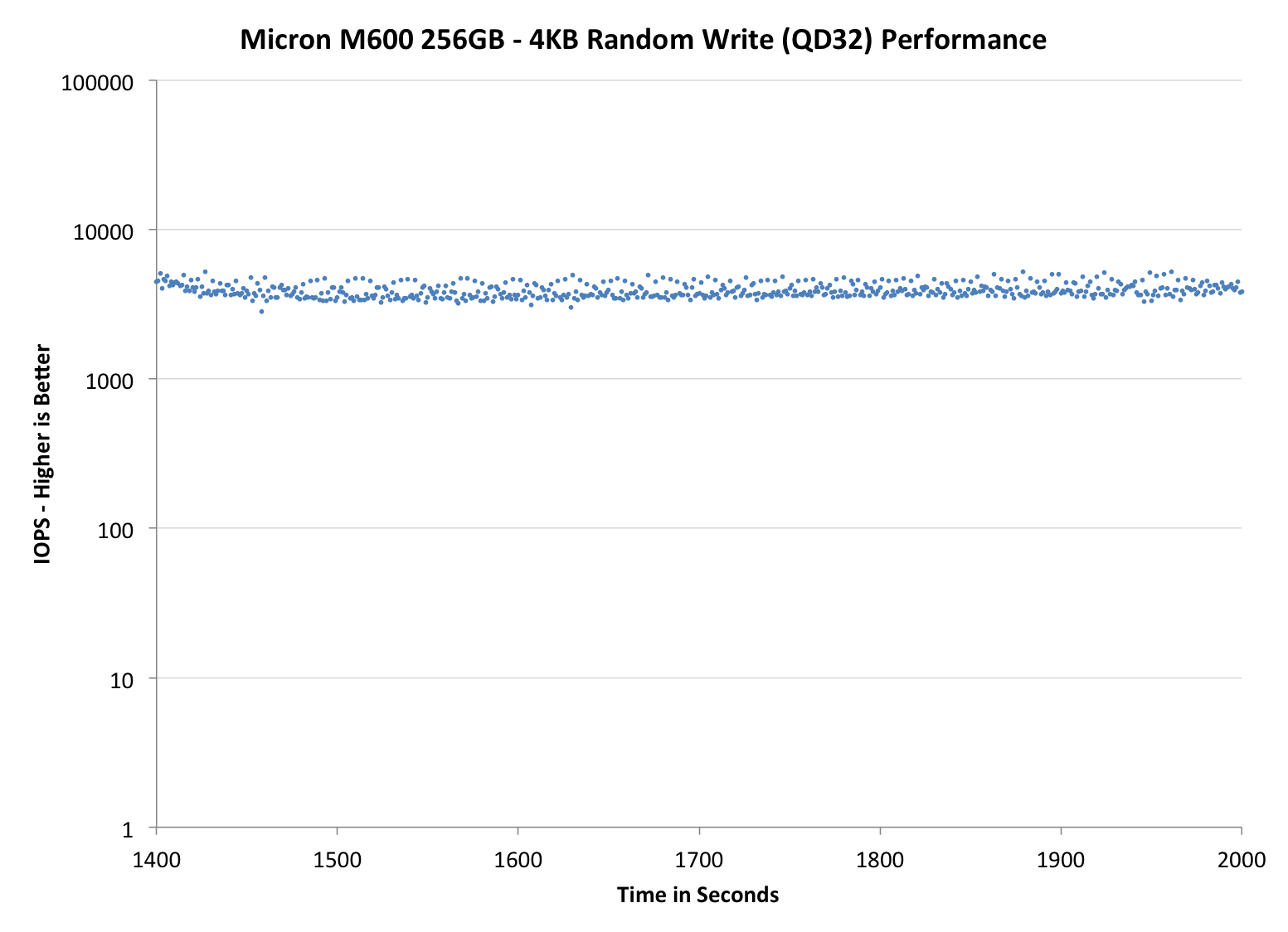
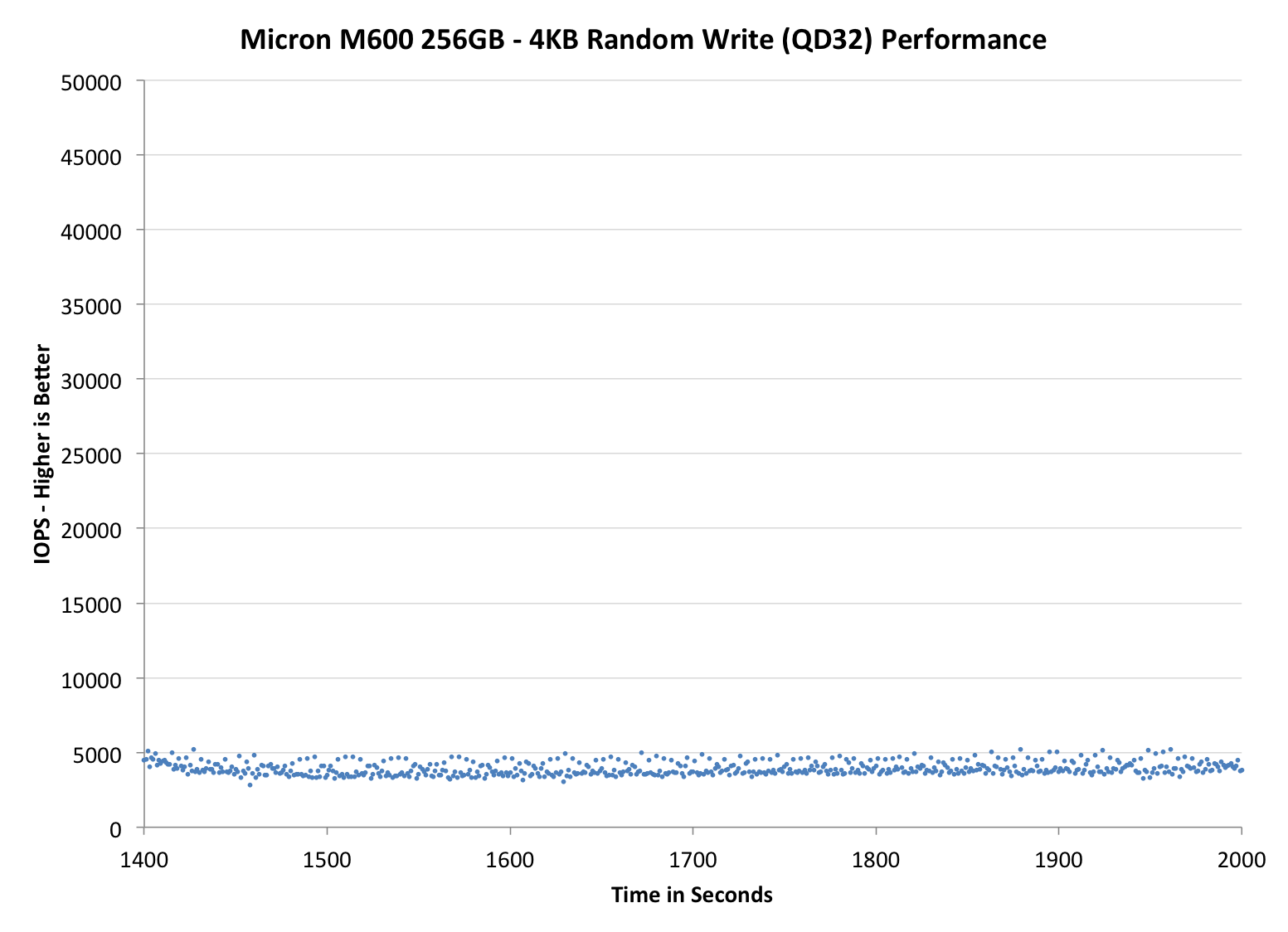
Performance consistency tells us a lot about the architecture of these SSDs and how they handle internal defragmentation. The reason we do not have consistent IO latency with SSDs is because inevitably all controllers have to do some amount of defragmentation or garbage collection in order to continue operating at high speeds. When and how an SSD decides to run its defrag or cleanup routines directly impacts the user experience as inconsistent performance results in application slowdowns.
To test IO consistency, we fill a secure erased SSD with sequential data to ensure that all user accessible LBAs have data associated with them. Next we kick off a 4KB random write workload across all LBAs at a queue depth of 32 using incompressible data. The test is run for just over half an hour and we record instantaneous IOPS every second.
We are also testing drives with added over-provisioning by limiting the LBA range. This gives us a look into the drive’s behavior with varying levels of empty space, which is frankly a more realistic approach for client workloads.
Each of the three graphs has its own purpose. The first one is of the whole duration of the test in log scale. The second and third one zoom into the beginning of steady-state operation (t=1400s) but on different scales: the second one uses log scale for easy comparison whereas the third one uses linear scale for better visualization of differences between drives. Click the dropdown selections below each graph to switch the source data.
For more detailed description of the test and why performance consistency matters, read our original Intel SSD DC S3700 article.
Default
25% Over-Provisioning
The 1TB M600 actually performs quite significantly worse than the 256GB model, which is most likely due to the tracking overhead that the increased capacity causes (more pages to track). Overall IO consistency has not really changed from the MX100 as Dynamic Write Acceleration only affects burst performance. I suspect the firmware architectures for sustained performance are similar between the MX100 and M600, although with added over-provisioning the M600 is a bit more consistent.
Default
25% Over-Provisioning
Default
25% Over-Provisioning
TRIM Validation
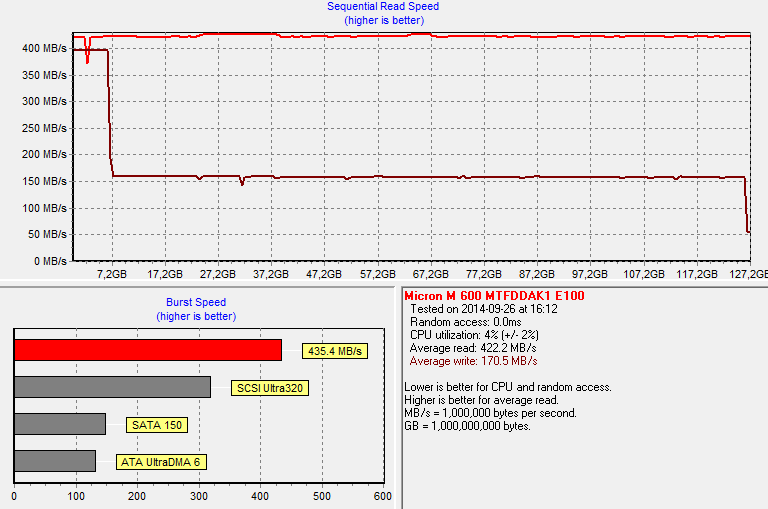
To test TRIM, I filled the 128GB M600 with sequential 128KB data and proceeded with a 30-minute random 4KB write (QD32) workload to put the drive into steady-state. After that I TRIM'ed the drive by issuing a quick format in Windows and ran HD Tach to produce the graph below.
It appears that TRIM does not fully recover the SLC cache as the acceleration capacity seems to be only ~7GB. I suspect that giving the drive some idle time would do the trick because it might take a couple of minutes (or more) for the internal garbage collection to finish after issuing a TRIM command.