
Huawei Honor 6 Review
WiFi Performance
Out of all the benchmarks that we’ve ran on the Honor 6, there is one that really stands out more than anything else. The phone has one of the worst performing WiFI systems that we’ve ever tested. Coming at a top speed of 52mbps on our test bench, the device lags far behind not only other flagships, but other smartphones period.
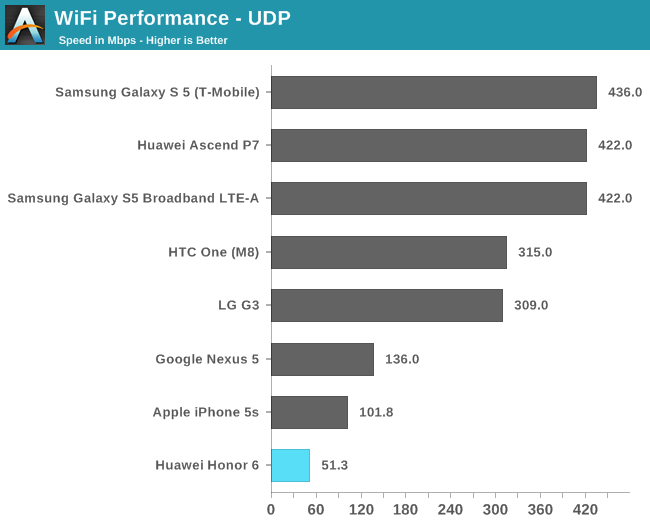
What really is happening here is a mystery to both me and Josh. We find a BCM4334 chipset in charge of the connectivity and it is, similarly to Samsung’s Exynos series interfaced via an SDIO bus. My first suspicion was that maybe the bus bandwidth to the DWMMC controller was misconfigured, but I have no evidence of this without the kernel sources being available. This leaves the possibility that the antenna is just badly designed and has unfavorable RF characteristics such as significant impedance mismatch/high SWR. In fact this can be more or less observed as the phone has a bit of a death-grip issue regarding WiFi strength when you cover up the top part of the device. Reception is so bad that I’ve found myself losing connectivity to my router when walking around the house. Whatever the cause may be, this is easily such a negative aspect of the device that it may very well be the deciding factor for many buyers.
NAND Performance
The internal eMMC NAND storage of a phone can be a crucial factor in a device's performance. Inside the Huawei we find a Toshiba 16GB NAND chip with the system and data partitions running on an ext4 filesystem.
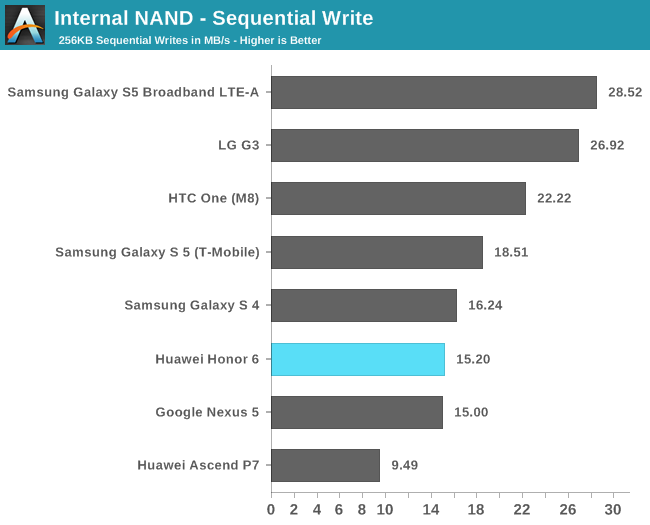
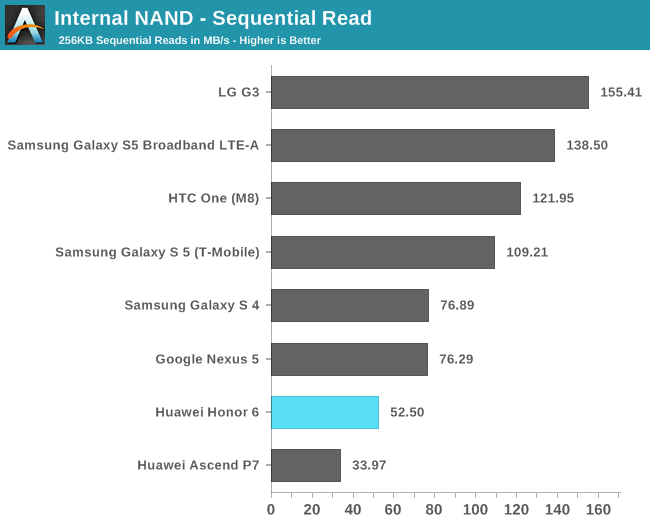
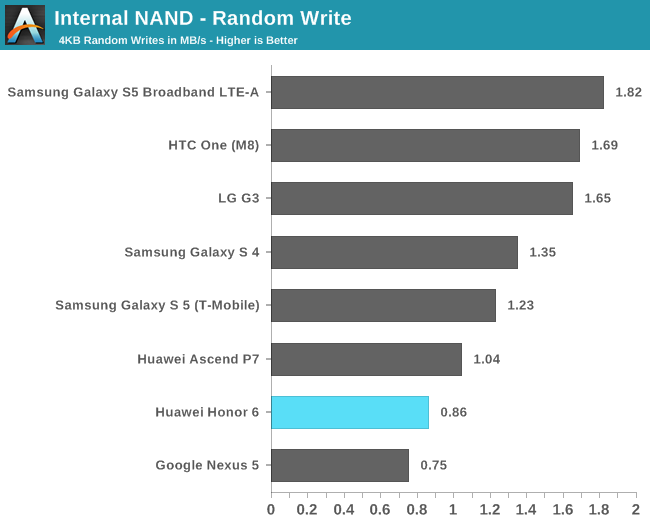
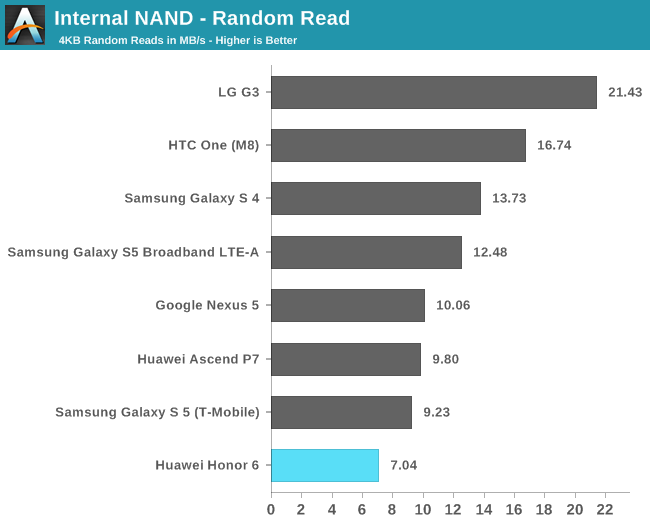
The performance is one of the lowest ones we find in the current-generation phones as Huawei skimped on the eMMC chip as it is outperformed by a factor of two or three by other smartphones. This is the same class model that you could find in some Galaxy S3 variants and other phones over 2.5 years ago. Only Huawei's own Ascend P7 performs worse.
The Honor 6 offers also a microSD card slot in case you want to expand your storage. The OS offers full exFat compatibility and I had no issues with my Samsung Pro 64GB card. I was however disappointed to see that the HiSilicon chip suffers from the same limitation that plagues other SoCs for no good reason: the DWMMC controller in charge of the SD-card is limited to SDR50 speeds, meaning that you won't be able to exceed ~35mB/s transfer speeds on your microSD, no matter how fast it actually is. It still baffles me that OEMs refuse to address this even almost 2 years after the first UHS-1 cards have been made widely available.
Next, let's look at the camera system of the Honor 6.
Originally published at https://www.anandtech.com/show/8425/huawei-honor-6-review (Wayback Machine).